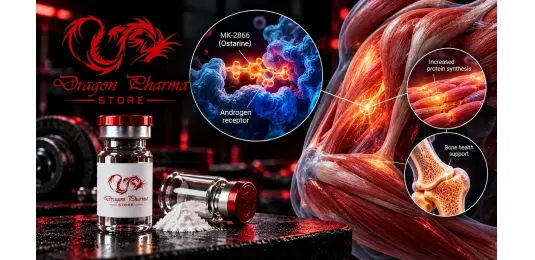
MK 2866 (Ostarine) - Dragon Pharma Research Guide
MK 2866, better known as ostarine and later named enobosarm, is a selective androgen receptor modulator (SARM) that has been studied for muscle wasting, body composition and bone. It is often described online as a steroid alternative or as a research chemical, but it is not approved as a medicine in any country and it cannot be legally sold as a dietary supplement in the United States. This reference guide summarises what published research shows about the mechanism, the dosages used in trials, the results reported, the effect on the hormonal axis, and why recovery after a cycle - the question behind the search term ostarine PCT - has no approved protocol.
Related searches: mk 2866, ostarine, mk-2866 dosage, ostarine results, ostarine pct, is ostarine a steroid, mk 2866 vs ostarine.
What MK 2866 Is and How Ostarine Works
Ostarine is a nonsteroidal small molecule that binds to the androgen receptor (AR), the same receptor that testosterone and anabolic steroids activate. It is classed as a selective androgen receptor modulator because it behaves as an agonist in some tissues and as a partial agonist or an antagonist in others. In preclinical models the pattern is anabolic activity in skeletal muscle and bone, agonist activity in AR-positive breast cancer cell lines, and partial agonist or antagonist activity in the prostate gland and seminal vesicles.
The binding affinity is high. One published measurement put the affinity constant (Ki) of enobosarm for the androgen receptor at 3.8 nM, which is roughly 17% of the affinity of dihydrotestosterone (DHT), the most potent natural androgen. Because the molecule is nonsteroidal, its chemical structure is unrelated to the steroid backbone of testosterone, nandrolone or oxandrolone. That structural difference is the reason SARMs are not steroids, even though both groups ultimately act through the same receptor.
Ostarine is active by mouth and is absorbed quickly, with peak blood concentrations reported at about 1 to 2 hours after a dose. The elimination half-life is approximately 14 to 24 hours, which is why once-daily dosing is used in trials. It does not bind to sex hormone binding globulin, and it is metabolised mainly by the CYP3A4 and UGT enzyme families, with enobosarm glucuronide as the main circulating metabolite. The full explanation for the tissue selectivity of this SARM class compared with testosterone is still unknown; published reviews list differing coregulator recruitment, tissue-specific signalling and local ligand metabolism as the possible reasons. Products of this class are grouped together in the SARMs category of the catalogue.
Ostarine vs Steroids and Testosterone
Ostarine is routinely marketed as a way to obtain anabolic effects without the profile of an anabolic androgenic steroid. Chemically and legally the two categories are clearly different, and the differences matter more than the marketing does.
- Chemical class - ostarine is a nonsteroidal SARM built as a lab-made small molecule, while testosterone and anabolic steroids share the steroid ring backbone
- Approval status - ostarine has no approved medical use anywhere, while testosterone and several anabolic steroids are approved medicines for defined indications such as hypogonadism
- Legal status in the US - SARMs are unapproved drugs and cannot lawfully be sold as dietary supplements, while testosterone is a controlled substance dispensed by prescription
- Tissue profile - ostarine shows anabolic effects in muscle and bone with partial agonist or antagonist activity in the prostate, whereas testosterone and anabolic steroids act broadly across androgen-sensitive tissues
- Binding and metabolism - ostarine does not bind SHBG and peaks within about 1 to 2 hours, while endogenous testosterone circulates largely bound to SHBG and is converted to DHT and estradiol by 5-alpha reductase and aromatase
- Sport - SARMs including ostarine are prohibited at all times as anabolic agents under class S1.2 of the WADA Prohibited List, the same class that covers other anabolic agents
None of those distinctions makes ostarine risk-free. The clinical trial record shows dose-related changes in cholesterol, sex hormones and liver enzymes, and the FDA has warned about serious adverse events including liver injury, cardiac events and infertility.
MK-2866 Dosage in Clinical Research
Doses discussed in forums have no relation to the doses used in clinical research, and this is the most important distinction when reading about any mk-2866 dosage. GTx, the company that developed the compound, reported 25 clinical studies in more than 1,700 people using single doses from 1 mg to 100 mg. The table below summarises the main study designs and findings documented in the peer-reviewed literature.
| Study setting | Dose studied | Duration | Documented finding |
|---|---|---|---|
| Healthy men, single-dose pharmacokinetic studies | 1 mg to 100 mg | Single dose | Linear and proportional pharmacokinetics; elimination half-life about 14 to 24 hours |
| Healthy elderly men and postmenopausal women, phase 2 (n = 120) | Up to 3 mg/day, with 3 mg/day compared against placebo | 12 weeks | Dose-dependent rise in total lean body mass that was statistically significant at 3 mg/day, plus improvements in physical function and insulin resistance |
| Cancer patients with weight loss, phase 2 (n = 159) | 1 mg/day or 3 mg/day versus placebo | Up to 113 days | Total lean body mass rose by a median 1.5 kg at 1 mg and 1.0 kg at 3 mg, while the placebo group was essentially unchanged at a median 0.02 kg |
| Cancer cachexia, phase 3 programme | 3 mg/day | Late-stage trials | Lean body mass improved but muscle strength did not, and the compound was not approved for this use |
| Healthy elderly men, hormonal safety analysis | 1 mg/day and 3 mg/day | Short term | Total testosterone fell by about 31% at 1 mg/day and about 57% at 3 mg/day; HDL cholesterol fell by 17% and 27% respectively |
Read the pattern rather than the individual rows. The doses that produced measurable muscle effects in controlled settings were 1 to 3 mg per day in older or clinically unwell people, and the very same doses already moved cholesterol and testosterone. Higher doses are not better documented; they appear in early pharmacokinetic work and in the supplement market, where content and purity are not controlled by any regulator.
Ostarine Results - Muscle, Bone and the Limits of the Data
The ostarine results reported in trials are consistent in direction and narrow in scope. Across the phase 2 studies the compound increased total lean body mass measured by dual-energy X-ray absorptiometry, and in the elderly cohort it also improved physical function. In the cancer cachexia study patients gained lean mass, yet the late-stage programme did not show a muscle strength benefit, and the drug was never approved for any indication.
Two points limit how far those results can be generalised. First, participants were mostly older adults or people with illness-related weight loss, not healthy young trainees, so the numbers cannot simply be transferred to recreational use. Second, lean body mass on a scan is a surrogate measure; it is not the same thing as muscle strength, performance or the cosmetic change that people actually expect. Bone is a genuine area of interest, because animal work describes osteo-anabolic activity for this class, but long-term human bone outcomes with ostarine are not established.
The safety picture sits next to the efficacy data. The FDA has warned that SARMs are associated with serious or life-threatening problems, including increased risk of heart attack or stroke, psychosis and hallucinations, sleep disturbance, sexual dysfunction, liver injury and acute liver failure, infertility, miscarriage and testicular shrinkage. Research compounds such as IGF-1 LR3 act on different pathways and are not a substitute for SARM data, and no compound in this space comes with a long-term human safety record.
Ostarine PCT - Suppression and Recovery After a Cycle
SARMs were designed to be tissue-selective, not hormone-neutral. Ostarine still engages the androgen receptor in the pituitary, and the clinical data show the consequences. In healthy elderly men, total testosterone dropped by roughly 31% at 1 mg/day and 57% at 3 mg/day. In postmenopausal women, luteinising hormone and follicle-stimulating hormone fell by about 17% and 30% at 3 mg/day. SHBG was reported to fall by about 61% in men and 80% in women at the 3 mg/day dose. Those figures come from carefully monitored short-term studies at low doses, not from the higher exposures common outside clinical settings.
Because endogenous testosterone production can be suppressed, people who stop a cycle may experience the symptoms of low testosterone before the axis recovers. That is the reason the term ostarine PCT exists. Post cycle therapy in the non-medical community usually means a SERM taken with the intention of raising LH and restarting testicular testosterone production, and the store keeps such items in the post cycle therapy section.
Two caveats matter here. No clinical trial has evaluated a PCT protocol specifically after ostarine, so no evidence-based regimen, dose or duration exists for that use, and no product is approved to reverse SARM-induced suppression. Blood work, medical supervision and time are the only tools with documented value; everything else is experimentation. Nothing in this section is medical advice, and self-administered hormonal recovery after research chemicals carries real risk.
Side Effects, Safety and Legal Status of MK 2866
The most frequent general adverse effects reported in enobosarm trials were headache, fatigue, anaemia, nausea, diarrhoea and back pain. The dose-related laboratory changes are more relevant for anyone reading the studies carefully.
- Cholesterol - HDL cholesterol fell by about 17% at 1 mg/day and 27% at 3 mg/day, with lower total cholesterol and triglycerides and unchanged LDL
- Hormones - lower total testosterone in men and lower LH and FSH in women at the 3 mg/day dose, plus large falls in SHBG
- Liver - elevated liver enzymes and liver toxicity are documented, and a review of suspected cases published since 2020 identified 20 reports of adverse events, most of them drug-induced liver injury, with jaundice and cholestatic or hepatocellular patterns among the main symptoms described
- Blood and metabolism - small increases in haemoglobin and haematocrit, and small decreases in fasting glucose, insulin levels and insulin resistance at 3 mg/day
- Unknowns - the effects of high doses, the long-term effects, and the masculinising potential in women are all described in the literature as uncharacterised
On legality, the FDA states plainly that SARMs are not approved and cannot lawfully be marketed in the United States as a dietary supplement or as a drug. Labels such as "for research use only" do not change that status, and independent testing has repeatedly found that products sold as SARMs may contain a different compound, a different dose, or no active substance at all. Ostarine is prohibited in sport at all times as anabolic agent S1.2 on the WADA Prohibited List. The traceable product in this category is the MK 2866 (ostarine) enobosarm item in the SARMs range.