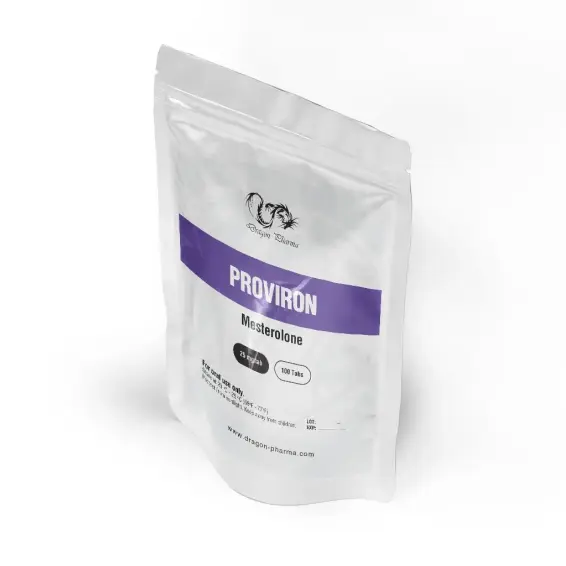
Proviron (Mesterolone) 25mg — DHT Oral Androgen by Dragon Pharma
Proviron (Mesterolone) is Dragon Pharma's formulation of the oral DHT-derived androgen at 25mg per tablet — one of the oldest AAS still in clinical use, developed by Schering (Germany) in the 1930s and prescribed pharmaceutically in Europe for male hypogonadism and fertility support to this day. Proviron occupies a unique pharmacological niche: it is the only commonly used oral AAS without 17-alpha-alkylation, meaning it carries no hepatotoxicity concern; it binds SHBG with very high affinity, significantly increasing free testosterone and free fractions of other co-administered AAS; and its androgenic activity adds libido, hardness and mood support on cycle without meaningful HPG axis suppression.
Also searched as: Proviron 25mg, Mesterolone, Proviron antiestrogen, Mesterolone tabs, Dragon Pharma Proviron.
Why Proviron Has No Hepatotoxicity — The C1-Methylation Difference
This is consistently misunderstood or omitted, and it is Proviron's most important pharmacological distinction from virtually every other oral AAS:
- Most oral AAS are 17-alpha-alkylated (17-AA) — a methyl or ethyl group at the C17 position that prevents hepatic first-pass degradation, allowing oral bioavailability. The 17-AA modification is the direct cause of oral AAS hepatotoxicity: the liver is exposed to the full first-pass dose of a compound engineered to resist its degradation
- Mesterolone is not 17-alpha-alkylated. It carries a methyl group at the C1 position instead — this modification provides some resistance to hepatic degradation through a different mechanism that does not produce the concentrated hepatocyte stress of 17-AA modification
- The practical consequence: Mesterolone does not elevate liver enzymes (ALT/AST) at clinical or performance doses. Extended daily use at 25-75mg produces no meaningful hepatotoxicity — a unique property among oral androgens
- This makes Proviron suitable for extended use throughout a full AAS cycle without the 4-6 week maximum cycle length restriction that applies to 17-AA orals like Dianabol, Winstrol, Anadrol and Superdrol
The SHBG Mechanism — Freeing Bound Testosterone
Proviron's most practically important mechanism for AAS users — and the one most poorly explained in competitor content:
- Sex Hormone Binding Globulin (SHBG) is a carrier protein in blood that binds testosterone (and other sex hormones) with high affinity. Only free (unbound) testosterone and the fraction loosely bound to albumin are biologically active — SHBG-bound testosterone cannot interact with androgen receptors
- Typically, approximately 97-99% of circulating testosterone is bound to SHBG (~44%) or albumin (~54%), with only 1-3% as free testosterone. AAS supraphysiological testosterone increases total testosterone dramatically, but SHBG also increases in response to high estrogen levels — potentially blunting the increase in free testosterone fraction
- Mesterolone binds SHBG with very high affinity — higher than testosterone itself. By occupying SHBG binding sites, Mesterolone displaces testosterone and other AAS from SHBG, shifting the testosterone from bound (inactive) to free (active) form
- The practical result: adding Proviron to a testosterone cycle can meaningfully increase free testosterone percentage, enhancing the effective anabolic signal from the same total testosterone dose without increasing the actual testosterone dose
- The same SHBG displacement applies to other co-administered AAS — nandrolone, boldenone, and other SHBG-binding compounds in the stack also benefit from increased free fractions when Proviron occupies SHBG sites
Proviron as an "Antiestrogen" — The Correct Mechanism
Proviron is categorised alongside AIs and SERMs in the antiestrogen section — but its anti-estrogenic effect works through a completely different mechanism:
- Mesterolone is not an aromatase inhibitor — it does not significantly block the conversion of testosterone to estradiol. Estrogen production continues normally during Proviron use
- Mesterolone does not block estrogen receptors — it is not a SERM
- Proviron's "anti-estrogenic" effect comes from two indirect mechanisms: first, by increasing free testosterone fraction (via SHBG binding), it increases the androgenic:estrogenic ratio — the same total estrogen has less relative influence when free androgens are significantly elevated; second, its DHT-derived structure has very low affinity for aromatase and does not contribute estrogen to the system
- Additionally, DHT-derived compounds have some local peripheral antiestrogenic activity — DHT competes with estradiol at tissue-level receptor sites in some tissues
- For actual estrogen control, AIs (Arimidex, Aromasin) are necessary — Proviron alone is not adequate for managing aromatisation-driven estrogen side effects at high testosterone doses
HPG Axis Effects — Why Proviron Doesn't Suppress Like Other Androgens
This is one of Proviron's most counterintuitive properties:
- All AAS suppress the HPG axis through androgen receptor-mediated negative feedback — activating hypothalamic and pituitary ARs signals the axis to reduce GnRH, LH and FSH production. Proviron activates ARs but its suppression of the HPG axis is disproportionately mild compared to other androgens at equivalent doses
- The proposed explanation: Mesterolone is very rapidly metabolised in most tissues, including possibly hypothalamic tissue, limiting sustained receptor activation. It produces androgenic effects peripherally (where its metabolites retain activity) while having less impact on the central HPG axis signalling
- In clinical use, Proviron has been prescribed to improve spermatogenesis in hypogonadal men — a use case that would be impossible if it significantly suppressed FSH (which drives spermatogenesis via Sertoli cells). This clinical history confirms its relatively mild HPG suppression at clinical doses
- Note: "less suppressive" does not mean "non-suppressive" — Proviron still contributes to HPG axis suppression, particularly at higher doses and when combined with other suppressive AAS
Effects and Benefits
- SHBG displacement — high-affinity SHBG binding increases free testosterone and other AAS fractions without changing total testosterone dose
- Libido and sexual function support — androgenic effect on libido well established; historically prescribed specifically for this indication
- Muscle hardness and density — androgenic effect produces drier, harder appearance without water retention (no aromatisation, no estrogen)
- No hepatotoxicity — non-17-AA oral; safe for extended cycle use
- Mild HPG axis suppression — less suppressive than comparable androgens; historically used for fertility support
- Mood and well-being support — androgenic effect during cycle supports motivation and training drive
Dosage and Administration
| Protocol | Daily Dose | Frequency | Duration |
|---|---|---|---|
| On-cycle androgenic support | 25–50 mg/day | Once or twice daily (12h half-life) | Full cycle length — no hepatotoxicity limit |
| SHBG reduction / free T maximisation | 50–75 mg/day | Twice daily | Full cycle |
| Libido / well-being | 25 mg/day | Once daily | As needed |
At 25mg per tablet and 100 tabs per pack, a full 12-week cycle at 50mg/day requires 84 tablets — well within one pack. The ~12-hour half-life supports twice-daily dosing for stable blood levels; once-daily dosing at 25-50mg is also commonly used. No cycle length restriction applies due to absence of hepatotoxicity.
Side Effects
- Androgenic side effects — acne, potential hair acceleration in genetically predisposed; androgenic ratio is high as a DHT derivative
- No estrogenic side effects — does not aromatise; no water retention from Proviron itself
- No hepatotoxicity — no liver enzyme elevation at clinical or performance doses
- Libido — typically increased rather than decreased; an intended effect at typical doses
- HPG suppression — mild; does not independently require PCT but contributes to cycle suppression
Cycle Context
- Enantat 250 — Proviron classically added to any testosterone cycle for SHBG reduction and androgenic quality enhancement
- Arimidex or Aromasin — Proviron complements but does not replace AI for actual estrogen management on aromatising cycles
- Primobolan 100 — both are DHT-derived compounds that produce hard, dry, quality muscle without estrogenic burden; a classic non-aromatising lean cycle combination
- Masteron 100 — both are DHT derivatives; Masteron injectable + Proviron oral provides dual-route DHT androgenic coverage with complementary hardening effects
"Proviron is the only commonly used oral AAS without 17-alpha-alkylation — its C1-methylation produces zero hepatotoxicity, allowing full-cycle oral androgen use. Its primary value lies not in its direct anabolic effect but in displacing testosterone from SHBG, increasing the free fraction of every AAS in the stack."
Storage and Handling
Store Proviron at room temperature, away from direct sunlight and moisture. Keep in original packaging until use.