Sermorelin vs Ipamorelin: GHRH and Ghrelin Pathways Compared
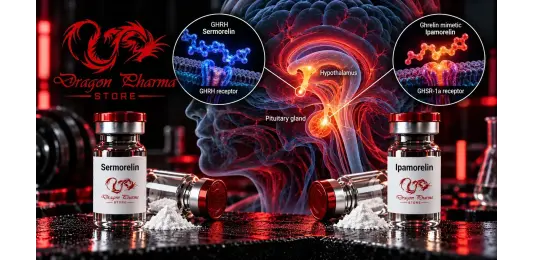
Sermorelin vs ipamorelin is one of the most common comparisons in growth hormone research, and the two compounds are often treated as interchangeable. They are not. Sermorelin is a GHRH analogue that acts on the pituitary GHRH receptor, while ipamorelin is a selective ghrelin receptor (GHSR-1a) agonist. That single difference explains almost everything else: why one clears in minutes and the other in hours, why one adds a second signal to the pituitary while the other amplifies the natural GH pulse, and why the human data sets behind them are not the same size. This guide compares both compounds by mechanism, half-life, studied dosage, effects on appetite and cortisol, and the safety signals published in human trials.
Related searches: sermorelin vs ipamorelin, sermorelin dosage, ipamorelin dosage, ipamorelin vs cjc-1295, growth hormone secretagogue, sermorelin vs ipamorelin which is better.
Two Classes of Growth Hormone Secretagogue - GHRH Analogue vs Ghrelin Mimetic
Both compounds belong to the broad family of growth hormone secretagogues, but they sit in different branches of it. Sermorelin is the synthetic 29-amino-acid N-terminal fragment of human GHRH, also written as GRF 1-29 or GHRH(1-29). It is the shortest fragment of the native hormone that still carries full biological activity, and the drug review literature describes it as an analogue of human growth hormone-releasing hormone that specifically stimulates GH secretion from the anterior pituitary after intravenous or subcutaneous administration. At the receptor level, sermorelin activates the pituitary GHRH receptor, which signals through cAMP and mitogen-activated protein kinase pathways and increases both GH synthesis and pulsatile GH release, with IGF-1 rising secondarily as a downstream effect.
Sermorelin acetate was formerly an FDA-approved product marketed as Geref, used in the diagnostic evaluation of pituitary GH secretory capacity and in the treatment of children with idiopathic growth hormone deficiency. The brand is no longer marketed, so a research-grade sermorelin (GHRH) vial is not a licensed medicine and belongs to the laboratory category.
Ipamorelin works from a different direction. It is a synthetic pentapeptide with the sequence Aib-His-D-2-Nal-D-Phe-Lys-NH2, developed by trimming the central dipeptide of an earlier growth hormone-releasing peptide (GHRP-1). Instead of mimicking GHRH, it mimics ghrelin and binds the growth hormone secretagogue receptor type 1a (GHSR-1a) on the pituitary and hypothalamus. An ipamorelin peptide therefore amplifies the GH pulse through the same receptor that ghrelin itself uses, and GHSR-1a signalling is also linked to appetite regulation and gastrointestinal motility. In the original characterisation study, ipamorelin released GH from rat pituitary cells with potency and efficacy close to GHRP-6 (EC50 1.3 nmol/L versus 2.2 nmol/L, and an Emax of 85 percent versus 100 percent), and GHRH-antagonist experiments confirmed that it signals through the GHRP-like receptor rather than the GHRH receptor.
Half-Life and Pharmacokinetics - Minutes vs Hours
The pharmacokinetic gap between these peptides is the widest single difference between them. Sermorelin is extremely short-acting. A widely cited review table of secretagogue characteristics lists sermorelin with a subcutaneous half-life of around 10 to 20 minutes. That short life is a direct consequence of the native GHRH structure: the peptide is broken down quickly by plasma proteases, which is why almost every clinical protocol uses daily or twice-daily injections rather than weekly dosing.
Ipamorelin behaves very differently. In a phase I dose-escalation trial in healthy male volunteers, five infusion rates between 4.21 and 140.45 nmol/kg were given over 15 minutes and the pharmacokinetics were dose-proportional, with a terminal half-life of 2 hours, a clearance of 0.078 L/h/kg and a volume of distribution at steady state of 0.22 L/kg. GH concentrations rose to a single peak at about 0.67 hours, roughly 40 minutes, then declined exponentially to negligible levels at every dose tested. A review table of secretagogue characteristics lists ipamorelin at 1.5 to 2.5 hours, consistent with that trial.
| Property | Sermorelin | Ipamorelin |
|---|---|---|
| Compound class | GHRH analogue, GHRH(1-29) | Synthetic pentapeptide GHRP |
| Target receptor | Pituitary GHRH receptor | Ghrelin receptor GHSR-1a |
| Signature of action | Adds a GHRH signal to the pituitary | Amplifies the natural GH pulse like ghrelin |
| Half-life | Roughly 10 to 20 minutes subcutaneously in review data | About 2 hours terminal; 1.5 to 2.5 hours in review tables |
| Time to GH peak | Acute GH release within about 10 minutes of a nightly dose | About 0.67 hours (roughly 40 minutes) after infusion |
| Effect on cortisol and ACTH | No marked stimulation; acts on the GHRH axis | No significant ACTH or cortisol release even above 200-fold the GH ED50 |
| Appetite | Not a ghrelin mimetic; no strong hunger signal documented | Ghrelin receptor agonist, linked to appetite regulation and gut motility |
| Regulatory history | Formerly FDA-approved as Geref; approvals withdrawn in 2009 | Never approved; phase I and one phase 2 surgical trial |
Appetite, Cortisol and Prolactin - The Selectivity Argument
Ipamorelin is frequently described as the cleanest of the GHRP class, and that reputation comes from a specific set of laboratory findings. In the 1998 characterisation study, GHRP-6 and GHRP-2 both raised plasma ACTH and cortisol in swine, while ipamorelin did not release ACTH or cortisol at levels significantly different from those seen after GHRH stimulation. That separation held even at doses more than 200-fold higher than the ED50 for GH release. None of the secretagogues tested changed FSH, LH, prolactin or TSH in that model, and the authors concluded that ipamorelin was the first GHRP-receptor agonist with a GH selectivity profile comparable to GHRH.
Appetite is where the ghrelin mechanism matters most, and the evidence has to be separated by compound. GHSR-1a is the receptor ghrelin uses to drive both GH release and hunger, and reviews note that activating it can influence appetite regulation, fat processing and energy use alongside GH secretion. Within the GHRP family, GHRP-6 is described in the same review as a potent appetite stimulator in its own right, whereas ipamorelin is not classified that way. Ipamorelin's ghrelin-like activity has instead been followed into gastrointestinal research: it was studied as a prokinetic agent for postoperative ileus, and the phase 2 trial in bowel resection patients found no statistically significant improvement in recovery endpoints. The practical takeaway is that the hunger signal belongs to the ghrelin receptor class rather than to sermorelin, and the human ipamorelin data on appetite remains thin.
Studied Dosages - Sermorelin Dosage and Ipamorelin Dosage in Human Research
Sermorelin has the longer and more varied human dose history, largely because it was a regulated product. In diagnostic testing, an intravenous dose of 1 microgram per kilogram of body weight was described as a rapid and relatively specific test of GH deficiency, with fewer false positive GH responses than other provocative tests. In paediatric treatment, once-daily subcutaneous sermorelin at 30 micrograms per kilogram given at bedtime was reported to increase height velocity in some prepubertal children with idiopathic GH deficiency, with gains sustained over 12 months of treatment. Those figures describe prescription use of a product that is no longer marketed, not a protocol for research material.
Adult research used larger absolute amounts. In one study of men aged 60 to 78, twice-daily subcutaneous sermorelin at either 0.5 mg (low) or 1 mg (high) was given for 14 days, paused for 14 days and then repeated; the high dose raised mean 24-hour GH, peak GH amplitude and GH area under the peaks, and IGF-1 rose in a dose-dependent way toward the levels seen in younger men. In a second study, 11 healthy men aged 64 to 76 received 2 mg of subcutaneous sermorelin nightly for 6 weeks. In a third, 19 men and women aged 55 to 71 self-injected 10 micrograms per kilogram nightly for 16 weeks after a placebo run-in.
Ipamorelin doses come from a much narrower evidence base. The phase I pharmacokinetic trial used single intravenous infusions of 4.21, 14.02, 42.13, 84.27 and 140.45 nmol/kg over 15 minutes, with eight healthy men per dose level. The only larger clinical study was a phase 2 trial in patients recovering from bowel resection, where 0.03 mg/kg was infused intravenously twice daily from postoperative day 1 until day 7 or discharge. A dose table is useful here, but note that these are study doses, not self-administration instructions.
| Setting | Compound and dose used in research | Key reported finding |
|---|---|---|
| GH deficiency testing | Sermorelin 1 mcg/kg IV | Rapid, relatively specific test of pituitary GH secretory capacity |
| Paediatric GH deficiency | Sermorelin 30 mcg/kg SC once daily at bedtime | Increased height velocity sustained over 12 months in some children |
| Elderly men, dose-response | Sermorelin 0.5 mg or 1 mg SC twice daily, 14 days on and 14 days off | High dose raised 24-hour GH and peak amplitude; IGF-1 rose dose-dependently |
| Healthy elderly men | Sermorelin 2 mg SC nightly for 6 weeks | 12-hour mean GH almost doubled; IGF-1 did not significantly rise |
| Adults aged 55 to 71 | Sermorelin analogue 10 mcg/kg SC nightly for 16 weeks | Significant increase in 12-hour integrated nocturnal GH in both sexes |
| Phase I pharmacokinetics | Ipamorelin 4.21 to 140.45 nmol/kg IV over 15 minutes | Dose-proportional PK, 2 hour half-life, GH peak at about 40 minutes |
| Postoperative ileus | Ipamorelin 0.03 mg/kg IV twice daily, up to 7 days | Well tolerated; no statistically significant improvement in recovery endpoints |
What Human Studies Showed - GH, IGF-1 and Body Composition
The sermorelin data describe a peptide that reliably raises GH pulsatility but does not always move IGF-1. In the 16-week trial at 10 micrograms per kilogram nightly, nightly administration produced an acute GH release within 10 minutes that lasted about 2 hours, raised 12-hour integrated nocturnal GH significantly in both women and men, and increased IGF-1 and IGFBP-3 within 2 weeks. Those IGF-1 elevations were maintained for about 12 weeks but drifted back toward baseline by week 16. Skin thickness increased in both sexes, lean body mass and insulin sensitivity improved in men only, and the only adverse effect reported was transient hyperlipidaemia that resolved by the end of the study.
In the 6-week study at 2 mg nightly, the total amount of GH released roughly doubled, but the increase was confined to about 2 hours after each injection and IGF-1 did not rise significantly at either 2 or 6 weeks. Body weight, BMI, waist-hip ratio, lean mass and fat percentage did not change, although two of six muscle strength tests and an abdominal endurance test improved. The authors of the review that compared the two studies concluded that the timing and frequency of sermorelin dosing materially affects IGF-1, with more frequent administration producing a more consistent IGF-1 response. In other words, a short half-life plus a once-nightly schedule may not be enough to drive IGF-1 upward.
Ipamorelin looks promising in animals and thin in humans. A 9-week mouse study found that twice-daily ipamorelin at 250 micrograms per kilogram produced far less weight gain than human GH in GH-deficient animals, and that ipamorelin increased relative body fat and leptin while GH reduced fat. Those are rodent findings and should not be read as human outcomes. In humans, the published record is limited to phase I pharmacokinetic and safety work plus the phase 2 postoperative ileus trial, where the median time to tolerate a first meal was 25.3 hours on ipamorelin versus 32.6 hours on placebo and did not reach statistical significance. The clinical review of secretagogues in men concludes that a paucity of human data limits understanding of how these compounds affect body composition in this population, which is why ipamorelin remains the less documented of the two peptides.
Side Effects, Safety and Practical Handling
Because the two peptides carry different evidence bases, their recorded safety profiles are also different in quality. For sermorelin, transient facial flushing and pain at the injection site were the most commonly reported adverse events in clinical use, and intravenous single doses as well as repeated once-daily subcutaneous doses were described as well tolerated. Because a GHRH analogue works upstream of GH release, it keeps the pituitary and its feedback loops in the circuit rather than delivering a fixed amount of GH, which is a qualitative difference from injecting recombinant GH directly. That said, no long-term safety data exist for either compound, and the theoretical mitogenic concern that follows any sustained IGF-1 elevation has no established clinical carcinogenic signal but also no long-term reassurance.
For ipamorelin, the phase I data and the 114-patient bowel resection trial both describe generally favourable tolerability, with no significant common adverse effects reported relative to comparator treatments. The broader safety consideration is not the molecule but the supply chain: peptides sold as research chemicals are not FDA-approved for performance or body-composition use, and composition, purity and concentration are unverified outside a laboratory. A GHRH-based approach such as sermorelin, a tesamorelin (GHRH) vial or a fixed CJC-1295 without DAC and ipamorelin blend all fall into that same research category.
- Choose sermorelin for research questions about the GHRH receptor, pulsatile GH secretion, IGF-1 response to dosing frequency, or the historical clinical data set - it is the more studied of the two in humans
- Choose ipamorelin for research questions about selective GHSR-1a activation, clean GH release without cortisol or ACTH stimulation, or ghrelin-driven gut motility - but expect a thin human evidence base
- Consider the half-life first - a 10 to 20 minute peptide and a 2 hour peptide produce very different GH pulse shapes, and protocol design has to match the kinetics
- Consider the comparator - direct recombinant GH such as Dragon Pharma somatropin bypasses the pituitary entirely, which is a different research model from either secretagogue
- Reconstitution practice - lyophilised peptides go into solution with bacteriostatic water run along the glass, mixed with a slow swirl (never shaken, which degrades the molecule), and kept refrigerated
- Dilution arithmetic only - for illustration, 2 mL of solvent in a 10 mg vial works out to 5 mg/mL; that is arithmetic, not a dosing instruction
Nothing in this article is medical advice, and research peptides are not for human consumption. The dose figures above are quoted from published trials of regulated products or from laboratory studies, and they are provided so that readers can see what was actually tested rather than to guide use.