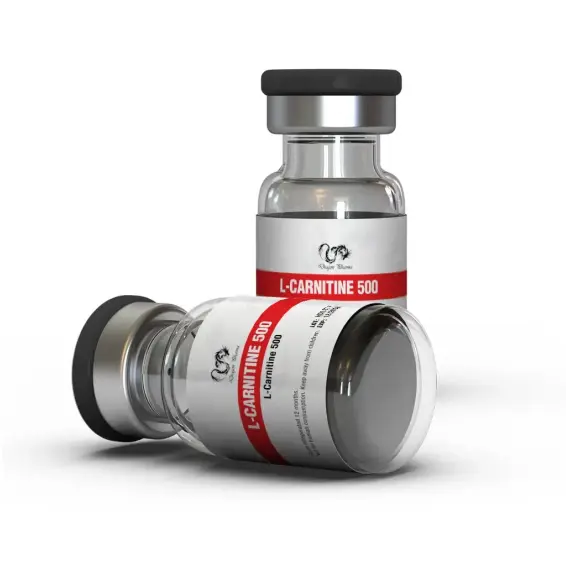
L-Carnitine 500mg/ml Injectable by Dragon Pharma
L-Carnitine 500 is Dragon Pharma's injectable formulation of L-Carnitine at 500mg/ml in a 10ml aqueous vial — providing near-complete bioavailability versus the 14-18% typically achieved through oral supplementation. L-Carnitine is a quaternary ammonium compound synthesised from lysine and methionine, essential for the transport of long-chain fatty acids across the inner mitochondrial membrane for beta-oxidation. In AAS contexts, L-Carnitine has an additional documented role: androgen receptor upregulation in muscle tissue.
Also searched as: L-Carnitine injection 500mg, injectable L-Carnitine, L-Carnitine 500mg/ml Dragon Pharma, L-Carnitine fat metabolism.
Why Injectable vs Oral — The Bioavailability Gap
The case for injectable L-Carnitine over oral supplementation rests on a significant and specific bioavailability difference:
- Oral L-Carnitine absorption is limited by active intestinal transport systems that become saturated at moderate doses — bioavailability is typically 14-18% from supplement form and 54-72% from food sources (where L-Carnitine is bound to proteins and absorbed differently)
- A 2g oral L-Carnitine supplement delivers approximately 280-360mg to systemic circulation. The same 2g administered intravenously or via intramuscular/subcutaneous injection delivers close to 100% systemically
- At 500mg/ml, a single 2ml injection of Dragon Pharma L-Carnitine delivers 1,000mg with near-complete bioavailability — equivalent to approximately 5,500-7,000mg of oral L-Carnitine supplement in terms of what reaches the bloodstream
- This bioavailability advantage is particularly relevant for the androgen receptor upregulation application (below), where plasma L-Carnitine concentrations — not gut absorption — determine the effect
How L-Carnitine Works — The CPT Shuttle Mechanism
L-Carnitine's primary metabolic function is a specific and elegant transport mechanism that most competitor content reduces to "moves fat to mitochondria":
- Long-chain fatty acids (the primary fat fuel for aerobic metabolism) cannot cross the inner mitochondrial membrane directly — they require a specific transport system
- L-Carnitine acts as the shuttle carrier in the carnitine palmitoyltransferase (CPT) system: CPT1 on the outer mitochondrial membrane conjugates L-Carnitine to the fatty acid (forming acylcarnitine); the acylcarnitine complex crosses the inner mitochondrial membrane via a translocase; CPT2 on the inner membrane cleaves the complex, releasing the fatty acid inside the mitochondrial matrix where beta-oxidation occurs
- Without sufficient L-Carnitine, this shuttle is rate-limiting — fatty acids accumulate in the cytoplasm rather than entering the mitochondria for oxidation
- Providing supraphysiological L-Carnitine ensures the CPT shuttle is never rate-limiting — maximising the rate at which fatty acids can be transported into mitochondria and oxidised for energy
- This is particularly relevant during fasted states and aerobic exercise when fatty acid oxidation is the primary energy source — L-Carnitine availability becomes the critical bottleneck
L-Carnitine and Androgen Receptor Upregulation — The AAS-Specific Benefit
This is one of the most clinically interesting and least-known aspects of L-Carnitine in an AAS context:
- A series of studies by Kraemer et al. (published in Journal of Strength and Conditioning Research, 2006 and subsequently) demonstrated that L-Carnitine L-Tartrate supplementation significantly upregulated androgen receptor content in muscle tissue — specifically in fast-twitch muscle fibres
- The mechanism: L-Carnitine is involved in the recovery of androgen receptors following exercise-induced downregulation. Post-exercise, androgen receptor content in muscle declines temporarily as part of the exercise stress response. L-Carnitine supplementation was shown to attenuate this post-exercise downregulation, maintaining higher androgen receptor density during the recovery period
- The practical implication for AAS users: more androgen receptors in muscle during the recovery period means more receptor availability for the exogenous androgens circulating from the cycle — potentially enhancing the anabolic signalling from a given AAS dose
- This effect was observed at plasma L-Carnitine concentrations achievable by injectable supplementation but difficult to achieve reliably with oral supplementation given the bioavailability gap
Effects and Benefits
- Enhanced fatty acid transport into mitochondria via CPT shuttle saturation — maximises fat oxidation during fasted training and aerobic work
- Androgen receptor upregulation in muscle tissue — maintains receptor density during post-exercise recovery, potentially enhancing AAS anabolic signalling
- Reduced exercise-induced muscle damage markers in some studies — potentially faster recovery between sessions
- No hormonal suppression — does not affect testosterone, HPG axis or require PCT
- Near-complete bioavailability versus 14-18% oral absorption
Dosage and Administration
| Protocol | Dose | Timing | Route |
|---|---|---|---|
| Fat metabolism support | 1,000–2,000 mg/day | Pre-workout or fasted morning | IM or SubQ |
| AAS / AR upregulation | 2,000 mg/day | Post-workout | IM or SubQ |
At 500mg/ml, a 2ml injection delivers 1,000mg; a 4ml injection delivers 2,000mg. The 10ml vial at 2,000mg/day provides 2.5 days at maximum dose — at the 1,000mg/day protocol, the 10ml vial provides 5 days. Injection can be intramuscular or subcutaneous — intramuscular is more commonly used for L-Carnitine injection due to faster absorption and lower injection site reaction risk at high volumes. Rotating injection sites is essential at daily dosing.
Side Effects
- Injection site reactions — localised soreness, redness or bruising; rotate sites and limit volume per injection site
- Fishy body odour — trimethylamine produced from gut bacterial metabolism of L-Carnitine is minimised with injectable (bypasses gut) vs oral supplementation
- Nausea at very high doses — uncommon with injectable; more commonly associated with oral L-Carnitine
- No hormonal side effects — no testosterone suppression, no estrogen effects, no PCT required
L-Carnitine in an AAS Protocol Context
- Post-workout injection alongside Testosterone cycles — AR upregulation effect is most relevant during AAS use where circulating androgens are supraphysiological
- Pre-workout fasted injection alongside Clenbuterol during cutting — L-Carnitine CPT shuttle saturation maximises fatty acid oxidation that Clenbuterol's beta-2 stimulation liberates from adipocytes
- During Tirzepatide or GLP-1 protocols — L-Carnitine ensures liberated fatty acids are efficiently transported into mitochondria for oxidation rather than re-esterification
"Injectable L-Carnitine at 500mg/ml delivers near-complete bioavailability — the androgen receptor upregulation data from Kraemer et al. establishes a specific AAS-relevant mechanism that oral supplementation at equivalent doses cannot reliably reproduce."
Storage and Handling
Store L-Carnitine 500 at room temperature away from direct sunlight. The aqueous solution is clear — discard if cloudiness or particulate matter is visible. Use sterile technique for every draw.