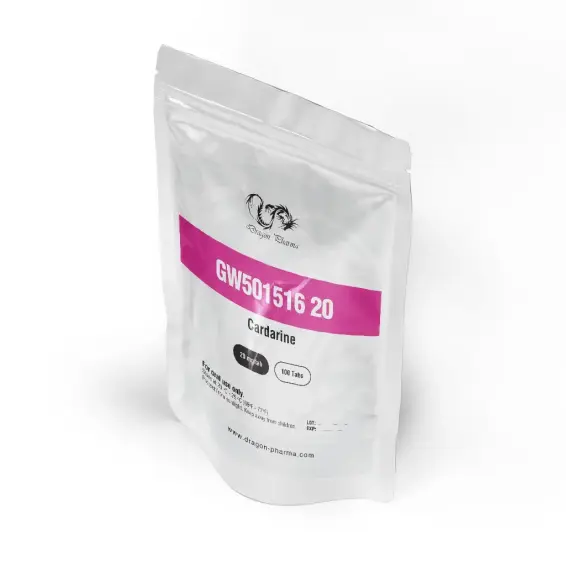
GW-501516 (Cardarine) 20mg by Dragon Pharma
GW-501516, commonly known as Cardarine, is Dragon Pharma's formulation at 20mg per tablet — a PPARδ (peroxisome proliferator-activated receptor delta) agonist that enhances fatty acid oxidation, endurance capacity and lipid metabolism. Supplied in a 100-tablet pack, GW-501516 is frequently and incorrectly classified as a SARM — it is not. Its mechanism is entirely different from androgen receptor modulators, and understanding this distinction is essential to understanding both its effects and its safety profile.
Also searched as: GW 501516, Cardarine 20mg, PPAR delta agonist, GW501516 Dragon Pharma.
GW-501516 Is Not a SARM — The Critical Misclassification
This is the most pervasive and consequential error in competitor content on this compound:
- SARMs (Selective Androgen Receptor Modulators) bind androgen receptors — the same receptors as testosterone and other anabolic steroids — with tissue-selective activity
- GW-501516 does not bind androgen receptors. It binds PPARδ (peroxisome proliferator-activated receptor delta) — a nuclear receptor that regulates fatty acid oxidation gene expression, mitochondrial biogenesis and metabolic switching
- GW-501516 has no anabolic activity, produces no testosterone suppression, does not require PCT, and does not produce any of the hormonal effects of SARMs or AAS
- Its mechanism — activating PPARδ to shift energy metabolism toward fat oxidation — is pharmacologically similar to the pathway activated by endurance exercise at the cellular level
- It is classified alongside SARMs in some contexts purely because it is commonly used by the same community and sold through the same channels — not because of any shared mechanism
The PPARδ Mechanism — How GW-501516 Actually Works
PPARδ is a nuclear receptor involved in regulating genes governing fatty acid oxidation and mitochondrial function. GW-501516's activation of PPARδ produces several downstream effects:
- Fatty acid oxidation upregulation: PPARδ activation increases expression of genes encoding enzymes involved in beta-oxidation — the cellular process of burning fatty acids for energy. The shift toward fat as a primary fuel source is similar to the metabolic adaptation seen in endurance-trained athletes
- Mitochondrial biogenesis: PPARδ activates PGC-1α co-activation — the same pathway stimulated by aerobic exercise — increasing mitochondrial density in skeletal muscle. More mitochondria per fibre = greater capacity for sustained aerobic energy production
- Muscle fibre type shift: Animal studies demonstrated a shift toward type I (slow-twitch, oxidative) muscle fibres with PPARδ activation — physically altering muscle composition toward endurance performance
- Endurance without training: The 2008 Narkar et al. study in Cell demonstrated that GW-501516 increased running endurance by 68% in untrained mice — generating significant media attention as a potential "exercise pill"
The Safety Question — Why GSK Discontinued Development
This is the most important safety information that competitor content almost universally omits or minimises:
- GlaxoSmithKline (GSK) developed GW-501516 in the 1990s-2000s for metabolic syndrome and dyslipidaemia indications
- In 2007, GSK halted all development of GW-501516 after animal toxicology studies showed rapid and widespread tumour development across multiple organ systems — in all animal species tested and at multiple dose levels
- The mechanism of concern: PPARδ activation may promote tumour proliferation and progression in pre-existing cancer cells. PPARδ plays a role in cell proliferation pathways, and its activation was found to accelerate cancer progression in models with pre-existing cancer
- Key distinction: GW-501516 does not appear to initiate cancer in healthy cells in all studies — the primary concern is its potential to accelerate existing tumour growth
- Human clinical data is very limited — the compound never progressed to Phase III trials. The safety picture in humans at the doses used in performance contexts is not established by rigorous clinical evidence
- WADA added GW-501516 to its prohibited list in 2009 specifically citing the cancer risk findings as a reason beyond doping concerns
Effects and Benefits
- Significant endurance enhancement — documented 68% increase in untrained mouse endurance; human reports consistent with meaningful aerobic capacity improvement
- Enhanced fatty acid oxidation — metabolic shift toward fat as primary fuel, improving body composition during caloric deficits
- Improved lipid profile — PPARδ activation associated with reduced LDL and triglycerides, increased HDL in animal studies
- No hormonal effects — no testosterone suppression, no estrogen effects, no PCT required
- Anti-catabolic during caloric deficit — fat oxidation shift preserves muscle glycogen, reducing catabolism of lean tissue
Dosage and Administration
| Protocol | Dose | Timing | Duration |
|---|---|---|---|
| Standard endurance/fat loss | 10–20 mg/day | Once daily (long half-life) | 4–8 weeks typically |
| Pre-workout timing | 20 mg | 1–2 hours before training | As above |
With a ~16-24 hour half-life, once-daily dosing maintains stable blood levels. The 20mg tablet represents the higher end of commonly used doses — some users start at 10mg (half tablet) before escalating. GW-501516 does not require PCT and can be discontinued without a taper. It does not interact with androgen receptors or the HPG axis and can be used during AAS cycles or independently.
Side Effects
- The primary safety concern is tumour acceleration — this is established in animal models and the mechanism (PPARδ's role in cell proliferation) provides a plausible biological basis for concern in humans
- No hormonal side effects — no testosterone suppression, no androgenic or estrogenic effects
- Digestive discomfort at higher doses reported by some users
- Users with any history of cancer or pre-cancerous conditions should not use GW-501516 given the established tumour acceleration findings
GW-501516 in a Protocol Context
- Commonly used with LGD-4033 (Ligandrol) or MK-2866 (Ostarine) — the endurance and fat oxidation effects complement the SARMs' anabolic properties
- Clenbuterol comparison — both enhance fat metabolism but through different mechanisms; Cardarine targets PPARδ gene expression changes while Clenbuterol targets beta-2 receptor activation
"GW-501516 is a PPARδ agonist — not a SARM — with documented endurance and fat oxidation effects through a mechanism distinct from any androgen receptor-binding compound. Understanding its mechanism and the safety questions raised by its discontinued clinical development is essential context for any user."
Storage and Handling
Store GW-501516 at room temperature, away from direct sunlight and moisture. Keep the original packaging sealed until use to maintain tablet potency.