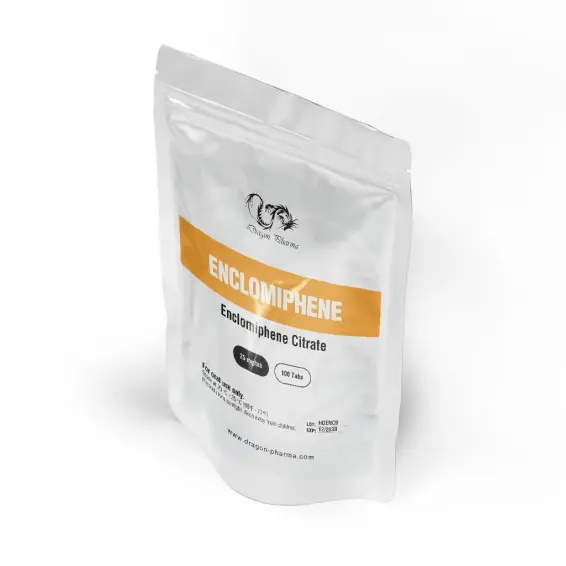
Enclomiphene Citrate by Dragon Pharma
Enclomiphene Citrate is Dragon Pharma's formulation of the trans-isomer of clomiphene at 25mcg per tablet — a selective estrogen receptor modulator (SERM) used for testosterone recovery, PCT support and as a potential alternative to exogenous testosterone in hypogonadal men. Supplied in a 100-tablet pack, Enclomiphene's significance lies in what distinguishes it from Clomid: it is the active testosterone-stimulating component of Clomiphene without the visual side effects associated with the other isomer.
Also searched as: Enclomiphene 25mcg, Enclomiphene Citrate PCT, trans-clomiphene, Enclomiphene Dragon Pharma.
Clomid Is Two Compounds — The Critical Distinction
This is one of the most important and least-explained facts in PCT literature, and a genuine information gap in virtually all competitor content:
- Clomiphene Citrate (Clomid) is not a single compound — it is a racemic mixture of two geometric isomers in approximately equal proportions: Enclomiphene (trans-isomer, ~38%) and Zuclomiphene (cis-isomer, ~62%)
- Enclomiphene is the active testosterone-stimulating isomer — it blocks estrogen receptors in the hypothalamus, removing estrogen's negative feedback on LH/FSH secretion, which drives the increase in testosterone production
- Zuclomiphene has a much longer half-life (~30 days vs ~10 hours for Enclomiphene) and acts as a partial estrogen agonist — it accumulates with repeated dosing and is responsible for the visual disturbances (blurred vision, light sensitivity, floaters) commonly reported with Clomid
- Clinical pharmacology data: in a randomised crossover study, Enclomiphene alone produced equivalent testosterone elevation to the full Clomid mixture at equivalent molar doses, with significantly fewer visual side effects
Enclomiphene vs Clomid vs Nolvadex — The Three-Way Comparison
| Parameter | Enclomiphene | Clomid (Clomiphene) | Nolvadex (Tamoxifen) |
|---|---|---|---|
| Composition | Pure trans-isomer | ~38% enclomiphene + ~62% zuclomiphene | Single compound |
| Half-life | ~10 hours | Mixed: ~10h + ~30 days (zuclomiphene) | ~5–7 days |
| Visual side effects | Minimal — zuclomiphene absent | Common — zuclomiphene accumulates | Possible but less common |
| LH/FSH stimulation | Strong — primary mechanism | Strong — via enclomiphene component | Indirect — less LH stimulation |
| Testosterone elevation | Significant — comparable to Clomid | Significant | Less direct than Clomiphene-class |
| Estrogen receptor | Antagonist (hypothalamus) | Mixed agonist/antagonist | Antagonist (tissue-selective) |
| TRT alternative use | Being studied — preserves fertility | Used historically, less selectively | Not used for this purpose |
Enclomiphene as a TRT Alternative — The Emerging Application
An important and underreported application of Enclomiphene that separates it from both Clomid and Nolvadex:
- Unlike exogenous testosterone (TRT), Enclomiphene stimulates endogenous testosterone production through the HPG axis — preserving testicular function and fertility
- Phase II and III clinical trials investigated Enclomiphene specifically as a treatment for secondary hypogonadism in men who want to maintain fertility — an application where conventional TRT is contraindicated because exogenous testosterone suppresses sperm production
- Trial data demonstrated Enclomiphene at 12.5-25mg/day produced testosterone elevations to eugonadal range while maintaining or improving sperm parameters — in contrast to TRT, which consistently suppresses spermatogenesis
- This positions Enclomiphene as a clinically meaningful option for hypogonadal men whose primary concern is fertility preservation alongside testosterone restoration
Effects and Benefits
- Stimulates LH and FSH release from the pituitary, driving natural testosterone production
- Produces comparable testosterone elevation to Clomid without the zuclomiphene-related visual side effects
- Preserves testicular function and spermatogenesis — relevant for fertility-concerned users post-cycle
- Shorter half-life than zuclomiphene means faster system clearance when stopping
- Potential TRT alternative in secondary hypogonadism where fertility preservation is a priority
Dosage and Administration
| Use Case | Typical Dose | Duration |
|---|---|---|
| PCT after AAS cycle | 12.5–25 mcg/day | 4–6 weeks |
| Testosterone support/TRT alternative | 12.5–25 mcg/day | Ongoing — as needed |
At 25mcg per tablet, dosing can be adjusted by tablet splitting for the 12.5mcg dose often used as a starting point. Note: the dosing of Enclomiphene is typically lower than equivalent Clomid doses because Enclomiphene is the pure active isomer — a 25mg Clomid dose contains only ~9.5mg of Enclomiphene, meaning 25mcg of pure Enclomiphene is roughly equivalent to 65mg of Clomid on a molar basis.
Side Effects
- Visual disturbances significantly less common than with Clomid — the absence of zuclomiphene removes the primary driver of this side effect class
- Mood changes possible — estrogen receptor modulation in the central nervous system affects mood in some users, though generally less pronounced than with Clomid
- Estrogen fluctuations — as testosterone rises, so does aromatisation; estrogen management may be needed at higher doses or in sensitive individuals
- Does not suppress natural testosterone — it stimulates it
Enclomiphene in a PCT Protocol
Enclomiphene can be used as a standalone PCT or alongside Nolvadex. The combination provides dual receptor pathway coverage — Enclomiphene's LH/FSH stimulation alongside Nolvadex's selective estrogen receptor antagonism in breast tissue. For comparison options:
- Clomid — the traditional alternative; contains both isomers; stronger combined effect but with zuclomiphene side effects
- Nolvadex — the standard SERM for PCT; different mechanism, commonly combined with Enclomiphene
- HCG — used pre-PCT to restore testicular volume; often combined with Enclomiphene/Nolvadex for full HPG axis recovery
"Enclomiphene represents the next step in SERM-based testosterone recovery — isolating the active isomer that does the work while eliminating the visual side effects that made Clomid less tolerable for many users."
Storage and Handling
Store Enclomiphene at room temperature, away from direct sunlight and moisture. Keep the original packaging sealed until use to maintain tablet potency.