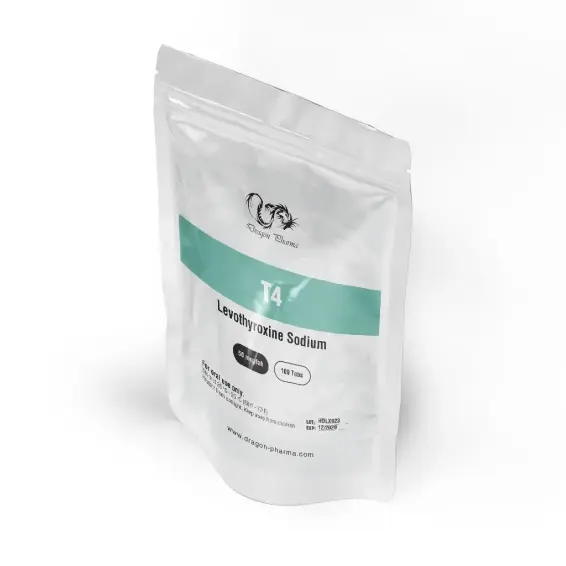
Levothyroxine Sodium (T4) 50mcg by Dragon Pharma
T4 is Dragon Pharma's formulation of Levothyroxine Sodium — synthetic thyroxine — at 50mcg per tablet. T4 is the thyroid gland's primary secretory hormone and a prohormone that must be converted to the active T3 (triiodothyronine) by peripheral deiodinase enzymes before producing its full metabolic effect. With a ~6-7 day half-life, T4 provides the most stable and gradual thyroid support of any thyroid compound in the Dragon Pharma range — a fundamentally different profile from the faster-acting, more potent T3 (Liothyronine).
Also searched as: T4 Levothyroxine 50mcg, L-thyroxine, Synthroid, Levothyroxine Dragon Pharma, T4 thyroid support.
T4 vs T3 — The Prohormone Distinction
Understanding T4's relationship to T3 is essential to understanding why they are used differently:
- The thyroid gland secretes approximately 80-90% of its output as T4 — it is the primary thyroid hormone in circulation. However, T4 has relatively weak direct activity at thyroid hormone receptors
- T4 serves as a prohormone: deiodinase enzymes in the liver, kidney and peripheral tissues convert T4 to T3 by removing one iodine atom. This conversion step is regulated — the body can modulate how much T4 is converted based on metabolic demand
- T3 is 3-4× more potent at thyroid receptors than T4. Approximately 80% of circulating T3 comes from peripheral T4 conversion; only ~20% is secreted directly by the thyroid
- When T4 is taken exogenously, the conversion rate to T3 is determined by the individual's deiodinase enzyme activity — this means T4's metabolic effect is more variable than T3's and depends on the user's conversion capacity
- This conversion dependence is the primary reason T3 is preferred over T4 in performance contexts where predictable, immediate metabolic elevation is the goal
Why T4 Is Used in Performance Contexts — The Specific Use Cases
Despite T3 being more potent and predictable, T4 has specific applications in the Dragon Pharma context that are rarely explained in competitor content:
- Thyroid axis restoration post-T3 cycle: After a T3 cycle, the HPT axis (hypothalamic-pituitary-thyroid) needs to recover. T4 at a moderate dose can bridge the gap between T3 cessation and full natural thyroid recovery — providing enough thyroid hormone to prevent hypothyroid symptoms while TSH recovers and natural T4 production resumes. It is more forgiving than T3 during this restoration phase due to its longer half-life and indirect activity
- Sustained low-level thyroid support: For users wanting mild, sustained metabolic support without the sharp BMR elevation and catabolic risk of T3 — T4 provides a gentler metabolic lift by supplying additional substrate for T4→T3 conversion
- Hypothyroidism management during AAS cycles: Some AAS suppress thyroid function (Trenbolone in particular has been associated with reduced T3 levels through increased T3 uptake by tissues); T4 supplementation during such cycles can maintain thyroid hormone availability
T4 vs T3 — Direct Comparison for Performance Use
| Parameter | T4 (Levothyroxine) | T3 (Liothyronine) |
|---|---|---|
| Form | Prohormone — converted to T3 | Active hormone — direct receptor activation |
| Half-life | ~6–7 days | ~2.5 days |
| Onset of effect | Slow — weeks to stabilise | Fast — days to effective levels |
| Potency per mcg | Lower — requires conversion | Higher — direct activity |
| Effect predictability | Variable — depends on individual conversion | Consistent — direct receptor binding |
| Muscle catabolism risk | Lower — gentler metabolic acceleration | Higher — more aggressive catabolism at equivalent doses |
| Dose titration speed | Slow — 6-7 day half-life means weeks to reach new steady-state | Fast — adjustments show effect within days |
| Taper requirement | Gradual taper advised | Gradual taper essential |
| Primary performance use | Thyroid support, post-T3 axis restoration, mild metabolic lift | Aggressive fat loss, BMR elevation |
Effects and Benefits
- Sustained thyroid hormone support — steady-state T4 levels provide consistent substrate for T3 conversion throughout the day
- Milder metabolic acceleration than T3 — appropriate for users wanting thyroid support without the aggressive catabolic risk of T3
- Post-T3 axis restoration — supports thyroid hormone availability while HPT axis recovers after T3 cycle
- Long half-life allows stable once-daily dosing with minimal fluctuation
- Widely studied safety profile — Levothyroxine is one of the most prescribed medications globally
Dosage and Administration
| Use Case | Dose | Timing | Duration |
|---|---|---|---|
| Performance thyroid support | 50–100 mcg/day | Morning, fasted | Duration of cycle |
| Post-T3 axis restoration | 50–100 mcg/day | Morning, fasted | 2–4 weeks tapering as natural axis recovers |
| Hypothyroid support during AAS | 50 mcg/day | Morning, fasted | Duration of AAS cycle |
Morning fasted administration is standard for T4 — food, calcium and iron supplements significantly reduce T4 absorption by binding it in the gut. Unlike T3 where splitting doses is sometimes used, T4's 6-7 day half-life makes once-daily morning dosing entirely appropriate for stable blood levels. Due to the long half-life, dose changes take 4-6 weeks to reach new steady-state — dose adjustments must be made conservatively and patiently.
Side Effects
- Milder side effect profile than T3 at equivalent thyroid receptor stimulation — the conversion step buffers acute thyroid overexposure
- Palpitations and elevated heart rate if overdosed — same mechanism as T3 but slower onset
- TSH suppression — natural thyroid production suppressed during exogenous T4 use; gradual taper recommended on discontinuation
- Absorption affected by food, calcium, iron and many medications — strict morning fasted administration is important
T4 in the Dragon Pharma Range
- T3 (Liothyronine 25mcg) — the active, more potent alternative for aggressive fat loss protocols; see T3 page for full comparison
- CYT3 — contains T3 (not T4) as part of its fat loss trio; T4 is not used in combination fat loss blends due to its conversion dependence
- Trenbolone users — T4 supplementation during Trenbolone cycles is particularly relevant given Trenbolone's documented effect on thyroid hormone utilisation
"T4 at 50mcg provides the thyroid prohormone substrate that converts to active T3 through the body's own regulated deiodinase pathway — a more gradual and controllable approach to thyroid support than direct T3 administration."
Storage and Handling
Store T4 at room temperature, away from direct sunlight, moisture and heat. Keep the original packaging sealed until use. Avoid storing near supplements containing calcium or iron which can interfere with absorption if co-administered.