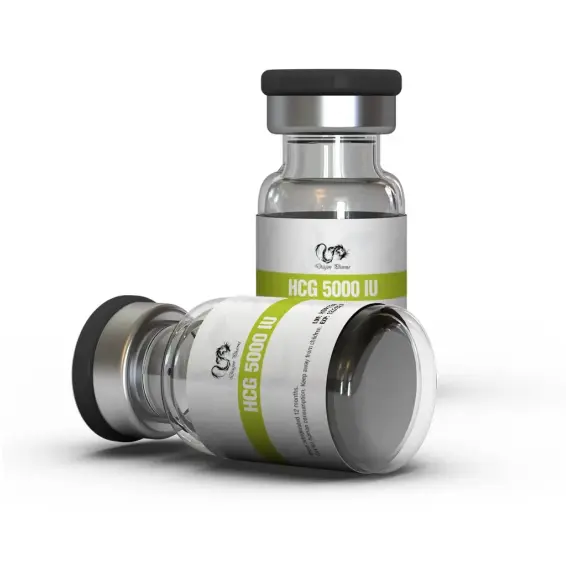
HCG 5000IU — Human Chorionic Gonadotropin by Dragon Pharma
HCG 5000IU (Human Chorionic Gonadotropin) is Dragon Pharma's formulation of the LH-mimetic gonadotropin at 5000 International Units per vial — the standard high-dose vial for testicular maintenance during long AAS cycles, pre-PCT priming, and post-cycle testicular reactivation. HCG is not a synthetic compound — it is purified from the urine of pregnant women, where the placenta produces it in large quantities to maintain corpus luteum function and sustain early pregnancy. Its identical structural similarity to LH means it stimulates LH receptors on Leydig cells in the testes, directly driving testosterone production independently of pituitary LH.
Also searched as: HCG 5000IU, Pregnyl 5000, Human Chorionic Gonadotropin, HCG PCT, Dragon Pharma HCG.
What HCG Is — Origin and Mechanism
HCG's biological origin and pharmacological mechanism are rarely explained together in competitor content:
- During early pregnancy, the developing embryo's trophoblast cells begin secreting HCG within days of implantation — HCG maintains the corpus luteum (the follicle remnant that produced the egg), which produces progesterone essential for sustaining early pregnancy until the placenta takes over at approximately 10-12 weeks
- Pregnant women excrete large amounts of HCG in urine — the same detection basis as home pregnancy tests (which detect urine HCG). Commercial HCG for medical use is purified from pooled postmenopausal or pregnant women's urine (similar to HMG's derivation)
- HCG and LH are both glycoprotein hormones sharing identical alpha subunits — the beta subunit differs slightly, but both bind and activate the same LH/hCG receptor on Leydig cells. HCG binds this receptor with similar affinity to LH but with a longer half-life (~33 hours vs LH's ~1 hour) — producing more sustained Leydig cell stimulation per injection
- This direct Leydig cell stimulation produces testosterone independently of the HPG axis — HCG works regardless of whether LH from the pituitary is suppressed, making it effective during AAS cycles when LH production has been shut down
The Core AAS Problem HCG Solves
Understanding why HCG matters requires understanding what prolonged AAS use does to the testes:
- AAS suppress LH and FSH through androgen receptor-mediated negative feedback. Without LH stimulation, Leydig cells in the testes become inactive — they stop producing testosterone, reduce in size and the testes themselves atrophy (reduce in volume)
- Prolonged LH deprivation (extended AAS cycles, particularly 16+ weeks) can produce Leydig cell dysfunction that persists after the AAS is cleared — the cells become less responsive to LH stimulation even when natural LH production resumes post-cycle
- HCG during the cycle maintains Leydig cell activity, prevents atrophy and preserves testicular responsiveness — so that when the AAS cycle ends and LH production tries to recover, the Leydig cells are in functional condition to respond
During-Cycle vs Pre-PCT — The Key Protocol Debate
Two schools of thought exist on optimal HCG use in AAS protocols:
- During-cycle HCG (maintenance protocol): 250-500IU every 3-4 days throughout the cycle — keeps Leydig cells active throughout; prevents testicular atrophy; means PCT begins with functionally intact testes. This is the approach favoured by practitioners emphasising long-term testicular health and easier PCT recovery
- Pre-PCT blast protocol: 1,000-2,000IU daily for 5-10 days immediately before beginning SERM PCT — a high-dose short burst designed to rapidly reactivate Leydig cells before SERMs restore LH production. Used more commonly after shorter cycles where ongoing during-cycle HCG wasn't used
- The desensitisation concern: HCG can paradoxically suppress HPG recovery if used at excessive doses or continued too long — very high doses or chronic continuous HCG use can desensitise LH receptors on Leydig cells, reducing their responsiveness. HCG also aromatises significantly (stimulates testosterone → estrogen conversion), potentially elevating estrogen during the pre-PCT period
- Consensus: during-cycle HCG at moderate doses (250-500IU every 3-4 days) is preferable to high-dose pre-PCT blasts for most users
HCG vs HMG — Which LH/FSH Source When
| Parameter | HCG 5000IU | HMG 150IU |
|---|---|---|
| LH activity | Yes — full LH mimetic | Yes — 75IU LH component |
| FSH activity | None | Yes — 75IU FSH component |
| Testosterone restoration | Yes — primary use case | Yes — via LH component |
| Spermatogenesis restoration | Incomplete — no FSH for Sertoli cells | Yes — FSH drives Sertoli cells |
| Best use | Testicular volume and testosterone maintenance/restoration | Fertility and full spermatogenesis recovery |
Dosage and Administration
| Protocol | Dose | Frequency | Duration |
|---|---|---|---|
| During-cycle maintenance | 250–500 IU | Every 3–4 days | Throughout cycle |
| Pre-PCT blast | 1,000–2,000 IU | Daily | 5–10 days before SERMs |
| Post-cycle only | 500–1,000 IU | Every other day | 2–3 weeks, then SERM PCT |
At 5000IU per vial, the during-cycle protocol (250IU every 3-4 days = ~625IU/week) provides approximately 8 weeks of dosing per vial. Reconstitute with bacteriostatic water — add 1-2ml for convenient dose measurement. Store reconstituted vial refrigerated at 2-8°C; use within 28-30 days. Subcutaneous injection in the abdomen is most common; IM is also used. Do not freeze — HCG is a protein hormone that degrades with freezing.
Side Effects
- Estrogen elevation — HCG stimulates Leydig cell testosterone production which aromatises; significant estrogen increase at higher doses. AI may be needed during HCG use, particularly with pre-PCT blasts
- LH receptor desensitisation — excessive dose or duration reduces Leydig cell responsiveness. Stay within conservative dose guidelines
- Injection site reactions — minor; subcutaneous injection well tolerated
- Mood effects — from testosterone and estrogen fluctuations at higher doses
PCT and Protocol Context
- Clomid — begin 24-48 hours after last HCG dose in pre-PCT blast protocol; Clomid works at hypothalamus/pituitary to restore LH production
- Nolvadex — alternative or combined SERM; begin same timing as Clomid
- HMG 150IU — add when FSH activity (spermatogenesis restoration) is also required alongside HCG's LH stimulation
"HCG at 250-500IU every 3-4 days during the cycle is the most evidence-supported approach — maintaining Leydig cell function throughout the suppressive period so PCT begins with responsive testes rather than attempting to reactivate cells that have been dormant for months."
Storage and Handling
Store lyophilised (powdered) HCG at room temperature or refrigerated. Reconstitute with bacteriostatic water and store reconstituted product refrigerated at 2-8°C for up to 28-30 days. Never freeze reconstituted HCG.