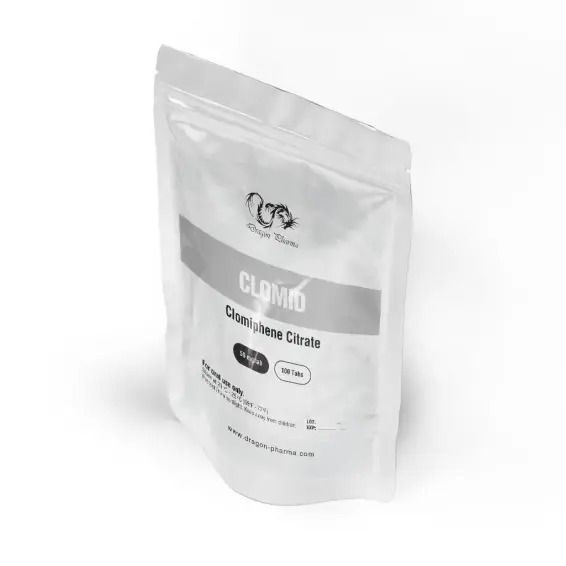
Clomiphene Citrate — Clomid by Dragon Pharma
Clomid is Dragon Pharma's formulation of Clomiphene Citrate at 50mg per tablet — the most widely used SERM for post-cycle testosterone recovery. A racemic mixture of two geometric isomers (Enclomiphene and Zuclomiphene), Clomid stimulates LH and FSH release from the pituitary by blocking estrogen receptors in the hypothalamus, driving natural testosterone production after an AAS cycle.
Also searched as: Clomiphene Citrate 50mg, Clomid PCT, Clomid for men testosterone, Clomid Dragon Pharma.
What Clomiphene Citrate Actually Is — The Isomer Composition
Clomid is not a single compound — a detail that explains both its effects and its side effects:
- Clomiphene Citrate is a racemic mixture of approximately 38% Enclomiphene (trans-isomer) and 62% Zuclomiphene (cis-isomer)
- Enclomiphene is the active testosterone-stimulating isomer — it blocks estrogen receptors in the hypothalamus, removing estrogen's negative feedback on LH/FSH secretion and driving increased testosterone production. Its half-life is approximately 10 hours
- Zuclomiphene has a much longer half-life (~30 days) and acts as a partial estrogen agonist. It accumulates with repeated dosing and is primarily responsible for Clomid's characteristic visual disturbances (blurred vision, light sensitivity, floaters)
- Despite this composition, Clomid remains the PCT standard because its combined LH/FSH stimulation is strong, well-characterised and the visual side effects — while unpleasant — are reversible and not universal across all users
How Clomid Works — The HPG Axis Recovery Mechanism
Understanding Clomid's mechanism clarifies why it is used after an AAS cycle specifically:
- During an AAS cycle, exogenous androgens suppress the HPG (hypothalamic-pituitary-gonadal) axis — the pituitary stops releasing LH and FSH, the testes stop producing testosterone and shrink over time
- Estrogen provides negative feedback to the hypothalamus — when estrogen is sensed, the hypothalamus reduces GnRH secretion, which reduces pituitary LH/FSH output
- After a cycle ends, estrogen levels often remain relatively elevated while testosterone is suppressed — the resulting high estrogen:testosterone ratio maintains hypothalamic suppression, slowing natural recovery
- Clomid's Enclomiphene component blocks estrogen receptors in the hypothalamus — removing this suppressive feedback. The hypothalamus resumes GnRH pulsing, the pituitary releases LH and FSH, and the testes are stimulated to resume testosterone production
Why Clomid Is Started at Higher Doses Then Tapered — The Loading Phase Explained
The standard PCT protocol starts at 50-100mg/day and reduces to 25-50mg/day — a dosing structure rarely explained properly:
- The higher initial dose is used to rapidly establish Enclomiphene's hypothalamic receptor blockade, quickly removing the estrogenic suppression that has been maintained throughout the cycle
- Once the hypothalamus is "reset" and LH/FSH are flowing again (typically within 1-2 weeks), the lower maintenance dose is sufficient to sustain the signal without adding unnecessary Zuclomiphene accumulation
- Maintaining the high dose throughout the full PCT would progressively accumulate more Zuclomiphene (its ~30-day half-life means it builds up over weeks), unnecessarily increasing visual side effect risk without proportional additional recovery benefit
- The taper reflects: high dose to establish the hypothalamic signal → lower dose to maintain it while the testes recover
Standard PCT Dosing Protocols
| Week | Clomid Dose | Purpose |
|---|---|---|
| Week 1 | 50–100 mg/day | Rapid hypothalamic receptor blockade — establish LH/FSH signal |
| Week 2 | 50 mg/day | Maintain signal as pituitary/testicular axis responds |
| Weeks 3–4 | 25–50 mg/day | Taper while natural testosterone production accelerates |
PCT typically begins when AAS blood levels have declined sufficiently — 14-21 days after the last long-ester injection (Enanthate/Cypionate) or 3-5 days after the last short-ester injection (Propionate). Starting PCT while significant AAS levels remain circulating is counterproductive — exogenous androgens will continue to suppress the HPG axis regardless of SERM administration.
Why Clomid + Nolvadex Is Better Than Either Alone
The combination of Clomid and Nolvadex in PCT is more effective than either alone — through complementary mechanisms:
- Clomid primarily acts on the hypothalamus — blocking estrogen receptors to increase GnRH/LH/FSH output and drive testicular testosterone production
- Nolvadex (Tamoxifen) primarily acts on breast tissue estrogen receptors — providing gynecomastia protection during the period when testosterone and estrogen are fluctuating. It also provides some pituitary-level LH stimulation through a complementary SERM mechanism
- A seminal study by Tan & Conaglen (Testosterone supplementation and recovery, as cited in reproductive endocrinology literature) demonstrated that Clomid + Nolvadex combination produced faster testosterone recovery than either compound used alone
- Practical implication: the combination covers both the hypothalamic signal restoration (Clomid) and the breast tissue protection + additional pituitary stimulation (Nolvadex) simultaneously
Side Effects
- Visual disturbances — blurred vision, light sensitivity, floaters — caused by Zuclomiphene accumulation; generally reversible after stopping; more common at higher doses and longer durations
- Mood changes — estrogen receptor modulation in the CNS affects mood; typically described as emotional sensitivity, irritability or depression in a minority of users
- Elevated estrogen possible as testosterone rises — as natural testosterone recovers and aromatises, estrogen may require management
- Does not suppress testosterone — it stimulates production; no PCT required after Clomid itself
Clomid vs Nolvadex vs Enclomiphene — PCT SERM Comparison
| Parameter | Clomid (Clomiphene) | Nolvadex (Tamoxifen) | Enclomiphene |
|---|---|---|---|
| LH/FSH stimulation | Strong — primary strength | Moderate — secondary effect | Strong — pure active isomer |
| Gynecomastia protection | Moderate | Strongest — primary strength | Moderate |
| Visual side effects | Common — Zuclomiphene | Less common | Minimal — Zuclomiphene absent |
| Half-life | Mixed: ~10h + ~30 days | ~5–7 days | ~10 hours |
| Best use | Standalone PCT or combined with Nolvadex | Combined with Clomid or standalone lighter PCT | When visual side effects are a concern |
Building a Complete PCT Around Clomid
- Nolvadex combined with Clomid for dual-SERM PCT — standard for heavier cycles
- HCG in the 2-3 weeks before starting Clomid — restores testicular volume and sensitivity before SERM therapy begins
- Enclomiphene as an alternative for users wanting Clomid's LH/FSH stimulation without Zuclomiphene's visual side effects
- Aromasin at a low dose during PCT if estrogen rises significantly as testosterone recovers
"Clomid is formulated at 50mg per tablet — the standard PCT dose that can be taken whole for the initial loading phase or split for the maintenance and taper phases, covering the full standard PCT protocol from a single pack."
Storage and Handling
Store Clomid at room temperature, away from direct sunlight and moisture. Keep the original packaging sealed until use to maintain tablet potency.