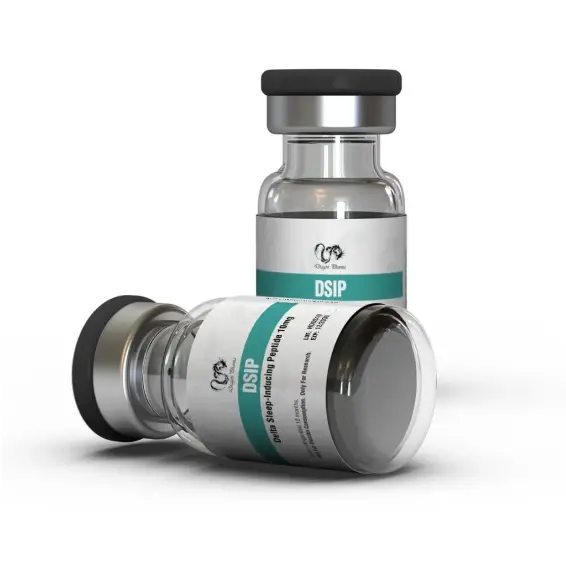
DSIP — Delta Sleep-Inducing Peptide by Dragon Pharma
DSIP (Delta Sleep-Inducing Peptide) is Dragon Pharma's formulation of the endogenous sleep neuropeptide at 10mg per vial — a naturally occurring nonapeptide (9 amino acids: Trp-Ala-Gly-Gly-Asp-Ala-Ser-Gly-Glu) first isolated in 1974 from the cerebral venous blood of sleeping rabbits by Monnier et al. at the University of Basel. DSIP is one of the earliest identified endogenous sleep-regulating peptides, proposed to specifically promote delta wave sleep (slow-wave sleep, NREM stage 3) — the deepest and most anabolically active sleep stage where the majority of nightly GH secretion occurs.
Also searched as: DSIP 10mg, Delta Sleep-Inducing Peptide, DSIP sleep peptide, DSIP Dragon Pharma.
The 1974 Discovery — How DSIP Was Found
DSIP's origin story is scientifically significant and rarely told in competitor content:
- In 1974, Marcel Monnier and colleagues at the University of Basel were investigating the biochemical basis of sleep by perfusing the brains of sleeping rabbits and collecting their cerebral venous blood
- When they injected this "sleep blood" into awake rabbits, the recipients entered slow-wave sleep rapidly — suggesting the sleeping rabbits were releasing a sleep-promoting substance into their cerebral circulation
- The active substance was isolated and identified as a 9-amino acid peptide — subsequently named Delta Sleep-Inducing Peptide based on its ability to promote delta wave activity on EEG (electroencephalogram) in the injected animals
- This discovery established DSIP as one of the first documented endogenous sleep-regulating neuropeptides — predating most of the modern sleep neuroscience understanding by two decades
What Delta Sleep Actually Is — Why It Matters for Recovery
Understanding DSIP's value requires understanding the sleep stage it targets:
- Human sleep is organised into cycles of NREM (non-rapid eye movement) and REM sleep. NREM is divided into stages 1, 2 and 3 — Stage 3 NREM is commonly called "deep sleep," "slow-wave sleep" (SWS) or "delta sleep" because of the characteristic large-amplitude, low-frequency delta waves (0.5-4 Hz) visible on EEG
- Delta sleep (NREM stage 3) is the physically restorative stage: approximately 70-80% of the total nightly GH pulse occurs during slow-wave sleep — specifically during the first two sleep cycles of the night. This GH release is the primary physiological driver of muscle protein synthesis, tissue repair and fat metabolism during sleep
- Memory consolidation, immune function restoration and cortisol regulation also preferentially occur during SWS
- Disrupted or insufficient delta sleep — extremely common with AAS use, particularly Trenbolone (which dramatically suppresses SWS), high-dose testosterone and during caloric deficit — directly impairs recovery through reduced GH pulsatility and elevated overnight cortisol
- DSIP's proposed mechanism specifically targets promotion of delta wave activity — not general sedation — making it fundamentally different from benzodiazepines or pharmaceutical sleep aids that achieve sedation but often suppress delta sleep
DSIP's Mechanisms — Honest Assessment of the Evidence
An honest discussion of DSIP's mechanism requires acknowledging an important limitation:
- Unlike most compounds in the Dragon Pharma range, DSIP has no confirmed specific receptor — the mechanism by which it promotes delta sleep has not been fully elucidated despite 50 years of research since its discovery
- Proposed mechanisms include: modulation of the HPA axis (reducing cortisol secretion during sleep), interaction with GABA-B receptors, interaction with opioid receptors, and direct effects on hypothalamic sleep-regulating centres — but no single mechanism has been confirmed as primary
- What is documented: DSIP administration increases slow-wave sleep EEG activity in animal models; reduces stress-induced cortisol secretion; has been shown to normalise disrupted sleep patterns in some clinical studies; and reduces corticotropin-releasing hormone (CRH) — the upstream driver of the cortisol stress response
- The honest picture: DSIP has real sleep-promoting effects supported by 50 years of research, but the precise receptor mechanism remains an open question in sleep neuroscience
DSIP and the GH Connection — Why AAS Users Specifically Benefit
This connection is entirely absent from competitor content but directly relevant:
- The largest single GH pulse of the day occurs 60-90 minutes after sleep onset, during the first episode of deep (delta) sleep — this pulse accounts for 50-70% of total daily GH secretion in healthy adults
- By promoting and deepening delta sleep, DSIP may indirectly amplify GH secretion through the natural sleep-associated GH pulse — a fundamentally different mechanism from GHRP or GHRH peptides that directly stimulate pituitary GH release
- In AAS cycles, particularly those involving Trenbolone (which extensively disrupts sleep architecture), this delta sleep GH amplification is blunted. DSIP addresses this from the sleep architecture side while GHRP peptides address it from the pituitary stimulation side
- DSIP's cortisol-lowering effect during sleep is independently valuable: nighttime cortisol elevation (common during caloric deficits, high-stress training and certain AAS) is catabolic and directly opposes GH's anabolic signalling
Clinical Evidence
| Finding | Source / Context |
|---|---|
| Increased delta wave EEG activity after DSIP administration | Monnier et al. (1977); multiple animal studies 1974-1990s |
| Reduced cortisol response to stress in humans | Schneider-Helmert et al. (1981) — small human study showing DSIP reduced cortisol in stressed subjects |
| Improvement in insomnia in clinical patients | Schneider-Helmert (1984) — double-blind human trial; DSIP improved sleep quality vs placebo |
| Normalisation of disrupted sleep patterns | Various studies in subjects with chronic insomnia and disturbed circadian rhythms |
| Antinociceptive (pain-reducing) properties | Multiple animal studies; proposed mechanism through opioid receptor interaction |
Effects and Benefits
- Promotion of delta wave (slow-wave, NREM stage 3) sleep — the primary named and documented effect
- Reduced overnight cortisol — stress-axis modulation during sleep; anabolically relevant
- Indirect GH pulse amplification — via delta sleep deepening, not pituitary stimulation
- No sedation mechanism — DSIP promotes physiological sleep architecture, not pharmacological sedation
- No tolerance or dependence — as an endogenous peptide, no receptor downregulation pattern documented
- No testosterone suppression — no PCT required
Dosage and Administration
| Protocol | Dose | Timing | Frequency |
|---|---|---|---|
| Sleep quality / recovery | 100–200 mcg | 30–60 minutes before sleep | Nightly or as needed |
| Higher dose | 200–500 mcg | 30–60 minutes before sleep | Nightly |
At 10mg per vial and 200mcg per dose, one vial provides 50 doses — approximately 7 weeks of nightly use. Reconstitute with bacteriostatic water. Inject subcutaneously 30-60 minutes before intended sleep time — timing is important as DSIP appears to work with the natural onset of sleep rather than forcing sleep at any time. Store reconstituted vial refrigerated at 2-8°C for up to 28 days.
DSIP in a Recovery Protocol
- MK-677 alongside DSIP — MK-677 independently improves slow-wave sleep quality through GHS-R1a stimulation while DSIP promotes delta wave architecture; the two work through different mechanisms toward the same recovery goal
- Ipamorelin before sleep — the pre-sleep GHRP injection timing is designed to coincide with the natural delta sleep GH pulse; DSIP deepening that delta sleep amplifies the GHRP-stimulated pulse further
- BPC-157 — systemic recovery peptide whose tissue repair effects are maximised during the anabolic GH-rich environment that deep sleep provides
Reconstitution and Storage
Reconstitute with bacteriostatic water — add slowly along the vial wall and swirl gently. Store reconstituted vial refrigerated at 2-8°C for up to 28 days. Never freeze.
"DSIP is the only peptide in the Dragon Pharma range specifically targeting delta wave sleep architecture — not sedation, but the promotion of the physiological deep sleep stage where 70-80% of nightly GH secretion and the majority of physical recovery occurs."