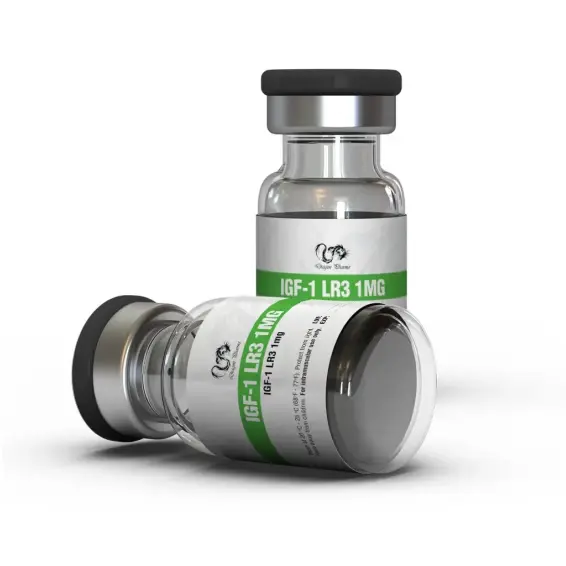
IGF-1 LR3 — Long R3 Insulin-Like Growth Factor by Dragon Pharma
IGF-1 LR3 is Dragon Pharma's formulation of Long R3 Insulin-Like Growth Factor-1 at 1mg per vial — a modified analogue of the naturally occurring IGF-1 that is approximately 2-3 times more potent than native IGF-1 due to specific structural modifications that dramatically reduce its binding to IGF-binding proteins. Supplied as a lyophilised vial requiring reconstitution, IGF-1 LR3 is the most anabolically potent peptide in the Dragon Pharma range by direct muscle receptor activity.
Also searched as: IGF-1 LR3 1mg, Long R3 IGF-1, insulin-like growth factor LR3, IGF-1 LR3 Dragon Pharma.
What "LR3" Means — The Structural Modification Explained
The "LR3" designation refers to two specific structural modifications to the native IGF-1 molecule — changes that are rarely explained in competitor content:
- "L" — 13 amino acid N-terminal extension: An additional 13 amino acid sequence is added to the N-terminus (beginning) of the native IGF-1 molecule. This extension is derived from a longer precursor form of IGF-1 and plays a key role in reducing IGFBP binding affinity
- "R3" — Arginine substitution at position 3: The glutamic acid (Glu) at position 3 of native IGF-1 is replaced with arginine (Arg). This single amino acid substitution is the primary driver of reduced IGFBP binding — the arginine residue sterically and electrostatically interferes with the binding site for IGF-binding proteins
- Combined effect: These two modifications together reduce IGF-1 LR3's affinity for IGF-binding proteins (IGFBPs) by approximately 1,000-fold compared to native IGF-1 — transforming a compound that would normally be immediately sequestered by binding proteins into one that remains freely bioavailable
Why IGFBP Binding Is the Critical Difference
This is the most important mechanistic distinction and a genuine information gap in virtually all competitor content:
- In the bloodstream, approximately 99% of endogenous IGF-1 is bound to IGF-binding proteins (IGFBPs 1-6) — only ~1% is in the free, biologically active form at any given time
- These binding proteins act as a reservoir and transport system — IGFBPs extend IGF-1's serum half-life to approximately 20 hours but also largely prevent it from reaching and activating IGF-1 receptors in muscle tissue
- When native IGF-1 is injected exogenously, it is rapidly bound by circulating IGFBPs and its free, active concentration is severely limited — the 20 mg/day of native IGF-1 produced by the liver daily is almost entirely IGFBP-bound
- IGF-1 LR3's 1,000-fold reduction in IGFBP binding affinity means the vast majority of injected LR3 remains in the free, active form — capable of directly binding and activating IGF-1 receptors in muscle, fat and other tissues without being sequestered
- This dramatically increased free fraction is why IGF-1 LR3 produces 2-3× the anabolic effect of equivalent doses of native IGF-1 despite being pharmacologically identical at the receptor level
IGF-1 LR3 vs Endogenous IGF-1 vs HGH — Understanding the Hierarchy
| Parameter | IGF-1 LR3 | Native IGF-1 | HGH (Somatropin) |
|---|---|---|---|
| Source | Synthetic analogue — injected directly | Liver-produced in response to GH | Pituitary hormone — injected directly |
| IGFBP binding | ~1,000× lower affinity — mostly free and active | ~99% IGFBP-bound at all times | N/A — GH acts upstream of IGF-1 |
| Half-life | ~20–30 hours (free fraction) | ~20 hours (mostly as IGFBP complex) | ~3–4 hours |
| Direct anabolic activity | Direct IGF-1R activation — immediate | Direct IGF-1R activation — mostly blocked by IGFBPs | Indirect — acts via IGF-1 production in liver |
| Potency vs native IGF-1 | ~2–3× more potent | Baseline reference | N/A — different mechanism |
| IGF-1 levels elevated | Yes — directly adds to systemic IGF-1 | Yes | Yes — stimulates liver IGF-1 production |
Post-Workout Injection — The IGF-1 LR3 Timing Logic
IGF-1 LR3's injection timing is frequently discussed but rarely explained with the correct mechanistic reasoning:
- Post-workout, muscle tissue is in a heightened state of IGF-1 receptor expression and nutrient sensitivity — satellite cell activation and mTOR signalling are at their peak
- Injecting IGF-1 LR3 post-workout delivers free, active IGF-1 analogue directly into this window of heightened receptor sensitivity, maximising the anabolic signal during the period when muscle is most responsive
- IGF-1 LR3's long ~20-30 hour half-life means a single post-workout injection maintains elevated IGF-1 activity through the following day's recovery period — not just the immediate post-exercise window
- Site injection (near trained muscle) is sometimes used — the rationale is that locally elevated IGF-1 concentrations near the recently trained muscle may preferentially activate satellite cells in that specific tissue. The systemic distribution of the compound ultimately spreads throughout the body regardless, so site injection's incremental benefit is debated
Effects and Benefits
- Direct IGF-1 receptor activation in muscle tissue — stimulating protein synthesis, satellite cell proliferation and muscle hypertrophy
- Enhanced nutrient uptake in muscle cells — IGF-1 signalling increases GLUT-4 transporter translocation, improving glucose and amino acid uptake into trained muscle
- Fat mobilisation — IGF-1 receptor activation in adipose tissue stimulates lipolysis, supporting body recomposition alongside muscle building
- Connective tissue repair — IGF-1 signalling supports collagen synthesis and tendon/ligament healing
- No suppression of natural testosterone — does not require Post Cycle Therapy
Dosage and Administration
| Protocol | Dose | Timing | Duration |
|---|---|---|---|
| Standard performance | 50–100 mcg/day | Post-workout | 4–6 weeks; cycling recommended |
| Advanced | 100–150 mcg/day | Post-workout | 4 weeks; longer may cause receptor desensitisation |
At 1mg per vial, dosing at 100mcg per injection provides 10 injections per vial — approximately 10 days at once-daily dosing. Cycling is recommended (4-6 weeks on, 4-6 weeks off) due to potential IGF-1 receptor downregulation with continuous use. Reconstitute with bacteriostatic water. Store refrigerated at 2-8°C after reconstitution — IGF-1 LR3 is notably sensitive to temperature; avoid freezing and minimise temperature fluctuations during storage and handling.
Side Effects
- Hypoglycaemia — IGF-1 shares structural similarity with insulin and activates some insulin receptor signalling; post-workout injection with carbohydrates on hand is strongly recommended
- Jaw and organ growth concerns with prolonged high-dose use — IGF-1 promotes growth of all tissues including organs; this is a dose and duration-dependent concern, most relevant at very high doses run continuously
- Potential for acceleration of pre-existing cancerous cells — IGF-1 is a pro-growth signal; users with cancer history or risk should avoid
- No testosterone suppression — no PCT required
IGF-1 LR3 in a Stack Protocol
- Dragontropin (HGH) — combined GH + direct IGF-1 LR3 provides both upstream GH stimulation and downstream direct IGF-1R activation simultaneously
- Enantat 250 or other testosterone bases — AAS and IGF-1 LR3 work through complementary receptor pathways; combined anabolic effect is synergistic
- BPC-157 + TB-500 — recovery peptides to support connective tissue alongside IGF-1 LR3's muscle hypertrophy drive
Reconstitution and Storage
Reconstitute with bacteriostatic water — add slowly along the vial wall and swirl gently. Store reconstituted vial refrigerated at 2-8°C for up to 28 days. IGF-1 LR3 is temperature-sensitive — avoid repeated freeze-thaw cycles and minimise time at room temperature after reconstitution.
"IGF-1 LR3 is the most direct anabolic peptide in our range — its structural modifications reduce IGFBP binding by approximately 1,000-fold, meaning the vast majority of each dose reaches muscle IGF-1 receptors in free, active form rather than being sequestered by plasma binding proteins."