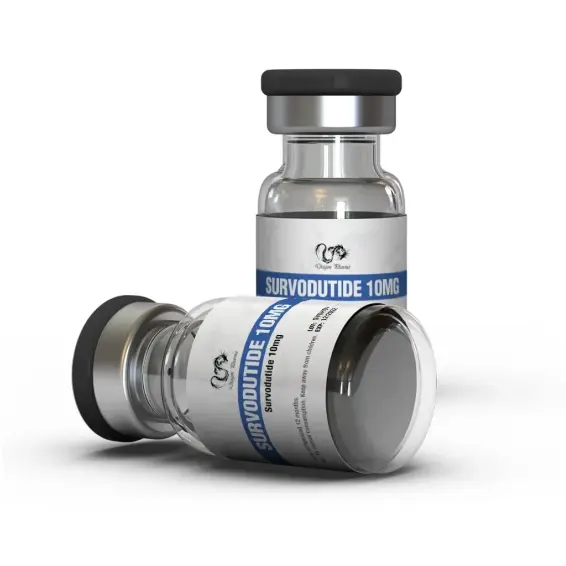
Survodutide — GLP-1/Glucagon Dual Agonist by Dragon Pharma
Survodutide (BI 456906) is Dragon Pharma's formulation of Boehringer Ingelheim's once-weekly GLP-1/Glucagon dual agonist at 10mg per vial — the Western pharmaceutical counterpart to Mazdutide in the GLP-1+Glucagon category, developed by one of the world's largest pharmaceutical companies with a clinical programme spanning both obesity and liver disease. Survodutide shares the GLP-1/Glucagon dual mechanism with Mazdutide but has distinct clinical data, particularly from its Phase II NASH programme — the most specific liver disease data of any compound in the Dragon Pharma weight management range.
Also searched as: Survodutide, BI 456906, Boehringer Ingelheim GLP-1 glucagon, Survodutide weight loss, Survodutide Dragon Pharma.
What Survodutide Is — Boehringer Ingelheim's GLP-1/Glucagon Agonist
Understanding Survodutide's developer and development context distinguishes it from other compounds in this category:
- Survodutide (internal code BI 456906) was developed by Boehringer Ingelheim — a privately held German pharmaceutical company and one of the world's 20 largest by revenue. This is a significantly different development context from Mazdutide (Innovent Biologics, China) and from the research peptide origins of most other compounds in this range
- Boehringer Ingelheim has a specific strategic focus on metabolic disease and liver conditions — the Survodutide programme reflects this, with parallel clinical development arms for obesity and non-alcoholic steatohepatitis (NASH/MAFLD)
- Survodutide uses a fatty acid conjugation approach for albumin binding — the same mechanism that extends Semaglutide's half-life to ~7 days — producing the once-weekly dosing profile
- Like all GLP-1/Glucagon dual agonists, Survodutide balances the appetite-suppressing, gastric-emptying-slowing effects of GLP-1R activation with the hepatic lipolysis and thermogenic energy expenditure effects of glucagon receptor activation
The NASH Clinical Programme — Survodutide's Specific Liver Data
This is Survodutide's most distinct clinical feature compared to other GLP-1+Glucagon compounds:
- Non-alcoholic steatohepatitis (NASH, now more commonly termed MASH — Metabolic dysfunction-Associated SteatoHepatitis) is a progressive liver disease involving inflammation and fibrosis on top of fatty liver — a condition with no approved treatments until very recently
- Boehringer Ingelheim conducted a dedicated Phase II trial of Survodutide in NASH/MASH patients — reporting results in 2023-2024 that showed significant improvements in liver histology (biopsy-confirmed reduction in inflammation and fibrosis) in a meaningful proportion of patients
- The liver fibrosis resolution rate from Survodutide's NASH Phase II provides a specific and measurable endpoint beyond body weight reduction — making it the compound with the most specific liver disease clinical data in the Dragon Pharma weight management range
- For AAS users specifically: AAS use — particularly oral 17-AA compounds and higher-dose injectable protocols — is associated with liver stress, elevated liver enzymes and in some cases NAFLD (non-alcoholic fatty liver disease). Survodutide's documented liver fibrosis reduction mechanism is directly relevant to this population
Survodutide Clinical Weight Loss Data
| Trial | Population | Dose | Weight Loss | Duration |
|---|---|---|---|---|
| Phase II (obesity, 2023) | Adults with obesity (BMI ≥30 or ≥27 with comorbidity) | 2.4–4.8 mg/week | ~14.9% body weight at highest dose | 46 weeks |
| Phase II (NASH, 2023–2024) | Adults with biopsy-confirmed NASH | Various | Significant hepatic fat and fibrosis reduction alongside weight loss | 48 weeks |
Survodutide vs Mazdutide — The GLP-1/Glucagon Comparison
Both are GLP-1/Glucagon dual agonists — the key distinctions are developer, clinical programme focus and regulatory trajectory:
| Parameter | Survodutide (BI 456906) | Mazdutide (IBI362/OXM3) |
|---|---|---|
| Developer | Boehringer Ingelheim (Germany) | Innovent Biologics (China) |
| Mechanism | GLP-1R + Glucagon receptor | GLP-1R + Glucagon receptor |
| Phase III obesity data | In progress (2024-2025) | GLORY-1: ~14% weight loss at 48 weeks |
| NASH/liver disease programme | Yes — Phase II histology data available | Hepatic fat reduction — less specific NASH data |
| Western regulatory pathway | Active — Boehringer Ingelheim pursuing EMA/FDA | Chinese NDA pathway primarily |
| Phase II weight loss | ~14.9% at 46 weeks (highest dose) | ~15.6% at 32 weeks (Phase II) |
| Primary differentiator | NASH/liver fibrosis clinical data; Western pharma development | Phase III obesity RCT completed |
The GLP-1/Glucagon Mechanism — Why It Matters
As with Mazdutide, understanding why Glucagon adds something GLP-1 alone cannot is essential:
- GLP-1 receptor activation: appetite suppression via hypothalamic signalling, gastric emptying delay, insulin secretagogue
- Glucagon receptor activation: direct hepatic lipolysis (triglyceride breakdown in liver), increased thermogenic energy expenditure, fatty acid oxidation upregulation — the mechanisms specifically relevant for liver fat reduction
- The GLP-1 component partially counteracts the hyperglycaemic effect of glucagon at therapeutic doses — producing the net glucose-neutral or mildly glucose-lowering combined effect that makes the combination clinically viable
Effects and Benefits
- ~14.9% body weight reduction over 46 weeks at highest Phase II dose
- Specific liver fibrosis and NASH improvement data — biopsy-confirmed histological benefit in Phase II NASH trial
- Direct hepatic lipolysis from glucagon receptor component — liver fat reduction alongside body weight reduction
- Increased thermogenic energy expenditure from glucagon receptor signalling
- No testosterone suppression — no PCT required
- Once-weekly dosing from the ~1-week half-life
Dosage and Administration
| Phase | Dose | Frequency | Notes |
|---|---|---|---|
| Starting | 0.6–1.2 mg/week | Once weekly | Allow 4 weeks before escalation; assess GI tolerance |
| Titration | 2.4 mg/week | Once weekly | Main Phase II dose — most weight loss data at this level |
| Higher dose | 4.8 mg/week | Once weekly | Highest Phase II dose — ~14.9% weight loss; more GI side effects |
At 10mg per vial, a 2.4mg/week protocol provides approximately 4 doses per vial. Reconstitute with bacteriostatic water. Store reconstituted vial refrigerated at 2-8°C for up to 28 days. Once-weekly injection can be taken at any time — consistency of day matters more than meal timing.
Side Effects
- Nausea — most common, particularly during escalation; consistent with GLP-1 class effects; gradual titration reduces severity
- Gastrointestinal effects — nausea, diarrhoea, vomiting; dose-dependent; typically subside after weeks 2-4 at each dose level
- No impact on testosterone, estrogen or the HPG axis
Reconstitution and Storage
Reconstitute with bacteriostatic water — add slowly along the vial wall and swirl gently. Store reconstituted vial refrigerated at 2-8°C for up to 28 days. Never freeze.
"Survodutide is the GLP-1/Glucagon dual agonist in the Dragon Pharma range developed by Boehringer Ingelheim — distinguished from Mazdutide by its specific Phase II NASH clinical programme with biopsy-confirmed liver fibrosis reduction data, making it the most liver-specific weight management compound we offer."
Stacking and Related Compounds
- Mazdutide — the Chinese-developed GLP-1/Glucagon dual agonist alternative; GLORY-1 Phase III data available; similar mechanism, different developer and clinical programme focus
- Tirzepatide — GLP-1/GIP dual agonist; strongest weight loss Phase III data; different receptor combination (GIP not Glucagon) covering a different metabolic pathway
- Cagrilintide — amylin analogue; complementary appetite suppression mechanism through area postrema; can be combined with GLP-1+Glucagon for triple-pathway coverage