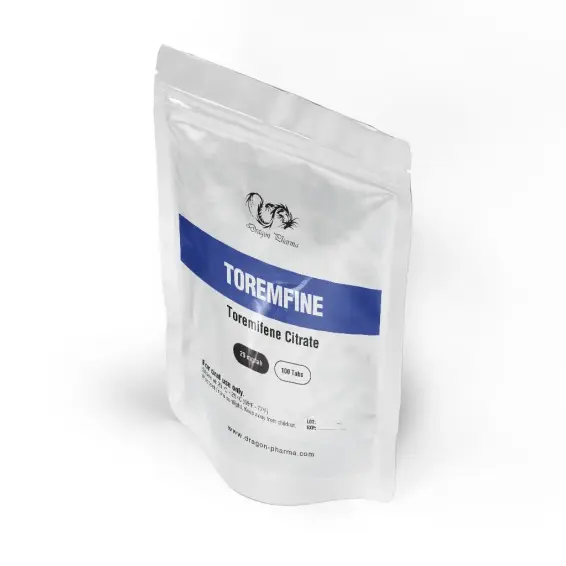
Toremifene Citrate (Toremfine) — Third-Generation SERM by Dragon Pharma
Toremifene Citrate (Toremfine, Fareston) is Dragon Pharma's formulation of the third-generation Selective Estrogen Receptor Modulator at 20mg per tablet — a structural analogue of Tamoxifen developed specifically to retain full SERM activity while reducing the genotoxic metabolites produced by Tamoxifen's hepatic metabolism. Toremifene is FDA-approved for breast cancer treatment and has been investigated specifically for prostate cancer prevention in men, making it the SERM with the most developed male-specific clinical data set. For AAS users, Toremifene offers the same PCT mechanism as Tamoxifen but with a safety profile that distinguishes it for men concerned with long-term use.
Also searched as: Toremifene Citrate 20mg, Toremfine, Fareston, Toremifene SERM PCT, Dragon Pharma Toremifene.
Toremifene vs Tamoxifen — The Structural Difference That Matters
Toremifene and Tamoxifen are structurally nearly identical — but one modification changes the safety calculus significantly:
- Toremifene differs from Tamoxifen by a single chlorine atom added to the ethyl side chain. This chlorination is not cosmetic — it fundamentally alters the hepatic metabolic pathway of the molecule
- Tamoxifen undergoes CYP3A4-mediated oxidation to form 3,4-epoxytamoxifen and α-hydroxytamoxifen — reactive intermediates that are genotoxic, capable of forming DNA adducts (covalent bonds with DNA) in liver tissue. These DNA adducts have been identified as the mechanism behind Tamoxifen's known (rare but documented) association with liver carcinogenicity in animal models and endometrial cancer risk in women
- The chlorination of Toremifene blocks this specific metabolic pathway — CYP3A4 cannot form the same genotoxic epoxide intermediates from Toremifene that it produces from Tamoxifen. Toremifene does not produce detectable DNA adducts in liver tissue at therapeutic doses in multiple studies
- The ERα antagonism — the mechanism responsible for both PCT effectiveness and gynecomastia prevention — is essentially equivalent between Toremifene and Tamoxifen at appropriate doses
Toremifene's Male-Specific Clinical Data
This is the information gap that most competitor content leaves entirely unfilled:
- FDA-approved for breast cancer: Toremifene (Fareston, Orion) received FDA approval for treatment of metastatic breast cancer in postmenopausal women — providing the regulatory foundation and extensive safety data of a fully approved pharmaceutical
- RADAR/REDEEM prostate cancer trials in men: Toremifene was specifically studied in men in the REDEEM trial — a Phase III randomised controlled trial investigating whether Toremifene could prevent progression from high-grade prostatic intraepithelial neoplasia (HGPIN) to prostate cancer in men. This makes Toremifene uniquely the SERM with a completed Phase III trial specifically in a male population, generating male pharmacokinetic and safety data that Tamoxifen's clinical history (primarily female breast cancer) does not provide
- The REDEEM trial used 20mg/day Toremifene in men — the same dose range relevant for AAS PCT — establishing tolerability in the male-specific context
SERM Comparison — Toremifene's Position
| Parameter | Toremifene (Toremfine) | Tamoxifen (Nolvadex) | Clomiphene (Clomid) |
|---|---|---|---|
| Generation | Third | First | First |
| Genotoxic metabolites | None detected — chlorination blocks pathway | Epoxide intermediates; DNA adducts in liver | No major genotoxic metabolites identified |
| ERα antagonism (breast/HPG) | Equivalent to Tamoxifen | Standard reference | Good — bilateral ER blockade |
| Male clinical trial data | Phase III REDEEM trial at 20mg/day in men | Primarily female breast cancer data | Male fertility and PCT history |
| Lipid effects | Favourable — LDL reduction, HDL preservation | Modest lipid benefit | Variable |
| FDA approval | Breast cancer (Fareston) | Breast cancer (Nolvadex) | Female infertility (Clomid) |
| Half-life | ~5–6 days | ~5–7 days (parent); ~14 days (Endoxifen) | ~5–7 days (mixed isomers) |
PCT Mechanism — How Toremifene Restores the HPG Axis
The PCT mechanism is identical to Tamoxifen and Clomid — ERα antagonism at the hypothalamus and pituitary:
- Estrogen exerts negative feedback on the HPG axis by binding ERα at the hypothalamus (suppressing GnRH) and pituitary (suppressing LH and FSH release). After an AAS cycle, elevated estrogen (from aromatisation of residual testosterone as exogenous AAS clears) sustains this suppression
- Toremifene blocks ERα at the hypothalamus and pituitary — removing this estrogen negative feedback signal. GnRH pulsatility resumes, driving LH and FSH recovery, which stimulates Leydig cell testosterone production
- Toremifene's ERα antagonism in breast tissue simultaneously provides gynecomastia protection during PCT
- The equivalent efficacy to Tamoxifen at comparable doses means Toremifene produces the same magnitude of LH/FSH stimulation with a potentially improved long-term safety profile
Lipid Profile Advantage
One practical advantage of Toremifene over AIs in the PCT context:
- AAS cycles — particularly those including 17-AA oral compounds — negatively impact lipid profiles (LDL elevation, HDL reduction). AIs used on-cycle worsen this further by eliminating estrogen's cardioprotective effects on lipids
- Toremifene, like Tamoxifen, acts as an estrogen agonist in hepatic tissue — producing favourable lipid effects including LDL reduction and HDL preservation. Studies in the REDEEM trial population demonstrated Toremifene's lipid benefits in men
- Transitioning from on-cycle AI to Toremifene-based PCT therefore provides lipid recovery support alongside HPG axis restart
Effects and Benefits
- HPG axis ERα antagonism — LH and FSH stimulation through hypothalamic/pituitary estrogen feedback removal; equivalent to Tamoxifen
- Gynecomastia prevention — breast tissue ERα blockade
- Reduced genotoxic metabolite production — key long-term safety distinction from Tamoxifen
- Favourable lipid profile — hepatic ER agonism; LDL reduction and HDL preservation
- Male-specific clinical data — Phase III REDEEM trial at 20mg/day in men
Dosage and Administration
| Protocol | Dose | Duration | Notes |
|---|---|---|---|
| PCT (standard) | 60mg/day → 40mg/day → 20mg/day | Week 1 at 60mg; weeks 2-3 at 40mg; weeks 4-6 at 20mg | Higher doses than Tamoxifen needed — different ERα binding kinetics |
| Gynecomastia prevention on-cycle | 20–40 mg/day | Throughout cycle as needed | Same breast ERα blockade mechanism as Tamoxifen |
Note: Toremifene requires higher doses than Tamoxifen to achieve equivalent ERα blockade because Toremifene — unlike Tamoxifen — is not significantly converted to a higher-potency metabolite equivalent to Endoxifen. Where Tamoxifen's active metabolite Endoxifen is 30-100× more potent than the parent, Toremifene's activity is more directly driven by the parent compound at its plasma concentration. Standard Toremifene PCT dosing uses 60mg/day initially (versus Tamoxifen's 40mg/day) to achieve comparable ERα occupancy.
PCT Combination Context
- Clomid — combined SERM PCT; Toremifene + Clomid at reduced individual doses covers HPG axis at complementary receptor binding profiles
- HCG 5000IU — Leydig cell maintenance pre-PCT or during cycle; same complementary role as with Tamoxifen-based PCT
"Toremifene's chlorinated structure eliminates the genotoxic epoxide metabolites produced by Tamoxifen's hepatic metabolism — with equivalent HPG axis ERα blockade and the only SERM with a completed Phase III trial specifically in men at 20mg/day, it represents the most pharmacologically refined SERM option for male AAS users."
Storage and Handling
Store Toremifene at room temperature, away from direct sunlight and moisture. Keep in original packaging until use.