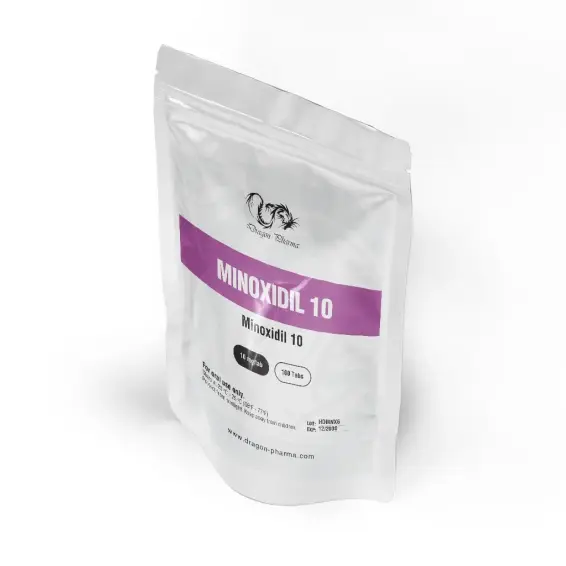
Minoxidil 10mg Oral Tablets by Dragon Pharma
Minoxidil is Dragon Pharma's formulation of oral Minoxidil at 10mg per tablet — a potassium channel opener originally developed as an antihypertensive medication, whose hair growth effect was discovered as a side effect and subsequently became the primary use case. Supplied in a 100-tablet pack, oral Minoxidil at low doses is increasingly preferred over topical application for androgenic alopecia, including AAS-accelerated hair loss.
Also searched as: Oral Minoxidil 10mg, Minoxidil tablets, Rogaine oral, Minoxidil Dragon Pharma.
The Origin of Minoxidil — Accidental Discovery
Minoxidil's history is one of the most well-documented examples of a drug repurposed from an unexpected side effect — a genuine information gap in most competitor content:
- Minoxidil was developed in the 1960s by Upjohn as an oral antihypertensive medication (trade name "Loniten") — its cardiovascular mechanism as a vasodilator made it effective for hypertension management
- During clinical trials for hypertension, physicians noted significant hair growth in patients — including on the scalp in men who had experienced hair loss — as an unexpected finding
- Upjohn subsequently investigated and developed Minoxidil specifically for topical hair loss treatment ("Rogaine"), which became the first FDA-approved hair loss medication in 1988
- Oral Minoxidil remained available for hypertension but was largely overlooked for hair loss until recent dermatology research (particularly 2019-2024) established that low-dose oral Minoxidil (0.25-5mg/day) is more effective than topical for many patients and has a more favourable side effect profile at these doses than the original antihypertensive doses (20-40mg/day)
How Minoxidil Actually Works — The KATP Channel Mechanism
The standard description of Minoxidil as "improving blood flow to hair follicles" is technically accurate but incomplete — the underlying mechanism is more specific:
- Minoxidil is a potassium channel opener — specifically, it opens ATP-sensitive potassium channels (KATP channels) in smooth muscle cells
- In blood vessels, KATP channel opening causes smooth muscle relaxation and vasodilation — the antihypertensive mechanism
- In hair follicles, KATP channels are present in dermal papilla cells (the cells at the base of the follicle that control hair growth cycling). Minoxidil's activation of these channels stimulates dermal papilla cells to produce growth signals including VEGF (vascular endothelial growth factor) and other follicle-active signalling molecules
- The result is prolongation of the anagen (growth) phase of the hair cycle and miniaturisation reversal — follicles that have been shrinking due to DHT-driven miniaturisation are partially rescued by the Minoxidil-driven dermal papilla activation
- Crucially: Minoxidil does not block DHT or androgen receptors — it does not address the cause of androgenic alopecia, only counteracts some of its effects on the follicle cycle
Oral vs Topical Minoxidil — Why Oral Is Increasingly Preferred
Recent dermatology research has shifted clinical practice toward low-dose oral Minoxidil — a development largely absent from competitor content:
| Parameter | Oral Minoxidil (low dose) | Topical Minoxidil (2-5%) |
|---|---|---|
| Application | Once daily tablet | Applied to scalp 1-2× daily |
| Compliance | Higher — no scalp application ritual | Lower — messy, time-consuming, often missed |
| Efficacy | Multiple studies show superior or equivalent hair regrowth at low oral doses vs topical | Established efficacy; FDA-approved route |
| Systemic absorption | Consistent — predictable blood levels | Variable — depends on scalp condition, application technique |
| Scalp irritation | Not applicable | Common — scaling, itching in significant subset of users |
| Body/facial hair growth | Possible side effect at higher oral doses | Possible from transfer via hands |
| Blood pressure effect | Mild reduction possible at 5mg+; minimal at 1-2.5mg | Minimal systemic absorption at 2-5% concentration |
Minoxidil in the Context of AAS Use — The Androgenic Hair Loss Problem
For users running androgenic anabolic steroids, hair loss acceleration is one of the most common cosmetic concerns — and Minoxidil's role in managing this is directly relevant:
- DHT-driven miniaturisation is the mechanism behind androgenic alopecia. AAS that convert to DHT (testosterone-derived compounds) or have high intrinsic androgenic activity accelerate this miniaturisation in genetically predisposed users
- Compounds with the highest hair loss risk: Trenbolone (binds AR very strongly), Winstrol (DHT-derived), Halotestin (very high androgenic ratio)
- Finasteride (5-alpha-reductase inhibitor blocking DHT conversion) does not work against Trenbolone, Winstrol or other compounds that are already DHT derivatives — they don't require 5-AR conversion. Minoxidil remains effective regardless of which compound is driving the alopecia, because it works downstream of the DHT signal at the follicle level
- Minoxidil is therefore often the most broadly applicable hair loss countermeasure for AAS users — particularly those running compounds where Finasteride provides no protection
Dosage and Administration
| Protocol | Daily Dose | Notes |
|---|---|---|
| Low dose (starting) | 1.25–2.5 mg/day | Tablet split; most common dermatology protocol |
| Standard oral dose | 2.5–5 mg/day | Evidence-based for androgenic alopecia |
| High dose (this tablet) | 5–10 mg/day | Full 10mg tablet; original antihypertensive range — monitor BP |
Dragon Pharma's 10mg tablet is above the standard low-dose oral Minoxidil protocol (0.25-5mg/day) used in dermatology for hair loss. The 10mg tablet can be split — most hair loss protocols use 1.25-5mg/day, making this tablet suitable for 2-8 days of dosing per tablet depending on the dose chosen. At 10mg/day (full tablet), blood pressure monitoring is advisable given Minoxidil's cardiovascular vasodilatory mechanism.
Side Effects
- Fluid retention and lower extremity oedema — more common at higher doses; typically mild at the low doses used for hair loss
- Blood pressure reduction — the antihypertensive mechanism is present at all doses; relevant for AAS users whose blood pressure may already be managed
- Hypertrichosis (unwanted body or facial hair growth) — common at higher oral doses; less common at 1-2.5mg/day
- Increased heart rate — possible at higher doses due to reflex tachycardia from vasodilation
- No hormonal effects — does not affect testosterone, DHT levels, estrogen or the HPG axis
Minoxidil Alongside Other Hair Loss Strategies
- Finasteride — 5-alpha-reductase inhibitor blocking DHT conversion from testosterone; complementary mechanism to Minoxidil; effective for testosterone-driven alopecia but not for DHT-derived AAS compounds
- Reducing androgenic load — switching to compounds with lower androgenic ratings (Anavar, Turinabol) addresses the source directly
"Oral Minoxidil represents a shift in how hair loss management is approached — recent dermatology evidence showing superior compliance and equivalent or better efficacy over topical application has made the oral route the increasingly preferred option for consistent long-term use."
Storage and Handling
Store Minoxidil tablets at room temperature, away from direct sunlight and moisture. Keep the original packaging sealed until use to maintain tablet potency.