SLU-PP-332 — ERRα/β/γ Pan-Agonist Exercise Mimetic by Dragon Pharma
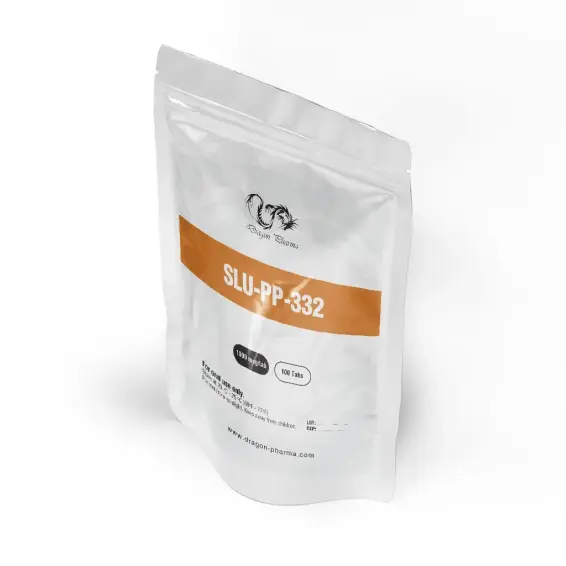
SLU-PP-332 is Dragon Pharma's formulation of the ERR pan-agonist at 1000mcg per tablet — a small molecule developed at Scripps Research Institute and published in Science (2023) that activates all three estrogen-related receptors (ERRα, ERRβ and ERRγ) simultaneously to drive mitochondrial biogenesis, oxidative metabolism and endurance adaptations. It is important to correct the classification: SLU-PP-332 is not a SARM — it does not bind androgen receptors and produces no androgenic anabolic effects. It is an exercise mimetic that replicates metabolic adaptations of aerobic training through an entirely different receptor system.
Also searched as: SLU-PP-332, ERR agonist endurance, exercise mimetic compound, SLU PP 332 Dragon Pharma, Cardarine alternative.
The Critical Classification — Why SLU-PP-332 Is Not a SARM
This misclassification matters because it sets completely wrong expectations about what the compound does:
- SARMs (Selective Androgen Receptor Modulators) bind androgen receptors — they produce anabolic effects in muscle and bone by activating AR-mediated gene expression for protein synthesis, myogenesis and hypertrophy
- SLU-PP-332 binds ERRα, ERRβ and ERRγ — Estrogen-Related Receptors. Despite the name, ERRs are not estrogen receptors and are not activated by estrogen. They are transcription factors that regulate mitochondrial function, oxidative phosphorylation gene expression and metabolic adaptation to exercise
- SLU-PP-332 does not produce the anabolic muscle building effects of SARMs — it does not increase muscle protein synthesis through AR activation, does not build mass, and does not suppress testosterone
- What it does produce is the endurance and metabolic phenotype of aerobic training — more mitochondria per cell, increased oxidative capacity, improved fat oxidation and enhanced stamina — through ERR-mediated transcriptional regulation
The ERR System — What These Receptors Do
ERRs are orphan nuclear receptors with no known endogenous hormonal ligand — they are active constitutively and modulated by co-activator proteins:
- ERRα — the most studied; regulates expression of genes involved in oxidative phosphorylation, fatty acid oxidation and mitochondrial biogenesis; highly expressed in cardiac and skeletal muscle; co-activator PGC-1α (the master regulator of mitochondrial biogenesis) works primarily through ERRα
- ERRβ — expressed in tissues with high energy demand; involved in mitochondrial function in neural and cardiac tissue; less studied than ERRα
- ERRγ — highly expressed in skeletal muscle and heart; regulates oxidative metabolism genes; expression increases with endurance exercise training — ERRγ is a key mediator of the trained muscle phenotype
- SLU-PP-332 activates all three simultaneously — a pan-agonist — producing broader and more complete ERR-mediated transcriptional activation than selective agonists targeting a single subtype
The 2023 Science Paper — What the Research Shows
SLU-PP-332 has a specific and recent peer-reviewed evidence base from its founding publication:
- Dierickx et al. (Science, 2023) reported that SLU-PP-332 administration in sedentary mice significantly increased mitochondrial content in skeletal muscle, shifted muscle fibre type composition toward oxidative type I fibres, and increased running endurance by approximately 70% compared to vehicle-treated controls
- The endurance improvement was achieved without exercise training — SLU-PP-332 alone in sedentary animals produced the mitochondrial and fibre-type adaptations that normally require weeks of aerobic training
- Cardiac analysis showed no toxicity signal at effective doses — distinguishing it from GW501516 (Cardarine) which showed concerning tumour promotion in animal carcinogenicity studies at high doses
- The paper described SLU-PP-332 as activating the ERRα-PGC-1α axis — the same pathway that aerobic exercise activates — establishing it as a genuine exercise mimetic rather than a simple stimulant or vasodilator
SLU-PP-332 vs GW-501516 (Cardarine) — The Comparison
SLU-PP-332 is frequently compared to Cardarine as the "next generation" endurance compound:
| Parameter | SLU-PP-332 | GW-501516 (Cardarine) |
|---|---|---|
| Target receptor | ERRα, ERRβ, ERRγ (all three) | PPARδ |
| Primary mechanism | Mitochondrial biogenesis via ERR/PGC-1α axis | Fatty acid oxidation gene upregulation via PPARδ |
| Endurance effect | ~70% running improvement in mice (Science 2023) | Significant endurance improvement in animals |
| Carcinogenicity concern | Not observed at effective doses in 2023 data | GSK discontinued 2007 — tumour promotion in animal studies |
| Fibre type shift | Yes — toward oxidative type I fibres | Partial — primarily metabolic not structural |
| Human data | None — preclinical only (2023) | None — discontinued before human trials |
| Classification | ERR pan-agonist / exercise mimetic | PPARδ agonist / exercise mimetic |
Effects and Benefits
- Mitochondrial biogenesis — increased mitochondrial density in skeletal muscle without training
- Oxidative fibre type shift — promotes type I (slow-twitch, fatigue-resistant) fibre characteristics
- Endurance enhancement — the primary documented effect; ~70% improvement in running capacity in sedentary animal models
- Fat oxidation upregulation — ERR activation drives fatty acid oxidation gene expression
- No androgenic anabolic effects — no mass building, no testosterone suppression, no PCT required
- No estrogen effects — ERRs are not activated by estrogen despite the naming
Dosage and Administration
| Protocol | Dose | Frequency | Notes |
|---|---|---|---|
| Endurance / exercise mimetic | 1,000–2,000 mcg/day | Once daily | No established human protocol — animal dosing guides current use |
At 1000mcg per tablet, one tablet per day is the baseline protocol. Human dosing for SLU-PP-332 is not established by clinical trials — protocols are entirely extrapolated from the 2023 mouse study dosing. This is a research compound at an early stage — the absence of human trials means individual responses are unknown and the safety profile in humans is uncharacterised. Users should approach this compound with this context fully understood.
Important Context — Research Stage
SLU-PP-332 is significantly earlier in development than most other compounds in the Dragon Pharma range:
- The foundational Science (2023) paper represents the first major publication — follow-up studies in 2024-2025 are beginning to appear but the compound is at preclinical stage only
- No human pharmacokinetic data, no human safety studies, no established human dosing — the compound is being used extrapolated entirely from animal research
- The absence of GSK-style carcinogenicity concerns at effective doses in the 2023 data is a relative positive versus Cardarine — but it is not equivalent to established safety; it is simply the absence of a specific known concern
- GW-501516 Cardarine remains the better-characterised endurance compound with more extensive (if also more concerning) animal data; SLU-PP-332 offers a potentially safer mechanism but with considerably less data
"SLU-PP-332 is not a SARM — it is an ERR pan-agonist that activates the ERRα-PGC-1α mitochondrial biogenesis axis that aerobic exercise training naturally engages, producing the endurance phenotype of training without the training itself."
Related Compounds
- GW-501516 Cardarine — the PPARδ-targeting endurance compound; more extensive (though discontinued) animal data; different receptor mechanism from SLU-PP-332
- Acadesine (AICAR) — AMPK activator with overlapping exercise-mimetic metabolic effects via different pathway; some users combine both for complementary endurance mechanisms
- MOTS-c — mitochondrial-derived peptide also activating AMPK through folate cycle; complementary mitochondrial support to SLU-PP-332's ERR-driven biogenesis