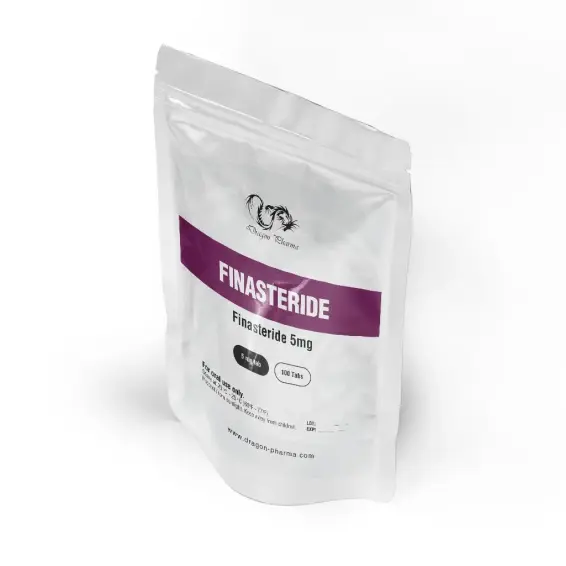
Finasteride 5mg by Dragon Pharma
Finasteride is Dragon Pharma's formulation of the 5-alpha reductase type II inhibitor at 5mg per tablet — the highest clinically used dose, originally indicated for benign prostatic hyperplasia (BPH) under the brand name Proscar, and available at 1mg (Propecia) specifically for androgenic alopecia. Finasteride reduces serum DHT by approximately 70% by blocking the enzyme that converts testosterone to dihydrotestosterone. In AAS contexts, Finasteride protects against hair loss from testosterone-derived compounds — but its application is strictly limited by a critical mechanistic constraint.
Also searched as: Finasteride 5mg, Propecia, Proscar, 5-alpha reductase inhibitor hair loss, Finasteride Dragon Pharma.
How Finasteride Works — The 5-Alpha Reductase Mechanism
Finasteride's mechanism is precise and its limitation follows directly from understanding it:
- Testosterone is converted to dihydrotestosterone (DHT) by the enzyme 5-alpha reductase type II — primarily in the scalp, prostate and skin. DHT binds androgen receptors in hair follicles with approximately 3-5× greater affinity than testosterone and is the primary driver of androgenic alopecia in genetically predisposed individuals
- Finasteride competitively and irreversibly inhibits 5-alpha reductase type II — blocking the testosterone → DHT conversion step and reducing circulating and scalp DHT by approximately 70% within 24 hours of the first dose
- With reduced DHT reaching hair follicles, the miniaturisation process slows or halts — in many users, some hair retention or regrowth is achieved over 6-12 months of consistent use
- Finasteride does not block androgen receptors and does not affect testosterone levels — it specifically targets the conversion enzyme
The Critical AAS Limitation — Which Compounds Finasteride Cannot Protect Against
This is the most important and most consistently omitted piece of information in competitor content on Finasteride for AAS users:
- Finasteride only works against compounds that require 5-alpha reductase conversion to produce their androgenic effect in the scalp — specifically testosterone
- Many AAS are already DHT derivatives or structurally modified compounds that do not require 5-AR conversion — Finasteride is completely ineffective against their androgenic scalp activity:
| Compound | Finasteride Effective? | Reason |
|---|---|---|
| Testosterone (all esters) | Yes — primary use case | Converts to DHT via 5-AR; blocking conversion reduces scalp DHT |
| Trenbolone | No | Does not convert via 5-AR; already has high intrinsic androgenic activity |
| Winstrol (Stanozolol) | No | DHT-derived — no 5-AR conversion required |
| Masteron (Drostanolone) | No | DHT-derived — no 5-AR conversion required |
| Anavar (Oxandrolone) | No | DHT-derived — no 5-AR conversion required |
| Dianabol (Methandienone) | No | Converts via 5-AR but to a less potent metabolite — not significantly protective |
| Nandrolone (Deca/NPP) | Counterproductive | 5-AR converts Nandrolone to a weaker metabolite — blocking this makes Nandrolone's scalp activity worse |
Practical implication for AAS users: Finasteride provides meaningful hair protection only during testosterone-only or testosterone-dominant cycles where DHT conversion from testosterone is the primary androgenic hair loss driver. In cycles containing Trenbolone, Winstrol, Masteron or other DHT derivatives, Finasteride adds no hair protection and may provide a false sense of security.
1mg vs 5mg — The Two Dose Distinctions
Finasteride is clinically available at two doses with different indications:
- Finasteride 1mg (Propecia) — FDA-approved specifically for androgenic alopecia (male pattern baldness). At 1mg/day, approximately 60-70% DHT reduction is achieved — close to the maximum possible reduction from Finasteride regardless of dose
- Finasteride 5mg (Proscar, this formulation) — FDA-approved for BPH (benign prostatic hyperplasia). At 5mg/day, approximately 70% DHT reduction is achieved — marginally more than 1mg in some studies but the difference is not clinically significant for hair loss
- For hair loss specifically, the 5mg tablet offers no meaningful advantage over 1mg — 1mg is already near the ceiling of achievable DHT reduction. The 5mg tablet is typically split to quarters (1.25mg) or halves (2.5mg) by users wanting Propecia-equivalent dosing at lower cost per milligram
Post-Finasteride Syndrome — The Reported Persistent Side Effects
A honest presentation of Finasteride requires acknowledging this contested but documented phenomenon:
- Post-Finasteride Syndrome (PFS) refers to a cluster of persistent side effects — including sexual dysfunction (reduced libido, erectile dysfunction, anorgasmia), depression, cognitive effects and other neurological symptoms — reported by some users that persist after stopping Finasteride
- The frequency of PFS is disputed — estimates range from very rare to affecting a significant minority of users depending on the source. The mechanism proposed involves DHT's role as a neurosteroid precursor and DHT's reduction potentially causing lasting neuroendocrine changes in some individuals
- The Post-Finasteride Syndrome Foundation (PFSF) has advocated for broader recognition; regulatory bodies including the EMA and FDA have updated labelling to include persistent sexual side effects
- In the context of AAS use, the existing hormonal complexity makes it difficult to isolate Finasteride's contribution to any side effects — this is an important consideration
Effects and Benefits
- ~70% reduction in serum and scalp DHT — the primary and specific effect
- Slowing or halting of androgenic alopecia driven by testosterone-to-DHT conversion
- Prostate size reduction in BPH at 5mg — the original clinical indication
- No testosterone suppression — does not affect the HPG axis directly
Dosage and Administration
| Use Case | Dose | Notes |
|---|---|---|
| Hair loss prevention (Propecia equivalent) | 1–1.25 mg/day (¼ tablet) | Split the 5mg tablet; near-maximum DHT reduction at 1mg |
| Higher dose hair loss | 2.5 mg/day (½ tablet) | No significant additional benefit over 1mg for hair; may increase side effect risk |
| BPH (original indication) | 5 mg/day (1 tablet) | Full tablet; clinical BPH indication |
For hair loss — the primary AAS user application — splitting the 5mg tablet to 1-1.25mg/day provides equivalent DHT reduction to the brand-name 1mg Propecia at significantly lower cost per dose. Effects on hair loss take 3-6 months to assess — early discontinuation before this window does not represent a fair trial. Finasteride must be taken continuously — stopping resumes DHT production and hair loss progression resumes within months.
Side Effects
- Sexual dysfunction — reduced libido, erectile dysfunction — reported in approximately 1-3% of users in clinical trials; may resolve on discontinuation or persist (see PFS above)
- Reduced ejaculate volume — common at 5mg; less common at 1mg
- Breast tenderness or mild gynecomastia — rare; from altered androgen:estrogen ratio
- Mild testosterone elevation — blocking DHT conversion slightly increases circulating testosterone (which would otherwise have been converted)
Hair Loss Management in AAS Context
- Finasteride 5mg — effective only for testosterone-driven hair loss; ineffective against DHT-derived AAS compounds
- Minoxidil 10mg — works downstream of DHT via KATP channel mechanism; effective regardless of which compound drives the alopecia — the most broadly applicable hair loss countermeasure for AAS users
- GHK-Cu — dermal papilla activation for follicle enlargement; complementary to both Finasteride and Minoxidil
"Finasteride 5mg provides near-maximum DHT reduction at quarter-tablet dosing (1.25mg) — the 5mg formulation allows cost-effective Propecia-equivalent dosing for continuous use during testosterone cycles where DHT-driven hair loss is the concern."
Storage and Handling
Store Finasteride at room temperature, away from direct sunlight and moisture. Women who are or may be pregnant must not handle crushed or broken Finasteride tablets — the compound is absorbed through skin and poses a risk to male foetal development.