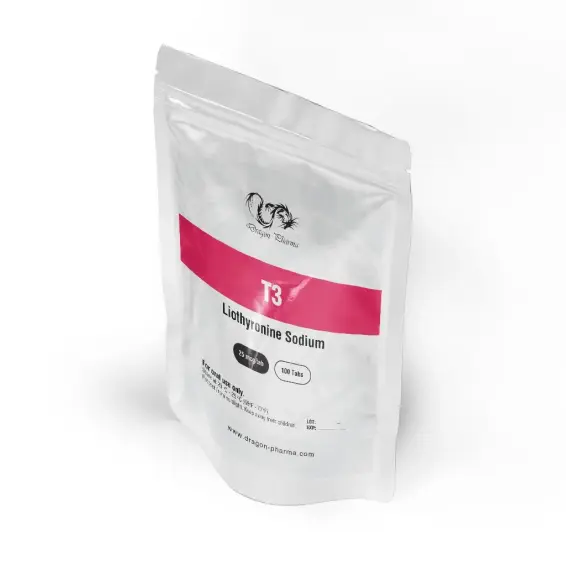
Liothyronine Sodium (T3) 25mcg by Dragon Pharma
T3 is Dragon Pharma's formulation of Liothyronine Sodium — synthetic triiodothyronine — at 25mcg per tablet. T3 is the active form of thyroid hormone that directly binds thyroid hormone receptors in cells throughout the body, regulating basal metabolic rate at the gene expression level. It is the most powerful BMR-elevating compound in the Dragon Pharma range — more potent than both Clenbuterol and Salbutamol at the metabolic level, and the only one that acts through thyroid receptor gene regulation rather than adrenergic receptor signalling.
Also searched as: T3 25mcg, Liothyronine Sodium, Cytomel, Tiromel, T3 fat loss Dragon Pharma.
T3 vs T4 — The Active Form Distinction
The thyroid gland produces two hormones: T4 (thyroxine, levothyroxine) and T3 (triiodothyronine, liothyronine). Their relationship is frequently misunderstood:
- T4 (Levothyroxine) is the primary secretory product of the thyroid gland — approximately 80-90% of thyroid output is T4. However, T4 is largely a prohormone — it has weak direct thyroid receptor activity itself
- T3 (Liothyronine) is the biologically active form — it binds thyroid hormone receptors (TRα and TRβ) with approximately 3-4× greater affinity than T4. Most T4 is converted to T3 in peripheral tissues (primarily liver and kidney) by deiodinase enzymes that remove one iodine atom
- Exogenous T3 bypasses the T4→T3 conversion step entirely — it delivers the active hormone directly to thyroid receptors without relying on peripheral deiodinase activity
- This is why T3 produces a more immediate and potent metabolic effect than equivalent doses of T4 — there is no conversion step limiting its bioavailability at the receptor
- T3's ~2.5 day half-life also allows faster dose titration than T4's ~7-day half-life — making T3 more practical for the short cycling windows used in performance contexts
How T3 Elevates Basal Metabolic Rate — The Mechanism
T3 is the most potent metabolic accelerator in the Dragon Pharma range. Unlike Clenbuterol and Salbutamol which act on adrenergic receptors, T3 acts directly at the genetic level:
- T3 enters cells and binds thyroid hormone receptors (TRα and TRβ) in the cell nucleus — nuclear receptors that directly regulate gene transcription
- T3-receptor complexes bind thyroid response elements (TREs) in the promoter regions of hundreds of metabolic genes — directly upregulating or downregulating their expression
- Key genes activated: Na⁺/K⁺-ATPase (increases futile ion cycling, generating heat); uncoupling proteins (increase mitochondrial heat production); enzymes of fatty acid oxidation, glucose metabolism and amino acid catabolism
- The result is a global acceleration of cellular metabolic activity — increased oxygen consumption, increased heat generation and increased nutrient turnover across all tissues simultaneously
- This mechanism is systemic and non-selective — unlike Clenbuterol which primarily targets adipose tissue and skeletal muscle via beta-2 receptors, T3 accelerates metabolism in every cell type with thyroid receptors — which is essentially all cells
T3 vs Clenbuterol vs Salbutamol — The Three-Way Metabolic Comparison
| Parameter | T3 (Liothyronine) | Clenbuterol | Salbutamol |
|---|---|---|---|
| Receptor target | Thyroid hormone receptors TRα/TRβ (nuclear) | Beta-2 adrenergic receptor | Beta-2 adrenergic receptor |
| Mechanism | Gene transcription regulation — systemic | cAMP signalling — thermogenic | cAMP signalling — thermogenic |
| BMR elevation | Most potent — systemic metabolic acceleration | Moderate — 5-10% above baseline | Mild — less potent than Clenbuterol |
| Muscle catabolism risk | High — accelerates all energy substrate catabolism | Low — anti-catabolic via mTOR | Low — anti-catabolic via mTOR |
| Receptor downregulation | Does not downregulate — sustained efficacy | ~50% in 2 weeks — cycling required | Partial — slower than Clenbuterol |
| Axis suppression | Yes — suppresses TSH and T4 production | None | None |
| Discontinuation | Must taper — abrupt stop risks rebound hypothyroidism | Can stop abruptly | Can stop abruptly |
Why T3 Must Be Tapered — The Thyroid Axis Recovery
This is the most clinically important aspect of T3 use and the least adequately explained in competitor content:
- Exogenous T3 suppresses the HPT (hypothalamic-pituitary-thyroid) axis through negative feedback — elevated T3 signals the hypothalamus and pituitary to reduce TRH (thyrotropin-releasing hormone) and TSH (thyroid-stimulating hormone) output
- Without TSH signalling, the thyroid gland reduces T3 and T4 production — the gland partially atrophies during prolonged suppression
- When exogenous T3 is stopped abruptly, there is a window where: exogenous T3 has cleared, natural TSH production has not yet recovered, and the thyroid gland has not yet resumed full output. This creates a transient hypothyroid state — low metabolism, fatigue, cold sensitivity and potential fat rebound
- Gradual tapering allows TSH to recover progressively as exogenous T3 doses decline — the thyroid axis restores function in step with the reducing exogenous load rather than facing an abrupt withdrawal
- The standard taper: reduce dose by 12.5-25mcg every 1-2 weeks until reaching the lowest dose before stopping
Effects and Benefits
- Significant BMR elevation — the most potent non-stimulant metabolic accelerator available
- Accelerated fat loss when combined with caloric deficit — systemic nutrient turnover acceleration
- No receptor downregulation — efficacy maintained throughout the cycle (unlike beta-2 agonists)
- Conversion of T4-based metabolism to active T3 signalling without reliance on peripheral conversion
Dosage and Administration
| Phase | Dose | Duration | Notes |
|---|---|---|---|
| Initiation | 25 mcg/day (1 tab) | 1–2 weeks | Assess tolerance; single tab is starting dose |
| Maintenance | 50–75 mcg/day | 4–6 weeks | Most commonly used range |
| Advanced | 75–125 mcg/day | 4 weeks maximum | High catabolic risk; AAS base essential |
| Taper | Reduce by 25 mcg every 1–2 weeks | 2–4 weeks | Never stop abruptly |
At 25mcg per tablet, dosing is straightforward — the 25mcg tablet is both the starting dose and the standard taper increment. Twice-daily dosing at the maintenance phase (e.g. 25mcg morning + 25mcg midday) distributes the dose across T3's ~2.5-day half-life more evenly, though once-daily dosing is also commonly used. T3's catabolic potential at doses above 50mcg/day makes an AAS testosterone base strongly advisable to protect lean mass.
Side Effects
- Muscle catabolism — T3 accelerates all energy substrate metabolism including protein; lean mass loss alongside fat loss is a significant risk at higher doses without an AAS base
- Elevated heart rate and palpitations — thyroid-mediated cardiac stimulation; monitor heart rate throughout
- Sweating and heat intolerance — inevitable consequence of elevated metabolic rate
- Anxiety and tremors at higher doses — sympathomimetic-like central effects
- Transient hypothyroidism post-cycle if not tapered correctly
T3 in a Fat Loss Protocol
- Enantat 250 or Propionat 100 as AAS base — essential at doses above 50mcg/day to counter T3's muscle-catabolic effects
- Clenbuterol alongside T3 — complementary mechanisms (thyroid vs beta-2); the combination is the basis of the CYT3 blend
- Anavar for additional lean mass protection during aggressive T3 protocols
"T3 at 25mcg per tablet is formulated at the standard starting and taper increment — the same tablet serves initiation, maintenance (at 2-3 tabs daily) and gradual discontinuation, covering the full T3 protocol lifecycle from a single 100-tab pack."
Storage and Handling
Store T3 at room temperature, away from direct sunlight and moisture. Keep the original packaging sealed until use to maintain tablet potency.