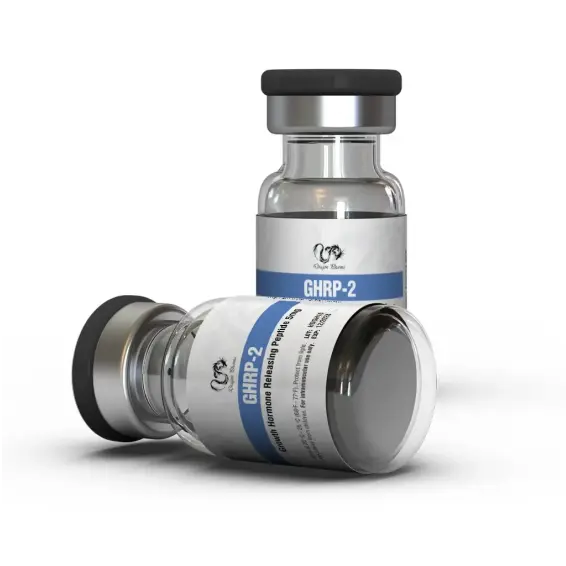
GHRP-2 (Pralmorelin) — Second Most Potent GHRP by Dragon Pharma
GHRP-2 (Growth Hormone Releasing Peptide-2, Pralmorelin) is Dragon Pharma's formulation of the second-most-potent GHS-R1a agonist at 5mg per vial — occupying the position between Hexarelin (most potent, fastest desensitisation) and Ipamorelin (mildest, cleanest profile) in the GHRP hierarchy. GHRP-2 (Pralmorelin) is also the only GHRP to have received clinical approval — in Japan, as a diagnostic test for GH deficiency — providing it with human pharmacokinetic data that most other GHRPs lack.
Also searched as: GHRP-2 5mg, Pralmorelin, GHRP 2 peptide, GHRP-2 Dragon Pharma.
GHRP-2's Clinical History — The Diagnostic Use in Japan
GHRP-2's regulatory history distinguishes it from other GHRPs:
- GHRP-2 (Pralmorelin, brand name GHRP Kaken 100) received regulatory approval in Japan for a specific clinical indication: as a diagnostic stimulation test for GH deficiency in children and adults. This is analogous to the GHRH stimulation test used in Western clinical practice but using a GHRP mechanism
- The diagnostic test involves injecting 100mcg GHRP-2 intravenously and measuring the GH response — a robust GH pulse indicates intact pituitary GH secretory capacity; a blunted response indicates GH deficiency
- This clinical application generated extensive human pharmacokinetic data: GHRP-2 at 1mcg/kg IV produces peak GH levels of approximately 40-80 ng/ml in GH-sufficient adults — confirming its potent GH-stimulating capacity in humans
- The Japanese approval also provided formal safety data in human populations — not the surrogate animal safety data that most performance peptides rely on
GHRP-2 in the GHRP Hierarchy
GHRP-2's position requires specific comparison to understand when to choose it over alternatives:
| Parameter | GHRP-2 | Hexarelin | GHRP-6 | Ipamorelin |
|---|---|---|---|---|
| GH potency | High | Highest | Moderate-High | Moderate |
| Cortisol elevation | Moderate | Significant | Moderate | Minimal |
| Prolactin elevation | Moderate | Significant | Moderate | Minimal |
| Appetite stimulation | Mild-moderate | Mild | Pronounced | None |
| Desensitisation | Moderate | Fast (4–8 weeks) | Moderate | Minimal |
| Clinical approval | Yes — Japan diagnostic | No | No | No |
| Best use | High GH with moderate side effects; diagnostic-grade potency | Max GH pulse; short cycles | Bulking — appetite + GH | Clean long-term GH |
The Appetite Mechanism — Two Different Ghrelin Pathways
GHRP-2's appetite stimulation operates through a specific pathway that most competitor content doesn't distinguish from the GH-releasing effect:
- GHS-R1a (the growth hormone secretagogue receptor) is expressed in two key locations: in somatotroph cells of the anterior pituitary (where activation releases GH) and in the hypothalamus and gut (where activation regulates hunger and appetite)
- GHRP-2 activates GHS-R1a at both locations simultaneously — the pituitary activation drives GH secretion; the hypothalamic/gut activation mimics ghrelin's hunger-stimulating signal
- GHRP-2's appetite stimulation is notably milder than GHRP-6, which is known for pronounced and sometimes uncomfortable hunger. GHRP-2's appetite effect is mild-to-moderate — present but not as prominent as GHRP-6's
- For users in caloric deficit or attempting a lean bulk, GHRP-2's mild appetite stimulation can assist with hitting caloric targets without the overwhelming hunger that GHRP-6 produces
GHRP-2 and Cortisol/Prolactin — The Moderate Side Effect Profile
This is the key balance point that places GHRP-2 between Hexarelin and Ipamorelin:
- GHRPs stimulate GH release through GHS-R1a but the signalling cascade also activates ACTH release (leading to cortisol) and prolactin release — effects that are receptor-subtype and downstream pathway dependent
- GHRP-2 at standard doses (100-300mcg) produces cortisol elevation of approximately 30-50% above baseline and moderate prolactin increases — meaningful but substantially less than Hexarelin's more significant cortisol and prolactin response
- This cortisol elevation is dose-dependent — lower doses (50-100mcg) produce less cortisol co-secretion. Some protocols use lower GHRP-2 doses specifically to maintain potent GH stimulation while limiting cortisol
- For long-term continuous use, the moderate cortisol elevation is a consideration — Ipamorelin's negligible cortisol effect makes it preferable for extended protocols where cortisol management matters
Effects and Benefits
- High GH pulse amplitude — second to Hexarelin; substantially higher than Ipamorelin at equivalent doses
- Clinically validated potency — human pharmacokinetic data from Japanese diagnostic studies; ~40-80 ng/ml peak GH in GH-sufficient adults at 1mcg/kg IV
- Mild-to-moderate appetite stimulation — useful for caloric target support without GHRP-6's overwhelming hunger effect
- Moderate desensitisation profile — longer viable continuous use than Hexarelin before cycling is required
- Synergistic with GHRH analogues — 3-5× GH amplification when combined with CJC-1295 no DAC or Tesamorelin
- No testosterone suppression — no PCT required
Dosage and Administration
| Protocol | Dose | Frequency | Notes |
|---|---|---|---|
| Standard GH stimulation | 100–200 mcg | 2–3× daily | Fasted injection; before bed for sleep GH pulse |
| Lower cortisol profile | 50–100 mcg | 2–3× daily | Reduced cortisol co-secretion at lower doses |
At 5mg per vial and 100mcg per injection dosed 2× daily, one vial provides 25 days of dosing. Fasted injection (2+ hours post-meal) maximises GH pulse amplitude — food, particularly carbohydrates and fat, blunts the GH response. Reconstitute with bacteriostatic water. Store refrigerated at 2-8°C after reconstitution for up to 28 days.
Stacking GHRP-2
- CJC-1295 no DAC — GHRH partner for 3-5× synergistic GH amplification; inject simultaneously with GHRP-2 for maximal GH pulse
- Ipamorelin — can alternate GHRP-2 and Ipamorelin across the day to balance potency and cortisol exposure; e.g. GHRP-2 pre-workout (potency when it matters) and Ipamorelin before bed (clean pulse during sleep)
- Hexarelin — for users wanting the full GHRP potency spectrum: Hexarelin for 4-6 week maximum GH cycles, GHRP-2 as the moderate-potency continuous option between Hexarelin cycles
Reconstitution and Storage
Reconstitute with bacteriostatic water — add slowly along the vial wall and swirl gently. Store reconstituted vial refrigerated at 2-8°C for up to 28 days. Never freeze.
"GHRP-2 (Pralmorelin) is the only GHRP in the Dragon Pharma range with clinical approval — its diagnostic use in Japan generated the human pharmacokinetic data that confirms its GH-stimulating potency in vivo, positioning it as the second-strongest GHRP with a more sustainable cortisol profile than Hexarelin."