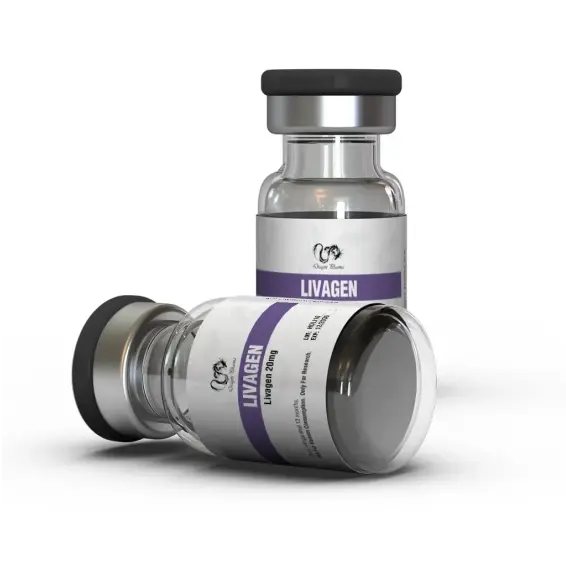
Livagen — Immune Bioregulator Tetrapeptide by Dragon Pharma
Livagen (Lys-Glu-Asp-Ala) is Dragon Pharma's formulation of the immune system bioregulator tetrapeptide at 20mg per vial — one of the Khavinson peptide bioregulator series developed at the St. Petersburg Institute of Bioregulation and Gerontology by Vladimir Khavinson and colleagues over four decades. Unlike most peptides in the range that target specific receptors or enzymes, Livagen operates through an epigenetic mechanism — direct DNA demethylation that reactivates gene expression patterns suppressed with age, with specific affinity for lymphoid and immune tissue.
Also searched as: Livagen peptide, Lys-Glu-Asp-Ala, Livagen bioregulator, Khavinson peptide immune, Livagen Dragon Pharma.
What Bioregulator Peptides Are — The Khavinson Classification
Livagen belongs to a specific and distinct category that most competitor content fails to explain:
- Bioregulator peptides (also called "cytomaxes" or Khavinson peptides) are a class of short peptides — predominantly di-, tri- and tetrapeptides — originally isolated from organ and tissue extracts by Vladimir Khavinson's team at the Russian Academy of Medical Sciences beginning in the 1970s-1980s
- The original hypothesis: different tissues contain tissue-specific short peptides that act as endogenous regulatory signals, modulating gene expression in those tissues. As organisms age, concentrations of these regulatory peptides decline, contributing to tissue dysfunction
- The bioregulators are tissue-specific — Livagen is derived from lymphoid/immune tissue and acts preferentially on immune system gene expression; other bioregulators in the Khavinson series target pineal tissue (Epithalon), thymus, cardiovascular tissue, etc.
- Unlike conventional receptor-targeting peptides, bioregulators interact directly with chromatin — binding to DNA sequences and histones to influence whether specific genes are expressed or silenced
The Epigenetic Mechanism — DNA Demethylation
Livagen's mechanism at the molecular level is epigenetic — a class of mechanism distinct from all other peptides in the Dragon Pharma range:
- DNA methylation is an epigenetic modification where methyl groups are added to cytosine bases in the promoter regions of genes — methylated promoters typically silence gene expression, preventing the gene from being transcribed into protein
- With aging, patterns of DNA methylation change significantly — many genes that should be active become hypermethylated (silenced), including genes involved in immune function, DNA repair and cellular homeostasis. This age-related hypermethylation is one of the molecular hallmarks of aging (one of the "hallmarks of aging" clocks)
- Livagen (Lys-Glu-Asp-Ala) has been shown in Khavinson's laboratory research to promote DNA demethylation in lymphoid cells — removing the methyl groups that are silencing genes and restoring more youthful gene expression patterns in immune tissue
- This is fundamentally different from receptor agonism or enzyme inhibition — Livagen acts at the epigenetic level, potentially restoring the transcriptional landscape of aging immune cells toward a younger phenotype
Livagen and the Immune System — Specific Tissue Affinity
Livagen's tissue specificity for the immune system has several specific documented effects:
- Lymphocyte activity — Khavinson's research documented increased lymphocyte proliferative response in aged subjects receiving bioregulator peptides including Livagen-related compounds; immune cells in older individuals showed improved functional responses after treatment
- Chromatin decondensation in lymphocytes — opening of chromatin structure allows previously silenced genes to become accessible for transcription; Livagen was shown to produce this effect specifically in lymphoid cells
- In animal longevity studies from the Khavinson group, combinations of bioregulator peptides including immune-targeted bioregulators extended lifespan in rodents by 20-40% — though the specific contribution of each peptide versus the combinations is difficult to isolate from this research
- The immune system relevance for AAS users: prolonged suppressive AAS cycles, particularly those involving immunosuppressive compounds or high cortisol periods, can impair immune function. Livagen's immune-restorative mechanism provides a targeted recovery tool during or after such cycles
Livagen vs Epitalon — The Bioregulator Comparison
| Parameter | Livagen | Epitalon |
|---|---|---|
| Sequence | Lys-Glu-Asp-Ala (tetrapeptide) | Ala-Glu-Asp-Gly (tetrapeptide) |
| Primary tissue target | Immune / lymphoid tissue | Pineal gland / systemic telomerase |
| Primary mechanism | DNA demethylation in lymphocytes | Telomerase activation; melatonin regulation |
| Primary anti-aging effect | Immune system restoration; gene reactivation | Telomere lengthening; circadian restoration |
| Research origin | Khavinson / St. Petersburg Institute | Khavinson / St. Petersburg Institute |
| Best combination use | Immune support; post-cycle immune recovery | Longevity; sleep; telomere preservation |
Effects and Benefits
- Epigenetic gene reactivation — DNA demethylation restoring suppressed gene expression in lymphoid cells
- Immune system restoration — improved lymphocyte function and proliferative response documented in aging models
- Chromatin remodelling in immune tissue — opening previously silenced genomic regions in lymphocytes
- Potential longevity contribution — in context of broader bioregulator peptide longevity research
- No testosterone suppression — no PCT required
Dosage and Administration
| Protocol | Dose | Frequency | Duration |
|---|---|---|---|
| Anti-aging / longevity | 100–200 mcg | Daily or every other day | 10–20 day courses, 1-2× yearly |
| Immune support | 100–200 mcg | Daily | 10–14 day course |
Bioregulator peptides are typically used in defined courses rather than continuously — 10-20 day intensive protocols, repeated 1-2 times per year, following the course-based approach used in Khavinson's research. At 20mg per vial and 200mcg per dose, one vial provides 100 doses — approximately 3 months of daily dosing or multiple annual courses. Reconstitute with bacteriostatic water. Store reconstituted vial refrigerated at 2-8°C for up to 28 days.
Side Effects
- No significant side effects documented in Khavinson's research programme — bioregulator peptides are among the most studied compounds in the Russian longevity research literature without documented adverse effects
- No hormonal effects — no testosterone, estrogen or HPG axis interaction
- No PCT required
Stacking and Related Compounds
- Epitalon — the most widely researched Khavinson bioregulator; telomerase activation complements Livagen's epigenetic immune restoration for comprehensive anti-aging coverage
- Thymosin Alpha-1 — immune system peptide through a different mechanism (thymic T-cell maturation); complementary immune support alongside Livagen's epigenetic approach
- BPC-157 — systemic recovery peptide; combining BPC-157's tissue repair with Livagen's immune system restoration provides both structural and immune recovery support
Reconstitution and Storage
Reconstitute with bacteriostatic water — add slowly along the vial wall and swirl gently. Store reconstituted vial refrigerated at 2-8°C for up to 28 days. Never freeze.
"Livagen operates through DNA demethylation — restoring gene expression patterns in aging lymphoid cells that have been epigenetically silenced, rather than activating a receptor. It is the immune system-targeted entry point in the Khavinson bioregulator series."