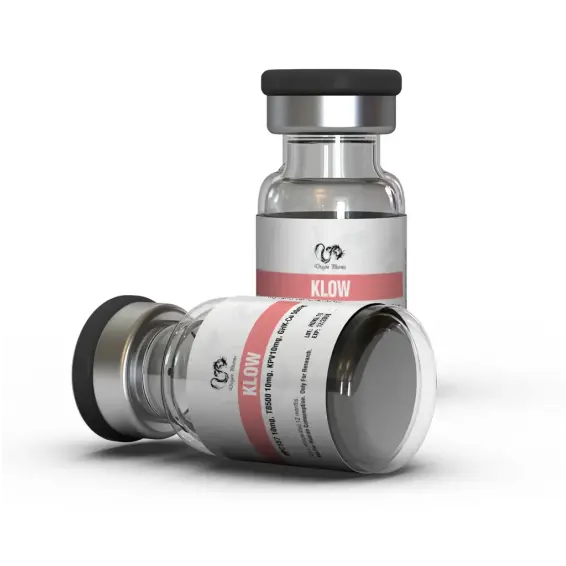
Klow Blend 80mg — BPC-157, TB-500, KPV and GHK-Cu by Dragon Pharma
Klow Blend is Dragon Pharma's advanced 4-peptide formulation combining BPC-157, TB-500, KPV and GHK-Cu in a single 80mg vial. Each component works through a distinct mechanism — localised tissue repair, systemic recovery, immune modulation and collagen-driven skin regeneration — covering a broader spectrum of recovery and repair than any single peptide or two-component blend can achieve.
Also searched as: Klow Blend 80mg, BPC-157 TB-500 KPV GHK-Cu blend, 4-peptide recovery blend, Klow Blend Dragon Pharma.
The Four Components — Mechanisms and Roles
Understanding why these four peptides are combined requires understanding what each one does and — critically — what the others cannot:
| Peptide | Mechanism | Primary Role in Blend | Unique Contribution |
|---|---|---|---|
| BPC-157 | Upregulates growth hormone receptors; promotes angiogenesis and VEGF activity | Localised tendon, ligament and gut repair | Most effective near the injury site; the only component with documented gut-protective properties |
| TB-500 | Thymosin Beta-4 fragment; promotes actin polymerisation and cell migration to damaged tissue | Systemic tissue repair and anti-inflammation | Works systemically regardless of injection site; reaches injuries BPC-157 cannot when site injection isn't practical |
| KPV | Alpha-MSH-derived tripeptide; binds MC1R and MC3R receptors; reduces NF-κB pathway activation | Anti-inflammatory and immune modulation | The only component specifically targeting immune-driven inflammation; addresses gut and skin inflammation through a different pathway than BPC-157 |
| GHK-Cu | Copper tripeptide; upregulates collagen, elastin and glycosaminoglycan synthesis; activates TGF-β | Skin regeneration and collagen repair | The only component with documented effects on skin quality and hair growth; functions at concentrations as low as 1 nanomolar |
Why These Four Together — The Information Gap
Most peptide blends combine compounds from the same functional category — BPC-157 + TB-500 is a local + systemic pairing within the same tissue repair category. Klow Blend extends beyond this by adding two compounds from entirely different functional categories:
- BPC-157 + TB-500 — cover tissue repair from complementary angles (localised vs systemic)
- KPV — addresses the immune-inflammatory component of recovery, which tissue repair peptides alone do not. Chronic low-grade inflammation is increasingly recognised as a limiting factor in tissue healing — particularly relevant in AAS users where systemic inflammatory markers can be elevated
- GHK-Cu — activates collagen and extracellular matrix remodelling at the protein synthesis level, which is distinct from the wound-healing and cell migration mechanisms of BPC-157 and TB-500
The result is a blend covering four distinct biological pathways simultaneously: localised growth factor signalling (BPC-157), systemic cell migration (TB-500), NF-κB immune pathway modulation (KPV), and TGF-β collagen remodelling (GHK-Cu).
KPV — The Least Known Component
KPV (Lys-Pro-Val) is a C-terminal tripeptide fragment of alpha-melanocyte-stimulating hormone (α-MSH). Unlike BPC-157 or TB-500 which are widely discussed in bodybuilding contexts, KPV remains less well-known despite a meaningful body of research:
- KPV binds melanocortin receptors MC1R and MC3R — receptors involved in systemic anti-inflammatory signalling
- Studies have demonstrated KPV reduces intestinal inflammation through direct NF-κB pathway inhibition — a mechanism distinct from BPC-157's gut protection via gastric protein pathways
- KPV has demonstrated wound healing activity in dermal tissue, complementing GHK-Cu's collagen synthesis role
- Unlike most anti-inflammatory compounds, KPV achieves its effects at very low doses without the immunosuppressive risks associated with corticosteroids
GHK-Cu — Concentration and Potency
GHK-Cu (Copper Tripeptide-1) is notable for its extreme biological potency at very low concentrations — active effects have been documented at concentrations of 1 nanomolar (0.000001 mg/ml), making it one of the most potent naturally occurring peptides by molar concentration. Its primary roles in the blend:
- Stimulates collagen and glycosaminoglycan synthesis in fibroblasts — rebuilding extracellular matrix damaged by training or injury
- Activates antioxidant defence via superoxide dismutase upregulation
- Promotes skin barrier repair and wound healing complementary to KPV's anti-inflammatory action
Effects and Benefits
- Localised tissue repair from BPC-157 near injury sites
- Systemic recovery support throughout the body from TB-500
- Immune-inflammatory modulation via KPV's NF-κB pathway action
- Collagen and extracellular matrix remodelling from GHK-Cu
- Skin quality and regeneration support
- No suppression of natural testosterone — does not require Post Cycle Therapy
Dosage and Administration
| Protocol | Typical Dose | Frequency |
|---|---|---|
| General recovery and skin support | 500 mcg – 1 mg | Daily or every other day |
| Acute injury or inflammation | 1–2 mg | Daily for 2–4 weeks |
Because the blend contains both localised (BPC-157) and systemic (TB-500, KPV, GHK-Cu) components, injection site location has a moderate effect — injecting near a specific injury or area of concern takes advantage of BPC-157's localised mechanism, while the remaining three components work systemically regardless. Reconstitute with bacteriostatic water and dose based on total blend volume.
Klow Blend vs Other Dragon Pharma Recovery Peptides
- Klow Blend (4-peptide, 80mg) — the most comprehensive recovery blend covering tissue repair, systemic recovery, immune modulation and collagen remodelling simultaneously
- BPC-157 + TB-500 Blend — focused tissue repair stack (localised + systemic) without the immune and collagen remodelling components
- BPC-157 standalone — localised repair only
- TB-500 standalone — systemic recovery only
Reconstitution and Storage
Klow Blend is supplied as a lyophilised powder requiring reconstitution with bacteriostatic water. Add bacteriostatic water slowly along the vial wall and swirl gently — do not shake. Store reconstituted vial refrigerated at 2-8°C, stable for approximately 28-30 days. Never freeze a reconstituted peptide vial.
"Klow Blend was developed to address the full recovery spectrum — not just tissue repair but the immune-inflammatory and collagen remodelling components that single-compound or two-component blends leave unaddressed. It is the most advanced recovery formulation in our peptide range."
Stacking and Related Compounds
Klow Blend is often combined with:
- Dragontropin (HGH) for users adding direct GH elevation to a comprehensive recovery protocol
- Ipamorelin for GH secretagogue support alongside peptide recovery
- Glow Blend for users combining recovery with skin and beauty-focused peptide protocols