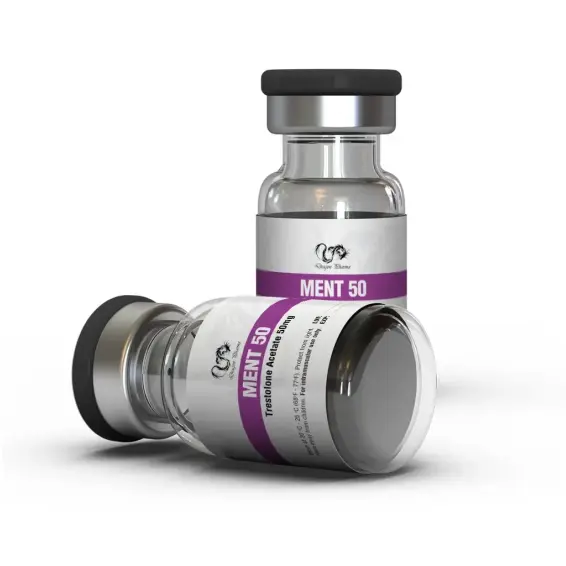
Trestolone Acetate — MENT 50 by Dragon Pharma
MENT 50 is Dragon Pharma's formulation of Trestolone Acetate (7α-methyl-19-nortestosterone, MENT) at 50mg/ml — one of the most anabolically potent injectable compounds available, with an anabolic ratio of approximately 2,300 versus testosterone's baseline of 100. MENT is a 19-nor steroid with unique properties: it does not require a testosterone base, it does not convert to DHT, and it aromatises to a specific estrogen metabolite (7α-methyl-estradiol) that requires specific management. Its history as an NIH-researched male contraceptive provides more human clinical data than most black-market compounds.
Also searched as: Trestolone Acetate 50mg, MENT injection, 7α-methyl-19-nortestosterone, MENT Dragon Pharma.
What MENT Is — The 7α-Methyl-19-Nor Structure
MENT's chemical structure explains its unique pharmacological profile:
- MENT is 7α-methyl-19-nortestosterone — derived from nortestosterone (the base structure of Nandrolone) with an additional 7α-methyl group added
- The 19-nor component (removal of the C-19 methyl group) gives MENT the same receptor binding profile as Nandrolone in some respects — high affinity for androgen and progestin receptors
- The 7α-methyl group differentiates MENT from Nandrolone in two critical ways: it dramatically increases the compound's resistance to 5-alpha-reductase (the enzyme that would convert it to a less potent DHT-like metabolite) and it significantly increases androgenic potency at the AR itself
- Because MENT is 5-AR resistant, the 5-AR inhibitor Finasteride has no effect on it — it does not convert to a weaker DHT metabolite in scalp or prostate tissue via 5-AR. However, its intrinsic androgenic ratio (650) is already substantial without conversion
MENT's History as a Male Contraceptive
Unlike most compounds in performance use, MENT has documented human clinical trial history:
- MENT was investigated from the 1990s through 2000s by the National Institutes of Health and international partners as a potential male hormonal contraceptive — specifically because of its combination of complete HPG suppression (effective sperm suppression) with adequate androgenic replacement without the conversion to DHT that limits testosterone's contraceptive utility
- Clinical trials demonstrated that MENT at low doses (400-700mcg/day implant) effectively suppressed spermatogenesis and provided androgenic replacement — confirming that MENT does not require a testosterone base, as it provides sufficient androgenic environment by itself
- This clinical programme generated human pharmacokinetic, safety and hormonal data that provides a more rigorous evidence base than most performance-context compounds have
- Development was ultimately deprioritised due to commercial factors rather than safety concerns — but the published data remains available in the peer-reviewed literature
Why MENT Can Be Used Without a Testosterone Base
This is one of the most operationally significant and least-explained aspects of MENT:
- The standard AAS rule is: always include a testosterone base because other AAS suppress natural testosterone and testosterone is required for androgenic health functions (libido, sexual function, mood)
- MENT is an exception: its androgenic ratio (650) and high AR affinity mean it provides the androgenic environment that testosterone normally supplies. It suppresses natural testosterone completely — but replaces its function via its own androgenic activity
- The NIH male contraceptive trials specifically demonstrated that MENT alone (without testosterone) maintained androgenic health markers in men — validating its use as a standalone compound
- In practice: MENT can be run as the sole injectable compound in a cycle, without Testosterone Propionate or Enanthate. Many users do stack MENT with testosterone for mass building, but the testosterone base is not required for androgenic wellbeing as it is with Trenbolone, Nandrolone, or other suppressive compounds
The Aromatisation Problem — 7α-Methyl-Estradiol
MENT aromatises — but to a specific estrogen metabolite that creates a unique management challenge:
- MENT converts to 7α-methyl-estradiol (7α-Me-E2) via aromatase — the same enzyme that converts testosterone to regular estradiol
- 7α-Methyl-estradiol is a more potent estrogen receptor agonist than regular estradiol — it binds ERα with approximately 4-5× greater potency than standard E2
- This means MENT's estrogenic side effects can be pronounced even at what appear to be modest serum estrogen levels by standard assay — because the 7α-methyl-estradiol produced by MENT is more estrogenic per unit than the estradiol that standard blood tests measure
- Standard estradiol blood tests do not detect 7α-methyl-estradiol — meaning serum estrogen panels may appear normal while estrogenic side effects (gynecomastia, water retention) are occurring from the unmeasured 7α-Me-E2
- Aromatase inhibitors (Arimidex, Aromasin) block the aromatase enzyme and will reduce MENT's conversion to 7α-Me-E2 — but dosing is difficult to calibrate without a specific assay for 7α-Me-E2
MENT vs Testosterone — The Potency Comparison
| Parameter | MENT (Trestolone) | Testosterone |
|---|---|---|
| Anabolic ratio | 2,300 | 100 |
| Androgenic ratio | 650 | 100 |
| 5-AR conversion | Resistant — 7α-methyl blocks | Full conversion to DHT |
| Aromatisation | Yes — to 7α-methyl-estradiol (more potent) | Yes — to regular estradiol |
| Progestin activity | Significant — 19-nor | Minimal |
| Testosterone base needed | No — provides androgenic environment itself | Is the base |
| Suppression | Complete HPG suppression | Dose-dependent suppression |
Effects and Benefits
- Exceptional anabolic potency — anabolic ratio of 2,300 produces rapid and significant lean mass gains
- Can be used as the sole injectable — no testosterone base required
- 5-AR resistant — no DHT conversion in prostate or scalp (though intrinsic androgenic ratio is already significant)
- Faster-acting than long-ester compounds due to Acetate ester (~8-hour half-life) allowing frequent dosing and rapid dose adjustment
- Complete HPG suppression making it effective as a male contraceptive at sub-performance doses
Dosage and Administration
| Experience Level | Daily Dose | Weekly Total | Frequency | Cycle Length |
|---|---|---|---|---|
| Intermediate (first MENT cycle) | 25–50 mg/day | 175–350 mg/week | Daily or EOD | 6–8 weeks |
| Advanced | 50–75 mg/day | 350–525 mg/week | Daily | 6–8 weeks |
MENT Acetate's ~8-hour half-life necessitates daily injection for stable blood levels — or at minimum every-other-day. At 50mg/ml, 0.5-1ml per day is the common injection volume range. Given the potency and the 7α-Me-E2 aromatisation issue, starting conservatively (25mg/day) and assessing estrogen-related side effects before escalating is strongly advisable. Arimidex or Aromasin is typically required given the enhanced estrogenic potency of 7α-Me-E2.
Side Effects
- Estrogenic — gynecomastia and water retention risk is pronounced despite potentially normal serum E2 levels, due to 7α-methyl-estradiol's higher ER potency. AI management is essential
- Progestin activity from 19-nor structure — prolactin elevation possible; Cabergoline may be needed alongside AI
- Complete HPG suppression — Post Cycle Therapy required after the cycle; recovery may take longer than from testosterone due to the deep suppression
- Androgenic effects — acne, potential hair loss despite 5-AR resistance (intrinsic androgenic ratio of 650 is significant)
PCT and Protocol
- PCT begins 3-5 days after last Acetate injection — short ester clears quickly
- Clomid and Nolvadex for PCT — MENT's complete suppression may require a longer PCT course than standard AAS
- HCG during cycle or bridging to PCT is advisable given the depth of HPG suppression
"MENT 50 delivers the highest anabolic-to-injection-volume ratio in the Dragon Pharma injectable range — an anabolic ratio of 2,300 with a short Acetate ester for daily dosing control and the unique property of not requiring a testosterone base for androgenic wellbeing."
Storage and Handling
Store MENT 50 at room temperature, away from direct sunlight and heat. Use sterile technique for every draw.