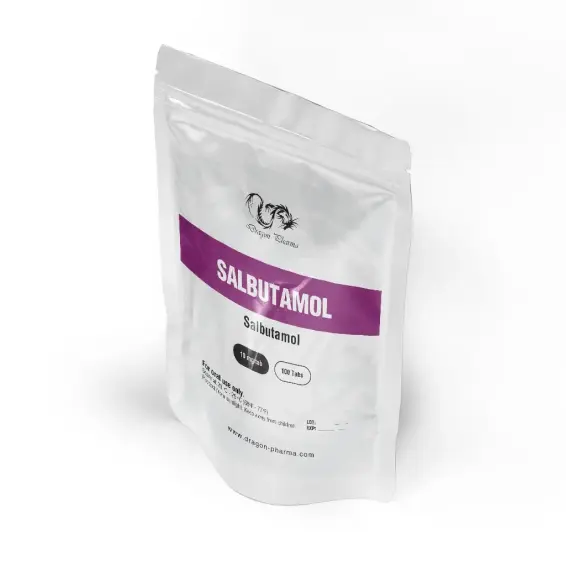
Salbutamol (Albuterol) 10mg by Dragon Pharma
Salbutamol (known as Albuterol in the US) is Dragon Pharma's formulation of oral Salbutamol at 10mg per tablet — a short-acting beta-2 adrenergic agonist originally developed as a bronchodilator, used in performance contexts for its thermogenic, lipolytic and anti-catabolic properties. At 10mg per tablet, this is a high-dose oral formulation — significantly above standard asthma dosing — designed for users seeking the systemic beta-2 effects rather than bronchodilation alone.
Also searched as: Albuterol 10mg, Salbutamol tablets oral, Albuterol oral fat loss, Salbutamol Dragon Pharma.
Salbutamol vs Clenbuterol — The Critical Pharmacological Differences
Salbutamol and Clenbuterol are both beta-2 agonists and are frequently compared, but their pharmacological profiles differ in several important ways that affect how they are used:
| Parameter | Salbutamol (Albuterol) | Clenbuterol |
|---|---|---|
| Beta receptor selectivity | Highly beta-2 selective — minimal beta-1 activity | Beta-2 predominant but less selective than Salbutamol |
| Half-life (oral) | ~4–6 hours | ~35–40 hours |
| Receptor downregulation | Faster downregulation — receptors recover between doses due to short half-life | Slower downregulation — long half-life maintains constant receptor occupation |
| Dosing frequency | 3–4× daily for sustained effect | Once daily (half-life too long for multiple doses) |
| 2-week on/off cycling | Less strictly required — short half-life allows partial receptor recovery between doses | Required — continuous receptor occupation causes 50% downregulation within 2 weeks |
| Cardiovascular impact | Generally considered milder — higher beta-2 selectivity means less beta-1 cardiac stimulation | More pronounced cardiac effects at equivalent doses |
| Thermogenic potency | Moderate — less potent per dose than Clenbuterol | More potent thermogenic per dose |
Why Salbutamol's Short Half-Life Changes the Receptor Dynamic
This is the most important pharmacological distinction and the least explained in competitor content:
- Clenbuterol's ~35-40 hour half-life means it is present at active concentrations 24 hours a day — beta-2 receptors are continuously occupied, driving the well-documented 50% downregulation within 2 weeks that necessitates the 2-week on/off cycling protocol
- Salbutamol's ~4-6 hour half-life means there are natural low-concentration windows between doses — beta-2 receptors are not continuously saturated and have time for partial recovery
- The practical consequence: Salbutamol users often run it continuously without strict 2-week cycling, instead relying on the natural trough periods between doses to prevent the degree of receptor downregulation Clenbuterol produces
- This does not mean receptor downregulation is absent with Salbutamol — it occurs, but at a slower and more manageable rate that the short half-life partially accommodates
Oral vs Inhaled Salbutamol — An Important Distinction
Salbutamol is most commonly known as an inhaled medication (Ventolin inhaler) for asthma. Oral Salbutamol at 10mg represents a fundamentally different application:
- Inhaled Salbutamol reaches the airway at very low systemic concentrations — the goal is local bronchodilation with minimal systemic absorption. A standard inhaled dose is 100-200mcg, producing local airway effect with very little reaching systemic circulation
- Oral Salbutamol at 10mg enters the bloodstream systemically — producing the full range of beta-2 effects throughout the body including adipose tissue (lipolysis), skeletal muscle (anti-catabolism), and the cardiovascular system
- The dose difference is approximately 50-100× — 10mg oral vs 0.1-0.2mg inhaled — reflecting the different goals and pharmacokinetics of each route
Effects and Benefits
- Thermogenic effect — increased basal metabolic rate via beta-2 receptor activation in adipose tissue (less potent than Clenbuterol per dose)
- Lipolytic activity — hormone-sensitive lipase (HSL) activation driving fatty acid release from adipocytes
- Anti-catabolic effect in skeletal muscle — beta-2 receptor activation reduces muscle protein breakdown via mTOR pathway stimulation, same mechanism as Clenbuterol
- Bronchodilation — vasodilation of airways, improving oxygen delivery during training
- Higher beta-2 selectivity than Clenbuterol — potentially milder cardiovascular side effects at equivalent anabolic doses
- No suppression of natural testosterone — does not require Post Cycle Therapy
Dosage and Administration
| Protocol | Daily Dose | Frequency | Notes |
|---|---|---|---|
| Standard fat loss | 16–32 mg/day | 3–4× daily (4–8mg per dose) | Split doses to maintain blood levels |
| Conservative start | 8–16 mg/day | 2–3× daily | Assess tolerance before escalating |
At 10mg per tablet, the Dragon Pharma formulation delivers a high per-tablet dose — the 10mg tablet is typically split for the lower doses or taken whole for higher-dose protocols. Due to the ~4-6 hour half-life, 3-4 daily doses maintain more stable blood levels than once-daily dosing would provide. Morning and pre-workout dosing is preferred for the later doses — the sympathomimetic stimulation affects sleep if taken in the evening.
Side Effects
- Tremors — dose-dependent; beta-2 receptor stimulation in skeletal muscle causing involuntary contractions; typically reduces as receptor tolerance develops
- Elevated heart rate — beta-2 agonism has some beta-1 cross-reactivity at higher doses despite Salbutamol's higher selectivity
- Headaches — common at higher doses; related to vasodilation
- Muscle cramps — same taurine depletion mechanism as Clenbuterol; taurine supplementation at 3-5g/day is recommended
- Hypokalemia (low potassium) at high doses — beta-2 agonists drive potassium into cells; potassium supplementation may be needed at higher doses
- No impact on testosterone, estrogen or the HPG axis — no PCT required
Salbutamol vs Clenbuterol — Which to Choose
- Choose Salbutamol when: cardiovascular sensitivity to Clenbuterol is a concern; strict 2-week cycling is impractical; a more manageable receptor profile is preferred; airway performance during training is a specific goal
- Choose Clenbuterol 40mcg when: maximum thermogenic potency per dose is the priority; once-daily dosing convenience is preferred; the 2-week on/off protocol is feasible
Building a Fat Loss Protocol Around Salbutamol
- Testosterone Propionate or Enantat 250 as an AAS base to protect lean mass during caloric deficit
- Anavar for additional anti-catabolic protection during aggressive cutting
- Taurine 3-5g/day throughout to prevent muscle cramps
- Potassium supplementation at higher doses to offset hypokalemia risk
"Salbutamol 10mg is formulated for systemic oral use — the same beta-2 mechanism as Clenbuterol with higher receptor selectivity and a shorter half-life that allows a different cycling approach and a potentially more manageable cardiovascular profile."
Storage and Handling
Store Salbutamol at room temperature, away from direct sunlight and moisture. Keep the original packaging sealed until use to maintain tablet potency.