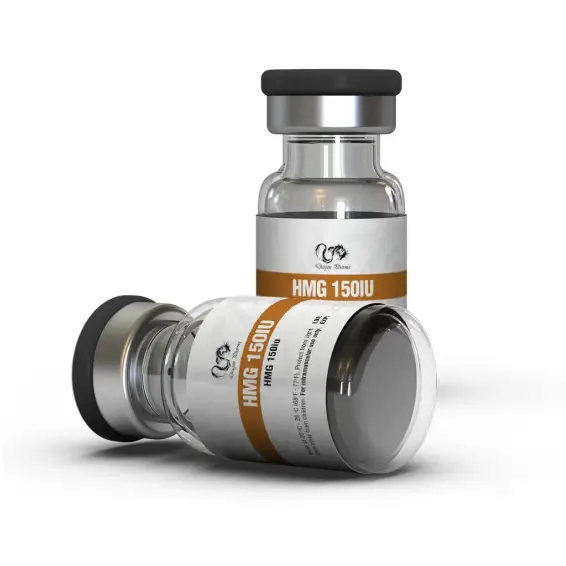
HMG 150IU — Human Menopausal Gonadotropin by Dragon Pharma
HMG 150IU (Human Menopausal Gonadotropin, Menotropin) is Dragon Pharma's formulation of purified gonadotropins at 150IU per vial — comprising 75IU of Follicle-Stimulating Hormone (FSH) and 75IU of Luteinizing Hormone (LH) activity. Unlike synthetic or recombinant gonadotropins, HMG is derived from the urine of postmenopausal women — the origin of the "menopausal" in its name — whose high natural gonadotropin output provides a purified source of both FSH and LH simultaneously. In AAS recovery contexts, HMG provides the FSH component that HCG cannot, making it specifically valuable for spermatogenesis restoration.
Also searched as: HMG 150IU, Human Menopausal Gonadotropin, Menotropin, HMG fertility AAS recovery, Dragon Pharma HMG.
What HMG Is — The Postmenopausal Urine Origin
HMG's origin is unique among all compounds in the Dragon Pharma range and almost universally omitted from competitor content:
- Postmenopausal women produce very high levels of FSH and LH — because the ovaries are no longer functional, negative feedback from estrogen and progesterone is lost, driving the pituitary to produce large quantities of gonadotropins in a futile attempt to stimulate ovulation
- This gonadotropin-rich urine was identified in the 1950s as a practical source for fertility treatment — the first commercially available HMG (Pergonal, Serono Laboratories) was introduced in 1964 for ovulation induction
- Modern HMG is highly purified from this source — the gonadotropins are extracted, purified and standardised to contain 75IU FSH and 75IU LH activity per 75IU ampoule (or 150IU total as in this 150IU vial)
- This natural origin means HMG contains the exact same glycoprotein hormones as endogenous human FSH and LH — structurally identical to what the pituitary produces, not synthetic analogues
Why HMG Addresses What HCG Cannot — The FSH Requirement
This is the most critical information gap in competitor content and the primary clinical reason HMG exists as a distinct product from HCG:
- HCG (Human Chorionic Gonadotropin) is an LH analogue — it binds LH receptors on Leydig cells in the testes, stimulating testosterone production. It does not bind FSH receptors and has no FSH activity
- Spermatogenesis (sperm production) requires both LH and FSH signalling — LH drives Leydig cell testosterone production (which testosterone then acts locally in the testes to support sperm production), but FSH directly stimulates Sertoli cells which are the essential supporting cells for sperm maturation
- Without FSH, Sertoli cell function is impaired and spermatogenesis cannot fully recover — this is why HCG alone is insufficient for fertility restoration in men with HCG-responsive (but FSH-deficient) infertility
- HMG provides both the LH activity (75IU — same function as HCG at this dose) and the FSH activity (75IU) that Sertoli cells require — making it the complete gonadotropin replacement for spermatogenesis recovery
HMG vs HCG — The AAS Recovery Comparison
| Parameter | HMG 150IU | HCG 5000IU |
|---|---|---|
| LH activity | Yes — 75IU LH component | Yes — full LH mimetic |
| FSH activity | Yes — 75IU FSH component | None |
| Testosterone restoration | Yes — via LH component on Leydig cells | Yes — primary use case |
| Spermatogenesis restoration | Yes — FSH drives Sertoli cell function | Incomplete — no Sertoli cell stimulation |
| Testicular volume restoration | Yes | Yes — primary use |
| Best AAS recovery use case | Fertility preservation/restoration; full HPG recovery when FSH is critical | Testicular maintenance during cycle; testosterone restoration pre-PCT |
| Origin | Purified from postmenopausal urine | Purified from pregnant women's urine / recombinant |
AAS Context — When HMG Is Specifically Indicated
HMG has specific clinical indications within AAS recovery that HCG does not cover:
- Fertility preservation during long AAS cycles: Extended AAS cycles (16+ weeks) with deep HPG suppression can significantly impair spermatogenesis. Adding HMG during the cycle (alongside or instead of HCG) maintains both Leydig and Sertoli cell function, preserving sperm production capacity throughout the suppressive period
- Post-cycle fertility restoration: For users planning conception after a cycle, spermatogenesis recovery with HCG alone may be incomplete due to FSH deficiency. HMG bridges this — providing FSH to Sertoli cells while the HPG axis recovers, accelerating return to full sperm production
- HCG-resistant cases: Some users have adequate testosterone recovery post-cycle with HCG or SERM-based PCT but persistent poor sperm parameters. Adding HMG provides the missing FSH signal to the Sertoli cells
Effects and Benefits
- Dual gonadotropin replacement — both FSH (75IU) and LH (75IU) activity from a single injection
- Sertoli cell stimulation via FSH — the only injectable product in the Dragon Pharma range providing this specific function
- Leydig cell testosterone stimulation via LH component — same effect as HCG at the LH receptor level
- Testicular volume maintenance and restoration — prevents or reverses testicular atrophy from prolonged HPG suppression
- Complete spermatogenesis restoration support — critical for AAS users prioritising fertility
Dosage and Administration
| Protocol | Dose | Frequency | Duration |
|---|---|---|---|
| On-cycle fertility preservation | 75–150 IU | 2–3× weekly | Duration of suppressive cycle |
| Post-cycle fertility restoration | 75–150 IU | 3× weekly | 4–8 weeks alongside SERM PCT |
At 150IU per vial (75IU FSH + 75IU LH), each vial provides one full dose at the standard 150IU protocol or two doses at the conservative 75IU protocol. Reconstitute with bacteriostatic water. Inject subcutaneously. HMG is administered separately from HCG in most protocols — HMG 2-3× weekly for FSH support alongside or instead of HCG for LH support. HMG can also be combined with SERM-based PCT (Clomid, Nolvadex) for comprehensive HPG and fertility recovery.
Side Effects
- Injection site discomfort — subcutaneous administration; minor and transient
- Overstimulation of LH pathway — at high doses, the LH component can drive supraphysiological testosterone production and potential desensitisation of Leydig cell LH receptors — same concern as with excessive HCG use; moderate dosing avoids this
- No HPG axis suppression — unlike AAS, gonadotropins do not suppress the HPG axis; they act downstream at the gonadal level
- No aromatisation concerns from HMG itself — though restored testosterone production will aromatise normally
Protocol Context
- HCG 5000IU — the LH-mimetic complement; HCG and HMG together cover LH more potently (from HCG) while HMG provides the FSH component; some protocols use HCG for testosterone restoration and add HMG specifically for spermatogenesis
- Clomid and Nolvadex for SERM-based HPG axis stimulation alongside HMG's direct gonadal support
"HMG is the only product in the Dragon Pharma range providing FSH activity — the gonadotropin that HCG cannot replicate and that Sertoli cells require for spermatogenesis. For AAS users prioritising fertility, HMG covers the FSH gap that HCG-only protocols leave open."
Reconstitution and Storage
Reconstitute with bacteriostatic water — add slowly along the vial wall and swirl gently. Use immediately or store reconstituted vial refrigerated at 2-8°C for up to 28 days. Never freeze. HMG is sensitive to heat — maintain the cold chain during storage and handling.