Melanotan II — Alpha-MSH Analogue by Dragon Pharma
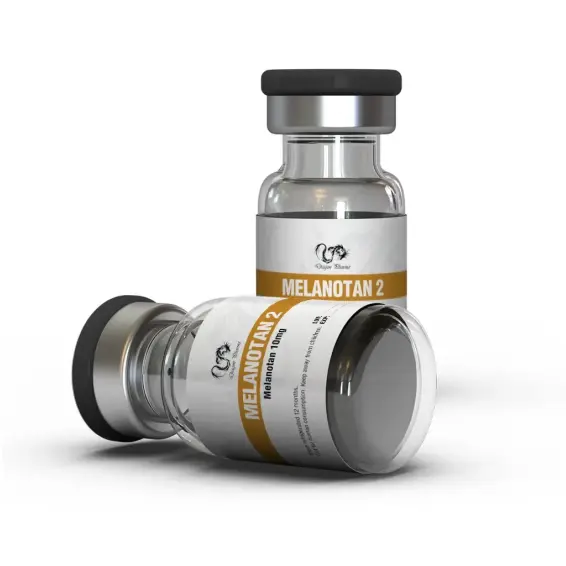
Melanotan II is Dragon Pharma's formulation of the synthetic alpha-Melanocyte Stimulating Hormone (α-MSH) analogue at 10mg per vial — a cyclic heptapeptide that stimulates melanin production in skin cells via melanocortin receptor activation, producing a sunless tan while simultaneously activating libido pathways through a separate receptor population. Melanotan II binds multiple melanocortin receptors (MC1R, MC3R, MC4R, MC5R) with different tissue-specific effects at each.
Also searched as: Melanotan 2, MT-II, MT2 peptide, tanning peptide vial, Melanotan II Dragon Pharma.
What Melanotan II Is — The Alpha-MSH Connection
Alpha-Melanocyte Stimulating Hormone (α-MSH) is a naturally occurring neuropeptide derived from POMC (pro-opiomelanocortin) in the pituitary gland. It regulates multiple physiological processes through melanocortin receptors. Melanotan II is a synthetic cyclic analogue — structurally modified from native α-MSH to resist enzymatic degradation:
- Native α-MSH is a linear 13 amino acid peptide with a very short half-life (~minutes) due to rapid proteolytic degradation. Melanotan II cyclises the peptide structure and shortens it to 7 amino acids — increasing receptor binding affinity and extending the half-life to approximately 1 hour
- The cyclic structure makes Melanotan II more resistant to degradation than native α-MSH while maintaining the melanocortin receptor binding capacity that drives its effects
- Melanotan II is not hormone-specific — it activates multiple melanocortin receptor subtypes, each with different primary locations and effects
The Four Receptor Profile — Why MT-II Does Multiple Things
This is the information gap that most competitor content on Melanotan II completely fails to explain — why it produces seemingly unrelated effects (tanning, libido, appetite suppression, spontaneous erections) from a single compound:
| Receptor | Primary Location | Effect of MT-II Activation |
|---|---|---|
| MC1R | Melanocytes (skin cells) | Increased melanin synthesis — skin darkening and tanning response. Primary tanning mechanism |
| MC3R | Hypothalamus, adipose tissue | Appetite suppression; metabolic regulation; some contribution to energy balance |
| MC4R | Central nervous system — hypothalamus, brainstem | Sexual arousal, libido enhancement, spontaneous erections (men); appetite regulation |
| MC5R | Exocrine glands | Sebaceous gland regulation; less clinically relevant at MT-II doses |
The tanning effect (MC1R) and the libido/erectile effect (MC4R) occur through entirely different receptors in entirely different tissues — they are both consequences of the same non-selective melanocortin receptor activation profile of Melanotan II.
Melanotan II vs Melanotan I — The Critical Distinction
Melanotan I and Melanotan II are different compounds with meaningfully different profiles — competitor content rarely distinguishes them clearly:
- Melanotan I (Afamelanotide) is a selective MC1R agonist — it primarily activates melanocytes for tanning with minimal MC4R activity. Afamelanotide received FDA approval (2019) for Erythropoietic Protoporphyria (EPP) under the brand name Scenesse — it is the only melanocortin agonist with FDA approval for any indication
- Melanotan II activates MC1R, MC3R, MC4R and MC5R — it is non-selective across the melanocortin receptor family. The broader receptor profile is responsible for its libido and spontaneous erection effects (MC4R), appetite suppression (MC3R), and more pronounced side effects versus Melanotan I
- Neither Melanotan II nor PT-141 (a Melanotan II derivative targeting MC4R for sexual dysfunction) is FDA-approved for tanning — the regulatory and safety landscape for Melanotan II specifically remains unresolved
The Mole Safety Question — An Honest Discussion
Any honest content on Melanotan II must address this:
- Melanotan II stimulates MC1R in all melanocytes — including those in pre-existing moles and atypical nevi. Increased melanogenesis in already-pigmented lesions raises a theoretical concern about accelerating changes in pigmented lesions
- Case reports of darkening of pre-existing moles during Melanotan II use are documented in dermatology literature — though whether this represents genuinely increased risk versus cosmetic darkening is not established by controlled studies
- Clinical guideline: users with a history of melanoma, dysplastic nevi or family history of melanoma should not use Melanotan II. All users are advised to monitor existing moles for changes (size, border irregularity, colour change) and report any suspicious changes to a dermatologist
- The absence of FDA approval means the long-term safety data that would normally accompany an approved pharmaceutical does not exist for Melanotan II specifically
Effects and Benefits
- Skin darkening and tanning without UV exposure — MC1R-driven melanin synthesis in melanocytes
- Enhanced UV-induced tanning when combined with sun exposure — baseline melanin increase makes subsequent UV tanning faster and more pronounced
- Libido enhancement and spontaneous erections (men) via MC4R activation in the CNS
- Mild appetite suppression via MC3R — relevant for users in caloric deficit
- No testosterone suppression — no PCT required
Dosage and Administration
| Phase | Dose | Frequency | Notes |
|---|---|---|---|
| Loading (tanning) | 0.5–1 mg/day | Daily | Continue until desired tan depth achieved; 2-4 weeks typically |
| Maintenance | 0.5–1 mg | 2–3× weekly | Maintain tan with UV exposure 1-2× weekly |
| Libido/acute use | 0.5–1 mg | As needed | Effects onset within 1-2 hours; spontaneous erections peak at 3-5 hours |
At 10mg per vial, a standard loading dose of 0.5mg/day provides 20 days of dosing per vial. The ~1-hour half-life means effects peak within 1-2 hours of injection and subside over 4-6 hours — timing before sun exposure or before a desired libido window is common practice. Reconstitute with bacteriostatic water. Store refrigerated at 2-8°C after reconstitution.
Side Effects
- Nausea — most common, particularly at higher doses; typically dose-dependent and diminishes with continued use
- Facial flushing — MC receptor-mediated vasodilation; common and transient
- Spontaneous erections — MC4R effect; may be unwanted outside the intended use context; dose-dependent
- Darkening of existing moles — see mole safety discussion above; dermatological monitoring recommended
- Fatigue and yawning — common post-injection; typically resolves within hours
- No testosterone suppression — no PCT required
Reconstitution and Storage
Reconstitute with bacteriostatic water — add slowly along the vial wall and swirl gently. Store reconstituted vial refrigerated at 2-8°C for up to 28-30 days. Never freeze.
"Melanotan II activates four melanocortin receptor subtypes simultaneously — MC1R for melanin synthesis and tanning, MC4R for libido and erectile function, MC3R for appetite modulation — effects that appear unrelated but all follow from a single non-selective alpha-MSH analogue."
Stacking and Related Compounds
- PT-141 (Bremelanotide) — if the primary goal is libido/sexual function rather than tanning; PT-141 is a Melanotan II derivative with more selective MC4R activity and less MC1R-driven tanning effect