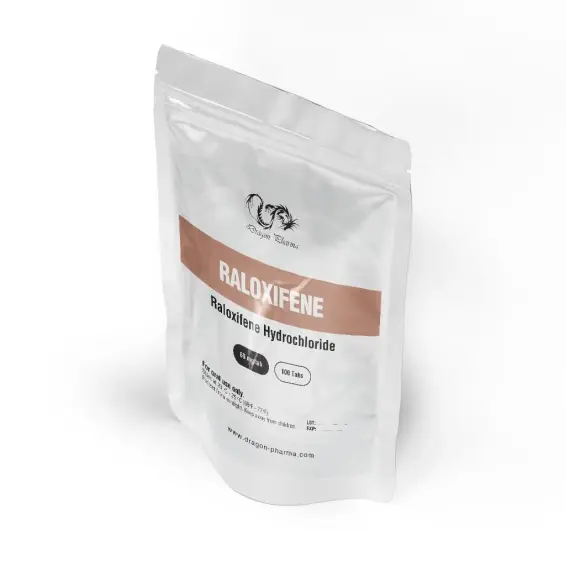
Raloxifene Hydrochloride — Evista by Dragon Pharma
Raloxifene is Dragon Pharma's formulation of Raloxifene Hydrochloride at 60mg per tablet — a third-generation selective estrogen receptor modulator (SERM) FDA-approved for osteoporosis treatment and breast cancer risk reduction, and increasingly used in bodybuilding specifically for the treatment of existing gynecomastia where Tamoxifen (Nolvadex) has shown inferior results in direct comparative studies.
Also searched as: Raloxifene 60mg, Evista tabs, Raloxifene gynecomastia, Raloxifene Dragon Pharma.
What Is Raloxifene — Third-Generation SERM
SERMs are classified by generation based on their tissue selectivity and clinical development timeline:
- First generation: Tamoxifen (Nolvadex) — broad estrogen receptor antagonism with partial agonist activity in some tissues
- Second generation: Toremifene — similar to Tamoxifen with some structural differences
- Third generation: Raloxifene — designed with improved tissue selectivity; antagonist in breast tissue and uterus, agonist in bone; different co-activator recruitment profile than earlier SERMs
The generational advance is clinically significant: Raloxifene's improved receptor binding profile and tissue selectivity translate to a different pattern of agonist/antagonist effects across tissues, which explains both its superior efficacy for existing gynecomastia and its different (generally less favourable) profile for testosterone recovery vs Tamoxifen.
Why Raloxifene Is Superior to Nolvadex for Treating Existing Gynecomastia
This is the most important and most poorly-explained distinction in all competitor content on these two SERMs:
- A direct comparative study (Lawrence et al., 2004, published in Journal of Clinical Endocrinology and Metabolism) randomised adolescent males with persistent pubertal gynecomastia to either Tamoxifen 10-20mg/day or Raloxifene 60mg/day for 3-9 months
- Results: Raloxifene group achieved 86% reduction in breast tissue volume vs 41% reduction in the Tamoxifen group — a statistically significant difference showing Raloxifene is approximately twice as effective for existing breast tissue reduction
- A subsequent study (Plourde et al., 2004, also JCEM) confirmed Raloxifene's superiority for gynecomastia tissue reduction vs Tamoxifen
- The mechanistic reason: Raloxifene's binding profile at the estrogen receptor in breast tissue differs from Tamoxifen — specifically, Raloxifene lacks the partial agonist activity that Tamoxifen retains at breast tissue estrogen receptors. In existing gynecomastia where breast tissue has already been stimulated by estrogen, partial agonism from Tamoxifen can provide ongoing low-level stimulation alongside its antagonism. Raloxifene's purer antagonism at breast ER produces more complete blockade
Raloxifene vs Nolvadex vs Clomid — The Three-Way SERM Comparison
| Parameter | Raloxifene (60mg) | Nolvadex (Tamoxifen) | Clomid (Clomiphene) |
|---|---|---|---|
| Gynecomastia treatment | Superior — 86% reduction in trials | Moderate — 41% reduction in same trials | Not indicated |
| Gynecomastia prevention | Effective | Standard choice | Some effect via estrogen receptor |
| LH/FSH stimulation for PCT | Minimal — weak hypothalamic activity | Moderate — some pituitary LH stimulation | Strong — primary PCT SERM |
| Breast tissue ER antagonism | Strongest — pure antagonist | Moderate — partial agonist activity present | Mixed — not breast-tissue specific |
| Bone density | Positive — agonist in bone (FDA approved for osteoporosis) | Neutral in men | Neutral |
| Visual side effects | Rare | Possible | Common — Zuclomiphene component |
| Half-life | ~27 hours | ~5–7 days | Mixed: ~10h + ~30 days |
When to Use Raloxifene vs Nolvadex
The clinical evidence points to specific use cases for each:
- Use Raloxifene when: existing gynecomastia is present and needs to be reduced; when Nolvadex has been tried and been insufficient; when pursuing the most evidence-backed treatment for established breast tissue development
- Use Nolvadex when: preventing gynecomastia on cycle (where pure antagonism advantage of Raloxifene is less critical); during PCT where the LH/FSH stimulation from Tamoxifen is useful alongside Clomid; when managing estrogen receptor activity during and after a cycle broadly
- Both can be combined — some users run Raloxifene for gynecomastia reduction while using Nolvadex + Clomid for PCT hormonal recovery
Effects and Benefits
- Superior reduction of existing gynecomastia breast tissue — 86% reduction vs 41% for Tamoxifen in direct comparative studies
- Effective prevention of new gynecomastia development during cycles
- Bone density support — agonist activity in bone provides the same bone-protective effect as estrogen without estrogenic side effects in other tissues
- No suppression of natural testosterone — stimulates neither significantly nor detrimentally the HPG axis
- FDA-approved drug with extensive safety data from osteoporosis and breast cancer risk reduction indications
Dosage and Administration
| Use Case | Dose | Duration |
|---|---|---|
| Existing gynecomastia treatment | 60 mg/day (1 tab) | 3–6 months for established tissue |
| On-cycle gynecomastia prevention | 60 mg/day | Duration of cycle |
| Combined with PCT SERMs | 60 mg/day Raloxifene + Clomid/Nolvadex | Duration of PCT |
Raloxifene's ~27-hour half-life makes once-daily dosing straightforward. The 60mg tablet is the standard dose used in all major clinical trials — no splitting required. Duration for treating established gynecomastia is longer than for prevention — studies ran 3-9 months to achieve the documented 86% breast tissue reduction.
Side Effects
- Hot flashes — most commonly reported; caused by estrogen receptor antagonism in the hypothalamus; typically mild and transient
- Venous thromboembolism risk — a class effect shared with all SERMs; individuals with VTE history or risk factors should approach with caution
- Leg cramps — reported in a subset of users, particularly at initiation
- Does not significantly stimulate LH or FSH — Raloxifene is not a substitute for PCT; it does not drive testosterone recovery and should be combined with Clomid or Nolvadex if HPG recovery is needed alongside gynecomastia treatment
Raloxifene in an AAS Context
- For existing gynecomastia from a cycle: Raloxifene 60mg/day as the primary treatment
- For PCT hormonal recovery alongside gynecomastia treatment: add Clomid or Nolvadex — Raloxifene does not replace SERM-based PCT
- For on-cycle estrogen management: pair with Arimidex or Aromasin for source-level estrogen control alongside Raloxifene's receptor-level protection
"Raloxifene is formulated at the standard 60mg clinical dose — the same dose used in the trials demonstrating 86% gynecomastia reduction vs 41% for Tamoxifen. For existing breast tissue development, the comparative evidence consistently favours Raloxifene."
Storage and Handling
Store Raloxifene at room temperature, away from direct sunlight and moisture. Keep the original packaging sealed until use to maintain tablet potency.