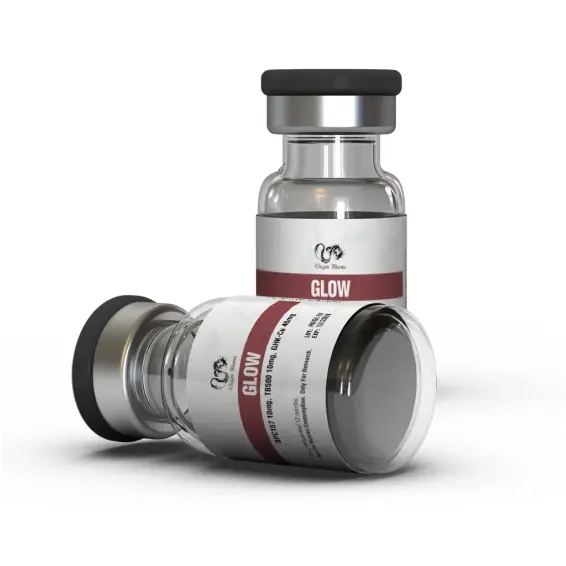
Glow Blend 60mg — BPC-157, TB-500 and GHK-Cu by Dragon Pharma
Glow Blend is Dragon Pharma's triple-peptide formulation combining BPC-157, TB-500 and GHK-Cu in a single 60mg vial at $200. By adding GHK-Cu to the established BPC-157 + TB-500 recovery duo, Glow Blend extends the combination into a third independent biological pathway — collagen and extracellular matrix remodelling — making it the aesthetics-focused peptide blend in the Dragon Pharma range.
Also searched as: Glow Blend 60mg, BPC-157 TB-500 GHK-Cu blend, triple peptide recovery skin blend, Glow Blend Dragon Pharma.
Why GHK-Cu Adds a Third Independent Pathway
The critical information gap in most descriptions of this blend — why GHK-Cu adds meaningful new function rather than simply more of the same:
| Peptide | Primary Pathway | What It Cannot Do |
|---|---|---|
| BPC-157 | Localised tissue repair — GH receptor upregulation, VEGF angiogenesis, gut protection; most effective near injury site | Does not directly drive collagen synthesis in fibroblasts; minimal systemic skin effect |
| TB-500 | Systemic repair — actin polymerisation, cell migration to damaged tissue throughout body | Primarily cell migration and inflammation; does not directly remodel collagen matrix |
| GHK-Cu | Collagen remodelling — TGF-β activation in fibroblasts; collagen I and III synthesis; SOD antioxidant; 4,000+ gene regulation | Less focused on acute injury repair than BPC-157; less migration-focused than TB-500 |
BPC-157 and TB-500 address tissue repair from complementary angles — one localised, one systemic. GHK-Cu addresses a different problem: the quality and density of the extracellular matrix (collagen, elastin, glycosaminoglycans) that supports tissue long-term. Together the three provide repair initiation (BPC-157), systemic healing mobilisation (TB-500) and structural matrix remodelling (GHK-Cu) — three independent biological programmes in a single injection.
Glow Blend vs Klow Blend — Which to Choose
Dragon Pharma offers two multi-peptide blends with overlapping but distinct compositions:
| Parameter | Glow Blend (this product) | Klow Blend |
|---|---|---|
| Components | BPC-157 + TB-500 + GHK-Cu | BPC-157 + TB-500 + KPV + GHK-Cu |
| Total content | 60 mg | 80 mg |
| Pathways covered | 3 — localised, systemic, collagen | 4 — localised, systemic, immune-NF-κB, collagen |
| KPV (NF-κB immune modulation) | Not included | Included — adds immune-inflammatory pathway |
| Primary focus | Skin aesthetics, collagen, tissue repair | Comprehensive recovery including immune-driven inflammation |
| Best suited to | Anti-aging skin protocols, post-procedure recovery, aesthetics-focused users | Injury recovery, chronic inflammation, gut health, broader systemic repair |
The practical decision: if the primary goal is skin quality, collagen density and aesthetic tissue remodelling, Glow Blend's three pathways cover the relevant biology. If the goal includes managing inflammatory conditions, injury recovery with immune components or gut-related concerns, Klow Blend's addition of KPV provides the NF-κB immune modulation pathway that Glow Blend lacks.
Why Glow Blend Is Specifically Suited to Aesthetic Applications
The aesthetic application — skin quality, anti-aging, post-procedure healing — benefits specifically from the Glow Blend composition:
- BPC-157 accelerates wound healing and angiogenesis at and near the skin surface — relevant for post-procedure skin recovery (after aesthetic treatments, microneedling, laser, etc.)
- TB-500 provides systemic anti-inflammatory and cell migration support — reducing systemic inflammation that accelerates skin aging and supporting repair across the skin's dermal layer regardless of injection site
- GHK-Cu drives collagen and elastin synthesis via TGF-β — directly addressing the collagen loss that underlies skin aging, wrinkle formation and loss of skin density. At its nanomolar biological activity threshold, meaningful fibroblast stimulation is achievable at the doses in the blend
Effects and Benefits
- Localised tissue repair from BPC-157 — particularly relevant near skin treatment sites or scarring
- Systemic anti-inflammatory and cell migration support from TB-500
- Collagen and elastin synthesis via GHK-Cu's TGF-β activation — the primary driver of improved skin density and texture
- GHK-Cu's documented 4,000+ gene modulation includes antioxidant, repair and anti-inflammatory gene expression shifts
- No suppression of natural testosterone — no PCT required
Dosage and Administration
| Protocol | Dose | Frequency |
|---|---|---|
| Skin and anti-aging | 500 mcg – 1 mg | Daily or every other day |
| Post-procedure recovery | 1–2 mg | Daily for 2–4 weeks |
Given the blend's localised (BPC-157) and systemic (TB-500, GHK-Cu) components, injection site has a moderate influence — injecting near an area of skin concern takes advantage of BPC-157's localised mechanism, while TB-500 and GHK-Cu work systemically regardless. Reconstitute with bacteriostatic water. Store refrigerated at 2-8°C after reconstitution for up to 28-30 days. Never freeze.
Glow Blend vs BPC-157 + TB-500 Blend
- Glow Blend (BPC-157 + TB-500 + GHK-Cu) — adds collagen remodelling via GHK-Cu; aesthetics and skin-focused applications
- BPC-157 + TB-500 Blend — focused tissue repair (localised + systemic) without collagen remodelling component; suited to pure injury recovery
- Klow Blend — adds KPV immune modulation on top of all Glow Blend components; most comprehensive recovery option
Reconstitution and Storage
Reconstitute with bacteriostatic water — add slowly along the vial wall and swirl gently. Store reconstituted vial refrigerated at 2-8°C for up to 28-30 days. Never freeze.
"Glow Blend extends the BPC-157 + TB-500 recovery combination into aesthetics territory — GHK-Cu's collagen remodelling pathway adds a third independent biological programme to the localised and systemic repair mechanisms of the original duo."
Stacking and Related Compounds
- Epitalon — telomerase and cellular aging support for comprehensive anti-aging protocols alongside Glow Blend
- Minoxidil — for users combining GHK-Cu's follicle enlargement effect with Minoxidil's KATP channel hair retention mechanism
- Dragontropin (HGH) — for users adding direct GH elevation to a comprehensive skin and collagen protocol