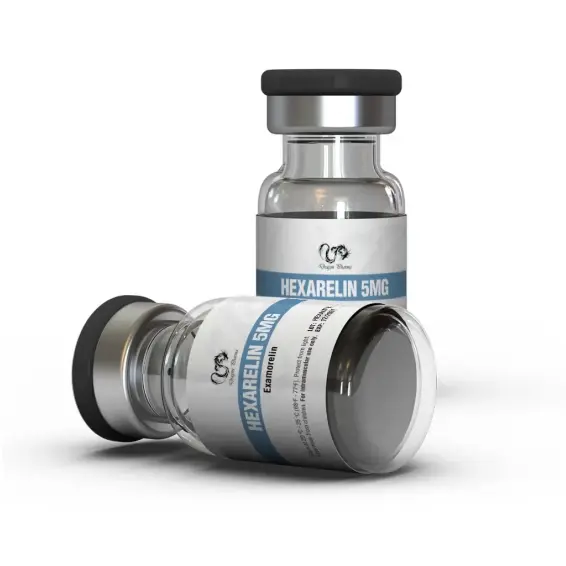
Hexarelin — Most Potent GHRP Peptide by Dragon Pharma
Hexarelin (Examorelin) is Dragon Pharma's formulation of the most potent growth hormone releasing peptide available at 5mg per vial — a synthetic hexapeptide GHS-R1a agonist that produces greater GH pulse amplitude than any other GHRP in the Dragon Pharma range. Its exceptional GH stimulation comes at a cost: faster receptor desensitisation than milder GHRPs and more pronounced cortisol and prolactin co-secretion. Hexarelin is also the only GHRP with documented direct cardiac effects through a separate receptor mechanism entirely — making it the most pharmacologically complex GHRP in the range.
Also searched as: Hexarelin 5mg, Examorelin, strongest GHRP, Hexarelin Dragon Pharma, GHRP-6 alternative.
The GHRP Potency Hierarchy — Where Hexarelin Sits
Understanding Hexarelin requires understanding the full GHRP landscape and where each compound sits in terms of GH potency, side effects and desensitisation:
| GHRP | GH Potency | Cortisol / Prolactin | Appetite | Desensitisation | Best For |
|---|---|---|---|---|---|
| Hexarelin | Highest | Significant | Moderate | Fastest — 4–8 weeks | Maximum GH pulse; cardiac; short cycles |
| GHRP-2 | High | Moderate | Mild | Moderate | High GH with less cortisol than Hexarelin |
| GHRP-6 | Moderate-High | Moderate | Pronounced | Moderate | GH + appetite stimulation for bulking |
| Ipamorelin | Moderate | Minimal | None | Slowest | Clean GH pulse; long-term protocols |
Why Hexarelin Is the Most Potent GHRP
Hexarelin's superior GH stimulation comes from its structural design:
- Hexarelin is a synthetic hexapeptide (His-D-2-Me-Trp-Ala-Trp-D-Phe-Lys-NH2) — the 2-methyltryptophan substitution at position 2 and the overall hexapeptide structure give it exceptional GHS-R1a binding affinity compared to shorter GHRP sequences
- At equivalent doses, Hexarelin produces GH pulse amplitudes 2-3 times greater than Ipamorelin and significantly greater than GHRP-2 in direct comparative studies
- This potency at GHS-R1a also activates the non-selective downstream signalling that produces cortisol and prolactin co-secretion — the same pathway used by GHRP-2 and GHRP-6, but to a greater degree per dose
- The trade-off is receptor desensitisation: continuous high-level GHS-R1a stimulation from Hexarelin's potent binding drives receptor downregulation faster than milder GHRPs — typically becoming apparent within 4-8 weeks of daily dosing, necessitating cycling
Hexarelin's Cardiac Effects — The CD36 Receptor Mechanism
This is Hexarelin's most scientifically unique property and virtually never explained in competitor content:
- Beyond GHS-R1a, Hexarelin binds a second receptor: CD36 (also known as scavenger receptor B2 or fatty acid translocase) — a membrane protein expressed abundantly in cardiac muscle, platelets and macrophages
- CD36 binding by Hexarelin is independent of GHS-R1a — it persists even in GHS-R1a knockout animals where Hexarelin's GH-stimulating effects are absent. This means the cardiac effects of Hexarelin are a separate pharmacological action, not a consequence of GH elevation
- CD36 activation by Hexarelin in cardiac tissue produces documented cardioprotective effects: reduced ischemia-reperfusion injury (the damage occurring when blood flow is restored to oxygen-starved heart tissue), improved post-infarction cardiac function and direct inotropic (contractility-enhancing) effects
- Multiple animal studies and some early human investigations explored Hexarelin as a cardioprotective agent — Ghigo et al. (1997) and subsequent studies demonstrated that Hexarelin improved cardiac function in patients with GH deficiency and in heart failure models through the CD36 pathway independent of GH elevation
- This dual mechanism — GHS-R1a GH stimulation AND CD36 cardiac protection — makes Hexarelin pharmacologically unique among all GHRPs and among all peptides in the Dragon Pharma range
The Desensitisation Problem — Why Cycling Is Essential
Hexarelin's most significant practical limitation is receptor desensitisation — rarely quantified in competitor content:
- Continuous daily Hexarelin administration produces GHS-R1a receptor downregulation that meaningfully reduces GH pulse amplitude within 4-8 weeks
- Studies measuring GH response to Hexarelin during continuous administration show approximately 50% reduction in peak GH at 4 weeks compared to the first injection response
- This does not occur to the same degree with Ipamorelin (which shows minimal desensitisation) or GHRP-2 (moderate desensitisation)
- Standard cycling approach: 4-6 weeks on Hexarelin, 4-6 weeks off (or substitute with Ipamorelin during the off period), then return to Hexarelin. This allows GHS-R1a receptor density and sensitivity to recover
- Alternatively: 4-6 week Hexarelin cycles specifically for acute GH maximisation goals (pre-competition, recovery from injury) rather than long-term continuous GH optimisation where Ipamorelin is more appropriate
Effects and Benefits
- Maximum GH pulse amplitude of any GHRP — greater acute GH stimulation than any other peptide that does not involve HGH injection
- Direct cardioprotective effects via CD36 receptor — independent of GH elevation
- IGF-1 elevation from sustained GH pulses — anabolic and recovery-supporting
- Synergistic with GHRH analogues — combining Hexarelin with CJC-1295 or Tesamorelin produces the same 3-5× synergistic amplification as other GHRP+GHRH combinations
- No testosterone suppression — no PCT required
Dosage and Administration
| Protocol | Dose | Frequency | Cycle |
|---|---|---|---|
| Maximum GH stimulation | 100–200 mcg/injection | 2–3× daily | 4–6 weeks maximum before break |
| Cardiac / lower dose | 50–100 mcg/injection | Once daily | 4–6 weeks |
At 5mg per vial and 100mcg per injection dosed 2× daily, one vial provides 25 days of dosing. Due to the ~70-minute half-life, 3× daily injection maximises cumulative GH exposure but most users find 2× daily an effective and practical compromise. Reconstitute with bacteriostatic water. Store refrigerated at 2-8°C after reconstitution. Fasted dosing (2+ hours post-meal) maximises the GH pulse.
Hexarelin in a Peptide Stack
- CJC-1295 no DAC — GHRH partner for 3-5× synergistic GH amplification; the standard GHRH+GHRP pairing with Hexarelin as the GHRP component for maximum acute GH output
- Ipamorelin — used during Hexarelin's off-cycle weeks; provides continued GHS-R1a stimulation without driving receptor downregulation, maintaining GH support between Hexarelin cycles
- BPC-157 and TB-500 for injury recovery alongside Hexarelin's GH pulse for amplified tissue repair
Reconstitution and Storage
Reconstitute with bacteriostatic water — add slowly along the vial wall and swirl gently. Store reconstituted vial refrigerated at 2-8°C for up to 28 days. Never freeze.
"Hexarelin delivers the highest GHRP-driven GH pulse amplitude available — its CD36 cardiac receptor mechanism is an entirely separate pharmacological action from GH stimulation, making it the only GHRP with documented direct heart tissue effects independent of growth hormone."