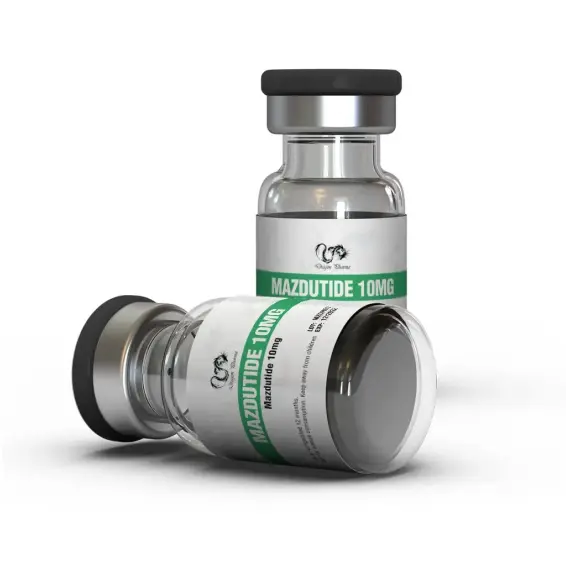
Mazdutide — GLP-1/Glucagon Dual Agonist by Dragon Pharma
Mazdutide (also known by its research code IBI362 or OXM3) is Dragon Pharma's formulation of the once-weekly GLP-1/Glucagon dual agonist developed by Innovent Biologics in China. It is important to clarify a common misrepresentation: Mazdutide is a GLP-1/Glucagon dual agonist — not a GLP-1/GIP agonist as sometimes incorrectly described. Glucagon receptor agonism adds a mechanistically distinct third dimension to weight loss compared to GLP-1 alone, through hepatic fat mobilisation and thermogenic energy expenditure.
Also searched as: Mazdutide 10mg, IBI362, OXM3, GLP-1 glucagon dual agonist, Mazdutide Dragon Pharma.
The Misclassification — GLP-1/Glucagon vs GLP-1/GIP
This distinction matters mechanistically and should be understood before comparing Mazdutide to other weight loss peptides:
| Parameter | Mazdutide (GLP-1 + Glucagon) | Tirzepatide (GLP-1 + GIP) | Semaglutide (GLP-1 only) |
|---|---|---|---|
| Receptor targets | GLP-1R + Glucagon receptor (GCGR) | GLP-1R + GIP receptor (GIPR) | GLP-1R only |
| Appetite suppression | Via GLP-1R hypothalamic signalling | Via GLP-1R + GIP enhances GLP-1 effect | Via GLP-1R |
| Hepatic fat mobilisation | Yes — Glucagon directly drives hepatic lipolysis | Indirect — via GIP insulin-sensitising effects | Minimal direct |
| Thermogenesis | Yes — Glucagon directly increases energy expenditure | Some — via GIP brown fat activation | Minimal |
| Glucose management | GLP-1 manages glucose; Glucagon at normal doses does not impair glycaemia | Dual glucose-lowering | Primary glucose-lowering |
Why Glucagon Agonism Adds a Distinct Weight Loss Pathway
Glucagon is typically known as a counter-regulatory hormone to insulin — it raises blood glucose when glucose is low. However, in the context of a GLP-1/Glucagon dual agonist, Glucagon's metabolic effects produce specific fat-loss benefits that GLP-1 alone cannot achieve:
- Hepatic lipolysis: Glucagon receptor activation in the liver directly stimulates the breakdown of triglycerides stored in liver tissue — making Mazdutide specifically effective for hepatic steatosis (fatty liver), a condition increasingly recognised as connected to metabolic obesity and AAS use at higher doses
- Increased energy expenditure: Glucagon receptor signalling increases thermogenesis — directly raising energy expenditure through brown adipose tissue activation and increased futile cycling in cells. This is a thermogenic effect that GLP-1 receptor agonists alone do not significantly provide
- Why doesn't Glucagon cause dangerous hyperglycaemia in this context? The GLP-1 component provides strong insulin secretagogue activity — the two signals partially balance each other on glucose homeostasis while their lipolytic and appetite effects are additive. At the doses used therapeutically, the net glucose effect is neutral to mildly positive (glucose-lowering)
Clinical Data — Mazdutide Phase II and III
| Trial | Population | Dose | Weight Loss | Duration |
|---|---|---|---|---|
| GLORY-1 Phase III (2024) | Chinese obese adults (BMI ≥28) | 6 mg/week | ~14.0% body weight reduction | 48 weeks |
| Phase II dose-finding | Overweight/obese adults | 3–9 mg/week | 8–15% body weight reduction | 24 weeks |
| Hepatic steatosis sub-study | Obese adults with fatty liver | 6 mg/week | Significant hepatic fat reduction | 24 weeks |
The GLORY-1 Phase III trial (2024) represents Mazdutide's most rigorous efficacy data — ~14% body weight reduction over 48 weeks at 6mg/week. This positions Mazdutide between Semaglutide (~15% at 72 weeks) and Tirzepatide (~20% at 72 weeks) in efficacy, while offering the specific advantage of hepatic fat reduction that GLP-1 alone does not provide as directly.
Mazdutide vs Other Weight Loss Peptides in the Dragon Pharma Range
| Compound | Mechanism | Clinical Weight Loss | Unique Advantage |
|---|---|---|---|
| Mazdutide | GLP-1 + Glucagon | ~14% over 48 weeks | Hepatic fat reduction; thermogenic expenditure |
| Tirzepatide | GLP-1 + GIP | ~20% over 72 weeks | Strongest Phase III weight loss data |
| Cagrilintide | Amylin analogue | ~11% standalone, ~23% + Sema | Area postrema mechanism; synergy with GLP-1 |
| AOD-9604 | GH fragment lipolysis | Modest standalone | No IGF-1 elevation; targeted fat oxidation |
Effects and Benefits
- Appetite suppression via GLP-1 receptor hypothalamic signalling — reduced hunger and increased satiety
- Hepatic fat mobilisation — direct glucagon receptor-driven lipolysis in liver tissue; relevant for fatty liver conditions
- Increased thermogenic energy expenditure from glucagon receptor signalling
- ~14% body weight reduction over 48 weeks at 6mg/week (GLORY-1 Phase III)
- No suppression of natural testosterone — no PCT required
- Once-weekly dosing from the ~1-week half-life
Dosage and Administration
| Phase | Dose | Frequency | Notes |
|---|---|---|---|
| Starting dose | 1–3 mg/week | Once weekly | Allow 4 weeks before escalation |
| Titration | 3–6 mg/week | Once weekly | Titrate every 4 weeks based on tolerance |
| Maintenance (Phase III) | 6 mg/week | Once weekly | 10mg vial provides ~1.5 doses at 6mg |
At 10mg per vial and 6mg/week maintenance dose, one vial provides approximately 1.5 weeks of dosing — users will need approximately 3 vials per month at maintenance. Reconstitute with bacteriostatic water. Unlike peptides requiring fasted dosing, Mazdutide's subcutaneous injection can be taken at any time of the week — consistency of day and time within the week is more important than meal timing.
Side Effects
- Nausea — most common, particularly during dose escalation; same class effect as all GLP-1 agonists; typically subsides with the titration approach
- Gastrointestinal effects — nausea, vomiting, diarrhoea — dose-dependent and most pronounced early in treatment
- The Glucagon component at higher doses could theoretically impair glucose homeostasis — mitigated by the GLP-1 component's insulin-stimulating effect at therapeutic doses
- No impact on testosterone, estrogen or the HPG axis
Reconstitution and Storage
Reconstitute with bacteriostatic water — add slowly along the vial wall and swirl gently. Store reconstituted vial refrigerated at 2-8°C for up to 28 days. Never freeze.
"Mazdutide is a GLP-1/Glucagon dual agonist — not GLP-1/GIP as sometimes misrepresented. Its Glucagon receptor component adds hepatic fat mobilisation and direct thermogenic energy expenditure that GLP-1 agonists alone cannot provide, making it the most liver-targeted weight loss peptide in the Dragon Pharma range."
Stacking and Related Compounds
- Cagrilintide — amylin analogue targeting a complementary appetite pathway; theoretical triple mechanism with Mazdutide covering GLP-1 + Glucagon + Amylin
- Tirzepatide — users wanting GLP-1/GIP combination instead of GLP-1/Glucagon; the strongest single-compound weight loss data
- AOD-9604 — direct fat oxidation via GH fragment mechanism alongside Mazdutide's appetite and hepatic effects