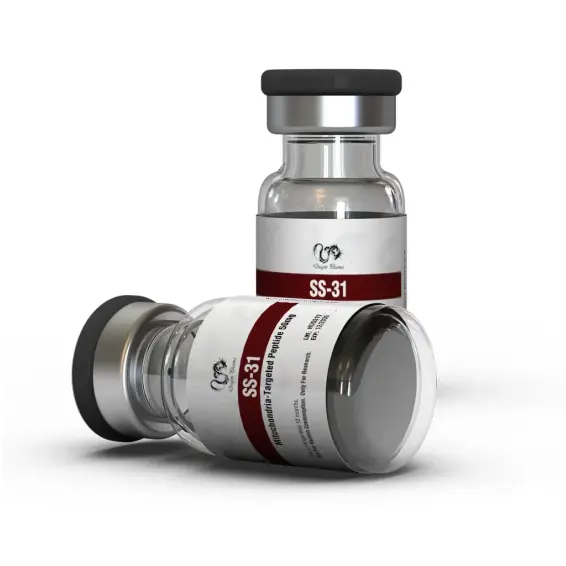
SS-31 (Elamipretide / Forzinity) — Cardiolipin-Targeted Mitochondrial Peptide by Dragon Pharma
SS-31 (Elamipretide, brand name Forzinity) is Dragon Pharma's formulation of the mitochondria-targeted antioxidant tetrapeptide at 50mg per vial — the most clinically advanced mitochondrial peptide available, with FDA Breakthrough Therapy Designation for Barth syndrome and Phase II-III clinical trial data in heart failure. SS-31 is not simply an antioxidant — its mechanism is uniquely specific: it selectively accumulates in the inner mitochondrial membrane and directly binds cardiolipin, a critical phospholipid whose dysfunction underlies mitochondrial energy failure in aging, heart disease and muscle disorders.
Also searched as: SS-31 peptide, Elamipretide, Forzinity, cardiolipin peptide, SS31 Dragon Pharma.
What SS-31 Actually Does — The Cardiolipin Mechanism
SS-31's mechanism is entirely specific and unlike any other compound in the Dragon Pharma range:
- Cardiolipin is a unique phospholipid found almost exclusively in the inner mitochondrial membrane — it constitutes approximately 20% of the inner membrane phospholipid content. Cardiolipin is essential for the structural integrity and function of the electron transport chain complexes (particularly Complex I and Complex III) and is required for the assembly of ATP synthase (Complex V)
- With aging, disease and oxidative stress, cardiolipin undergoes peroxidation — reactive oxygen species attack the polyunsaturated fatty acid side chains of cardiolipin, producing oxidised cardiolipin that disrupts cristae structure and electron transport chain function. Damaged cardiolipin is also a signal for mitophagy (mitochondrial elimination) and apoptosis
- SS-31's tetrapeptide structure (D-Arg-Dmt-Lys-Phe-NH2) contains an alternating pattern of positively charged residues and aromatic residues that gives it high affinity for cardiolipin specifically — the peptide physically intercalates between cardiolipin molecules in the inner membrane
- By binding cardiolipin, SS-31: prevents cardiolipin peroxidation; stabilises cristae structure (the inner membrane folds where electron transport chain complexes sit); promotes reassembly of damaged electron transport chain complexes; and reduces mitochondrial ROS production by improving electron flow through Complex I
- This is not general antioxidant scavenging — it is specific structural protection and stabilisation of the mitochondrial inner membrane at the site where energy production occurs
The FDA Designation and Clinical Data
SS-31 (Elamipretide) has the strongest regulatory recognition of any mitochondrial peptide:
- FDA Breakthrough Therapy Designation for Barth syndrome — a rare X-linked genetic mitochondrial disorder caused by mutations in tafazzin (a cardiolipin remodelling enzyme), causing severe cardiomyopathy and skeletal muscle weakness. The designation acknowledges that Elamipretide may offer substantial improvement over existing therapies and accelerates FDA review
- TAZPOWER trial (Phase II/III): A randomised controlled trial in Barth syndrome patients demonstrated that Elamipretide significantly improved skeletal muscle strength (hand grip and 6-minute walk test) vs placebo — the first drug to show efficacy in this population
- Heart failure trials: Multiple Phase II trials in heart failure with preserved or reduced ejection fraction showed improvements in cardiac function metrics. The HOPEMD Phase II/III programme represents one of the larger mitochondrial cardiology development programmes in clinical medicine
- This clinical data provides human pharmacokinetic and safety evidence that most research peptides lack — Elamipretide has been administered to hundreds of human subjects across multiple trials
How SS-31 Differs From Other Mitochondrial Compounds in the Range
| Compound | Mechanism Level | Primary Target | Key Effect |
|---|---|---|---|
| SS-31 (Elamipretide) | Structural — inner membrane | Cardiolipin directly | Electron transport chain stabilisation; cristae protection |
| NAD+ | Metabolic — electron carrier | Complex I / Sirtuins | Electron carrier replenishment; sirtuin activation |
| MOTS-c | Signalling — AMPK activation | Folate cycle / AMPK | Mitochondrial biogenesis; metabolic adaptation |
| AICAR | Signalling — ZMP/AMPK | AMPK directly | Metabolic gene expression; fatty acid oxidation |
SS-31's structural inner membrane protection is complementary to — not redundant with — the signalling approaches of NAD+, MOTS-c and AICAR. Those compounds improve how mitochondria are regulated and supplied with substrates; SS-31 improves the physical integrity of the membrane where electron transport occurs.
Performance and Recovery Relevance
SS-31's applications extend beyond aging and disease into performance contexts:
- Intense exercise — particularly eccentric and high-volume training — produces mitochondrial ROS that oxidises cardiolipin, transiently impairing mitochondrial efficiency. SS-31's cardiolipin protection directly addresses this exercise-induced mitochondrial stress
- In animal exercise studies, SS-31 administration improved running endurance and reduced exercise-induced oxidative damage in mitochondria — supporting the cardiolipin-protection mechanism as relevant to athletic performance
- The skeletal muscle improvements in Barth syndrome (a disease of cardiolipin dysfunction) — improved grip strength and walk distance — provide the closest human analogue to the muscle performance benefits that SS-31 might offer in healthy athletic populations
- For AAS users, the high training volumes and potential for mitochondrial stress from metabolic demands of muscle hypertrophy make SS-31's mitochondrial structural protection potentially valuable during heavy cycles
Effects and Benefits
- Cardiolipin stabilisation — direct binding to inner mitochondrial membrane phospholipid; prevents oxidative cardiolipin damage
- Electron transport chain structural support — stabilises Complex I, III and V assembly within cristae
- Mitochondrial ROS reduction — by improving electron flow through Complex I, fewer electrons escape to form superoxide
- Skeletal muscle function improvement — documented in Barth syndrome human trials; exercise endurance improvement in animal models
- Cardiac function support — Phase II data in heart failure showing improved ejection fraction metrics
- No testosterone suppression — no PCT required
Dosage and Administration
| Protocol | Dose | Frequency | Notes |
|---|---|---|---|
| Mitochondrial support / performance | 0.25–1 mg/kg/day | Once daily SubQ | Clinical trials used 0.25–4 mg/kg; start low |
| Anti-aging / longevity | 5–10 mg/day | Daily or every other day | Fixed dose approach extrapolated from clinical ranges |
At 50mg per vial, a 5mg/day protocol provides 10 days per vial. SS-31 is the most expensive compound in the Dragon Pharma range — its clinical-grade development and Phase II/III trial history are reflected in the price. Reconstitute with bacteriostatic water. Store refrigerated at 2-8°C after reconstitution for up to 28 days.
Side Effects
- Injection site reactions — mild; subcutaneous administration well-tolerated in clinical trials
- No significant systemic adverse effects documented in Phase II/III trials — safety profile established across hundreds of human subjects
- No hormonal effects — no PCT required
Stacking and Related Compounds
- NAD+ — electron carrier replenishment alongside SS-31's structural stabilisation; NAD+ addresses the metabolic substrate supply while SS-31 protects the structural machinery that uses it
- MOTS-c — AMPK-driven mitochondrial biogenesis alongside SS-31's mitochondrial structural maintenance; more and better-functioning mitochondria
- Epitalon — telomerase activation for longevity alongside SS-31's mitochondrial structural integrity; comprehensive cellular aging countermeasure
"SS-31 (Elamipretide) is the only compound in the Dragon Pharma range with FDA Breakthrough Therapy Designation — its cardiolipin-targeting mechanism directly addresses the inner mitochondrial membrane structural damage that drives energy failure in aging, heart disease and muscle disorders."
Reconstitution and Storage
Reconstitute with bacteriostatic water — add slowly along the vial wall and swirl gently. Store reconstituted vial refrigerated at 2-8°C for up to 28 days. Never freeze.